In 1921, when Matilda Geddings Gray took the reins of her family’s Louisiana oil and timber business, she stepped ahead of her two brothers to lead the company, claiming authority at a time when few women did and forging an unlikely path in the process.
But business was only part of her story. While running the company, Ms. Gray also trained as a sculptor, and with equal parts confidence, curiosity and resources, she traveled the world acquiring works that ranged from Impressionist paintings and Fabergé objects to Indigenous textiles and important jewelry. Over time, she amassed what would become one of the most remarkable private collections of fine and decorative arts and jewelry in the United States.
Her companion and protégée was her young niece, Matilda Gray Stream, who would inherit not just the collection but the sensibility behind it, expanding and preserving it across generations.
Together, their holdings form the Stream Family Collection, part of which will be offered at Christie’s in New York. A live sale is scheduled for June 10, and an accompanying online sale from June 2 through June 17. Nearly 400 lots will be offered, including 40 Fabergé works and nearly 200 pieces of jewelry.
“This collection is the perfect storm,” said Capera Ryan, deputy chairman of the Americas at Christie’s, who is based in Dallas, during a video call. “It has rarity, museum-quality pieces, incredible provenance, and freshness. Much of it hasn’t been seen publicly in nearly a century. And underlying it all is the story of two visionary women.”
“Matilda Geddings Gray was forging a place for herself in a man’s world,” Ms. Ryan continued. “She approached collecting the same way she approached business — with confidence and a willingness to take risks. She bought what she loved, and it didn’t matter what people told her.”
A great example of her instincts was her early interest in Fabergé. In 1933, when she began buying Fabergé, the Russian jeweler’s name was not widely known in the United States, Ms. Ryan said. The Fabergé highlights coming to auction include an early 20th-century silver rhinoceros automaton, with an estimate of $300,000 to $500,000; five hardstone and enamel flower studies; and a gold cup, cover and stand originally presented by the city of St. Petersburg to Count Nikolai Saltykov in 1790, and later owned by Emperor Nicholas II of Russia. (Following her death, Ms. Gray’s foundation earmarked about 50 pieces, including three Imperial Easter eggs, for long-term loan to the Metropolitan Museum of Art in New York.)
Many of these Fabergé works were acquired through the American industrialist Armand Hammer, who purchased imperial treasures from the Soviet government in the years following the Russian Revolution.
A Rebel
Ms. Gray, who died in 1971 at 81, built a reputation not only as a shrewd businesswoman but also as a philanthropist and preservationist. She restored historic buildings across Louisiana, including the John Gauche House, an Italianate villa in New Orleans that became her residence after she purchased it in 1937.
She inherited her wealth from her father, John Geddings Gray, who began accumulating large stretches of land in the late 19th century in his home state of Louisiana and developed oil and timber businesses.
Family accounts describe her as formidable and intellectually restless. “From a young age, she wanted to be out in the world on her own and she was constantly feeding an intellectual appetite,” said her great-nephew, Gray Stream, the president of Matilda Stream Management in Lake Charles, La., which oversees the family’s entities, and an heir to the family’s estate.
“In business, I often heard she liked to show her dominance, especially around men who might have wanted to put her in her place,” he continued, speaking via a video call.
Ms. Gray’s protégée, Ms. Stream, was Mr. Stream’s grandmother, and he said that she both built on her aunt’s collection and preserved it. “My grandmother was very sentimental,” Mr. Stream said. When she passed away in 2023, he began thinking about selling parts of the collection.
“It’s never an easy decision to sell,” said Ms. Ryan, who has known Mr. Gray since their college days at Vanderbilt University in Nashville. She said they had regular conversations after the death of his grandmother about the global art market and the legacy that he wanted to maintain. “He was very thoughtful about what he wanted to sell and keep,” she said.
One motivation, she said, is a strong demand for Fabergé. In December, Christie’s sold a Fabergé Imperial Winter Egg for $30.2 million. And in February, a bloodstone snuff box in the shape of a hippo’s head sold for $609,600 against a low estimate of $100,000.
Jewelry with Personality
The jewelry in the sale reflects the personalities of both women. It is varied, sometimes whimsical and extravagant, and often deeply personal.
“I love women who unapologetically bought jewels for themselves,” said Claibourne Poindexter, the head of jewelry for the Americas at Christie’s. “There’s a sense of independence in these pieces.”
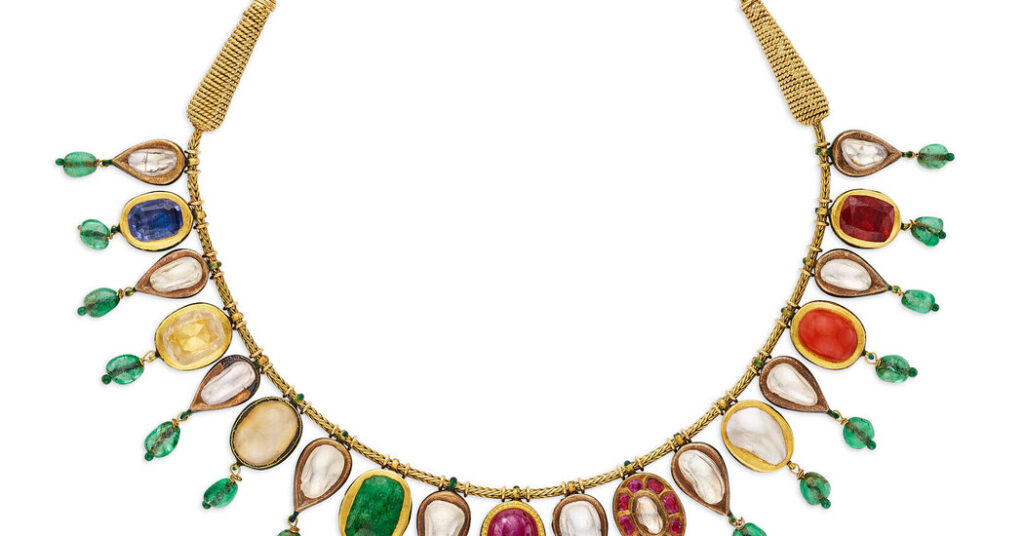
Among the highlights is a Tiffany & Company Art Deco bracelet set with five Colombian emeralds, each exceeding 10 carats, alongside approximately 20 carats of diamonds. It is estimated at $300,000 to $500,000. An India-inspired Cartier necklace from the 1950s features softly contoured sapphires, emeralds, rubies and spinels — a departure from the house’s more structured aesthetic. It is one of several Cartier pieces custom-made for Ms. Gray and Ms. Stream over the years. There is also a range of smaller, more intimate objects: pinkie rings and charm bracelets.
For dealers, the sale echoes another landmark auction: that of jewelry owned by the American socialite Wallis Simpson, the Duchess of Windsor. “Most of the Duchess of Windsor’s jewelry was made for her, and it reflected her life and her style,” said Russell Zelenetz, co-owner of Stephen Russell vintage store on Madison Avenue, in a phone interview. “That appears to be the case with Gray’s jewelry, too.”
At the center of the jewelry offering is a 49.91-carat top-quality diamond ring, estimated at $500,000 to $700,000. Mr. Poindexter described the diamond as untouched, a rarity in a market that often modifies stones to maximize brilliance.
The ring, like many pieces in the collection, carries a family story. Mr. Stream recounted that his grandmother called his father requesting that he transfer funds to purchase a 70-carat diamond ring.
“He told her that instead of buying the ring, he had wanted to purchase two tugboats [they were in the marine towing business] in her name and they were a good investment,” Mr. Stream said.
That diamond, he said, was apparently later acquired by Richard Burton for Elizabeth Taylor.
A few years later, Ms. Stream called her son with another request for funds, this time for the 49.91-carat diamond — and said the purchase was not up for discussion. “My father still refers to the diamond as the tugboat diamond,” Mr. Stream said.
An Artist’s Eye
Ms. Gray’s personal interest in fine art informed her broader interests. She studied at the Newcomb College School of Art in Louisiana and worked in bronze sculptures, some of which remain in the family’s private collection.
The art offered at auction includes a bronze sculpture by Edgar Degas and a painting by William Adolphe Bouguereau, each with a pre-sale estimate of $200,000 to $300,000. There is also a painting by Diego Rivera that carries an estimate of $300,000 to $500,000.
Ms. Gray developed a personal relationship with Mr. Rivera and visited him and Frida Kahlo with her niece. Mr. Rivera painted two portraits of the younger woman, which will remain with the family.
The Stream Family Collection showcases unique pieces, and it also tells the story of two women: one who chose to lead rather than follow, and of another who chose to preserve and extend that vision.
The post A Louisiana Dynasty’s Treasures Come to Market appeared first on New York Times.