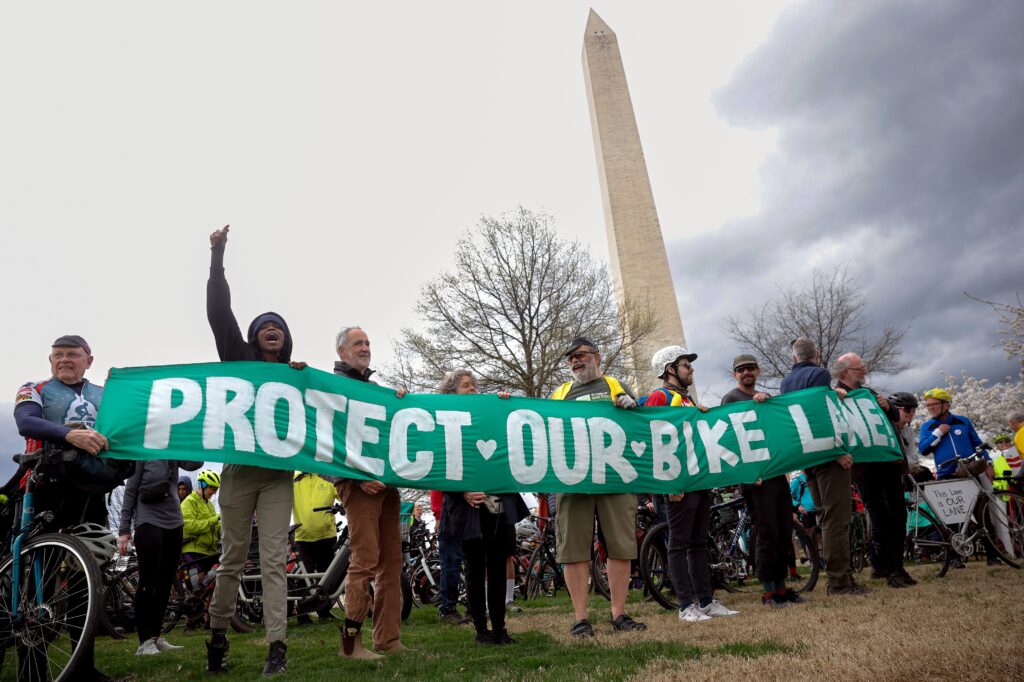
A federal judge on Tuesday put a stop to plans for the removal of popular bike lanes near the National Mall in Washington, saying the Trump administration effort to take them out in advance of America’s 250th anniversary celebrations was “arbitrary and capricious.”
Since their construction five years ago, the 15th Street bike lanes have been credited with improving public safety while ferrying nearly 4,000 daily users between Columbia Heights and the Tidal Basin area. Research by the District’s Department of Transportation found that bicycle injury crashes fell by 91 percent, and reports showed there was less congestion after the lanes were installed.
But, operating under President Donald Trump’s executive order to make D.C. “Safe and Beautiful,” the Federal Highway Administration (FHWA) was expected to begin work to take down the portion of the bike lanes between Constitution Avenue and the Tidal Basin on Thursday, according to court documents. The D.C. Department of Transportation maintains the bulk of the route and the part south of Constitution Avenue and around the Tidal Basin is under federal control.
Officials with the FHWA had said the agency was looking to return “common sense into city planning” through the project. The agency also argued that removing the lanes was needed to “improve traffic flow for the hundreds of thousands of tourists” expected to visit D.C. for such big events as the National Cherry Blossom Festival and the administration’s Freedom 250 celebrations.
Cycling advocates expressed worries that removing the lanes would make the area less safe to travel in and, in late March, the Washington Area Bicyclist Association sued the Interior Department in the U.S. District Court for D.C. to try to permanently stop the effort.
Among other things, the organization argued that the Trump administration did not conduct a proper environmental assessment of the potential impacts of removing the lanes.
On Tuesday, Judge Amy Berman Jackson sided with the organization, ordering that the removal project not go forward on Thursday while remanding it back to the National Park Service and the FHWA for further review.
In a 61-page opinion accompanying her decision, Jackson said the federal government did not give “sufficient consideration to available safety and traffic data” in deciding to remove the bike lanes.
Jackson called some of the documents submitted by the Trump administration “fluff” and said that, while the federal government, had mentioned that taking out the bike lanes was necessary because of “substantial visitation expected” for events between late May and August, it did not “identify any problems or unusual traffic congestion caused by the existence of the bike lanes during similar events.”
The Washington Area Bicyclist Association’s leaders called the judge’s ruling a victory for cyclists.
“It’s definitely a win and we think it acknowledges how important the bike lane is for anyone who tries to get around,” said Kalli Krumpos, advocacy director for the association. “It’s a nod to the importance of procedures and we need the federal government to fully consider the impact of its actions.”
Elizabeth Kiker, the cycling group’s executive director, said the ruling “sets a precedent for bike allies to fight for bike lanes.”
“It sets a strong precedent that you can’t just rip them out because you don’t like them,” Kiker said. “You have to study them and you have to prove it.”
The Interior Department and the National Park Service did not respond to a request for comment on Tuesday.
Jackson also criticized the government’s reasoning that its decision for taking out the bike lanes was, in part, to make the city’s roadways and parks “clean, well-kept and pleasant.” She said, “beauty is in the eye of the beholder, and it is not up to the Court to quibble with the federal government about whether helmeted cyclists in spandex or automobiles fitted with exhaust pipes are more pleasing to look at.”
She wrote in her opinion that the government’s suggestion that taking out the lanes would be part of an effort to “’support mobility, security, and a positive visitor experience’ is similarly ephemeral and unexplained.”
The National Park Service, Jackson wrote, had not indicated that it had done a cost-benefit analysis of restoring the lanes for vehicular traffic. She also said there was no evidence presented that showed if the bike lanes had a “negative impact on anyone’s safety.”
The bike advocacy group had shared results from a study done by D.C.’s DDOT that showed a significant reduction in collisions in the months after the bike lanes were installed. Roadway crashes along the corridor dropped by 46 percent and the flow of traffic improved, according to that study.
Jackson wrote, “the bottom line is — whatever the deficiencies of the only study in the record — the government does not dispute, and it did not submit any data that would contradict plaintiff’s contention that the dedicated lanes reduce collisions.”
The post Federal judge’s order allows popular D.C. bike lanes to remain appeared first on Washington Post.