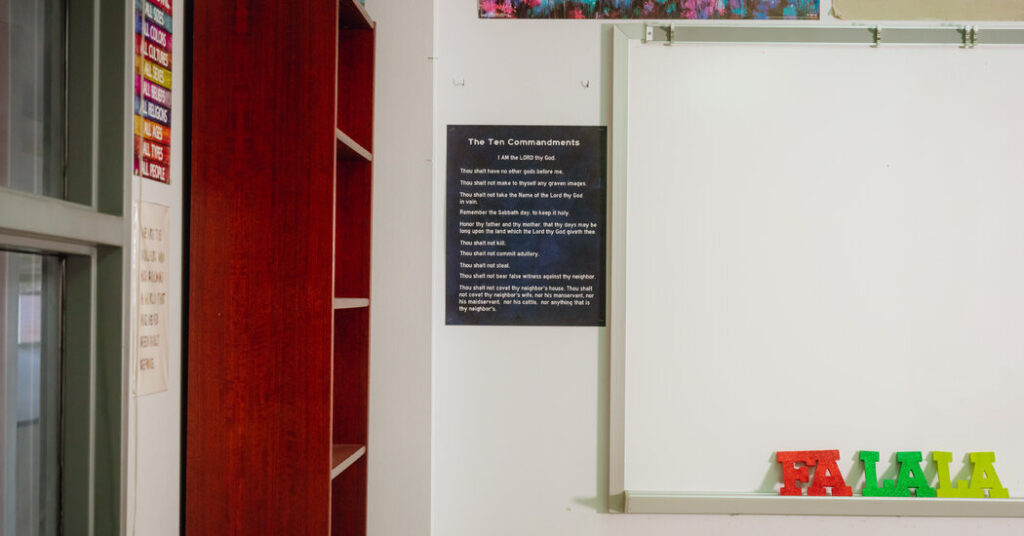
A federal appeals court on Tuesday narrowly upheld a Texas law that requires public schools to display posters of the Ten Commandments in classrooms.
By 9-to-8, the U.S. Court of Appeals for the Fifth Circuit ruled that the law does not violate the separation of church and state, reversing two lower court decisions. The court also ruled the measure does not restrict parents’ right to direct their children’s religious upbringing.
“Students are neither catechized on the Commandments nor taught to adopt them,” the ruling said. “Nor are teachers commanded to proselytize students who ask about the displays or contradict students who disagree with them.”
Since Gov. Greg Abbott, a Republican, signed a law in 2025 mandating the religious displays, families of various faith backgrounds have challenged it, arguing that the law amounted to state endorsement of religion. The law was passed amid a broader conservative push to infuse Christianity into public schools, and several other Republican-led states have passed similar laws.
The organizations representing the 15 Texas families who filed the lawsuit said in a statement that they were disappointed in the decision and planned to ask the Supreme Court to reverse it.
The Texas law mandates the displays in a “conspicuous” location in each classroom on a typeface visible from anywhere in the room. The posters must be at least 16 inches wide and 20 inches tall and must include the text of a particular version of the Ten Commandments. Schools are not required to purchase the posters, but they must accept donations of them.
In separate rulings last year, two federal judges in the state sided with the challengers, saying the law likely violated the First Amendment. Those rulings effectively blocked the law’s enforcement across 24 Texas school districts, including in Houston and Austin.
But the attorney general, Ken Paxton, had encouraged school districts that had not been blocked to hang the Ten Commandments posters, threatening legal action against those that did not comply.
In January, the full appeals court heard arguments over Texas’ law as well as a similar mandate passed in Louisiana in 2024. In February, the court said it was premature to decide whether the Louisiana law was constitutional because it had not gone into effect. That decision cleared the way for Louisiana to enforce the law.
On Tuesday, Louisiana’s attorney general, Liz Murrill, celebrated the ruling, saying that it demonstrates that “our law was always constitutional.”
Mr. Paxton similarly called the ruling a “major victory for Texas and our moral values.”
For some teachers, the ruling was not welcome news. Lena Lee, a high school English teacher in Keller, Texas, a Fort Worth suburb, called the decision “devastating.” Ms. Lee has been hanging spiritually themed posters from a multitude of faiths in defiance of the law, a practice she said she would continue.
“Students in Texas are being unjustly used as pawns in this game for conservatism,” she said. “Schools should not be a battleground for conservatives to push their agenda.”
The organizations representing the families said the ruling “goes against fundamental First Amendment principles and binding U.S. Supreme Court authority.”
“The First Amendment safeguards the separation of church and state, and the freedom of families to choose how, when and if to provide their children with religious instruction,” they said. “This decision tramples those rights.”
After the law was passed, a group of conservative legal groups and churches raised funds to distribute posters to districts across the state. First Liberty Institute, a Christian legal organization, was one of those groups. In a statement on Tuesday, Kelly Shackelford, the organization’s chief executive, said the Ten Commandments are critical to the nation’s history.
“Banning them from schools because they are religious is not justified by the Constitution and would undermine a comprehensive education for America’s students,” Mr. Shackelford said.
Pooja Salhotra covers breaking news across the United States.
The post Federal Appeals Court Upholds Texas Ten Commandments Law appeared first on New York Times.