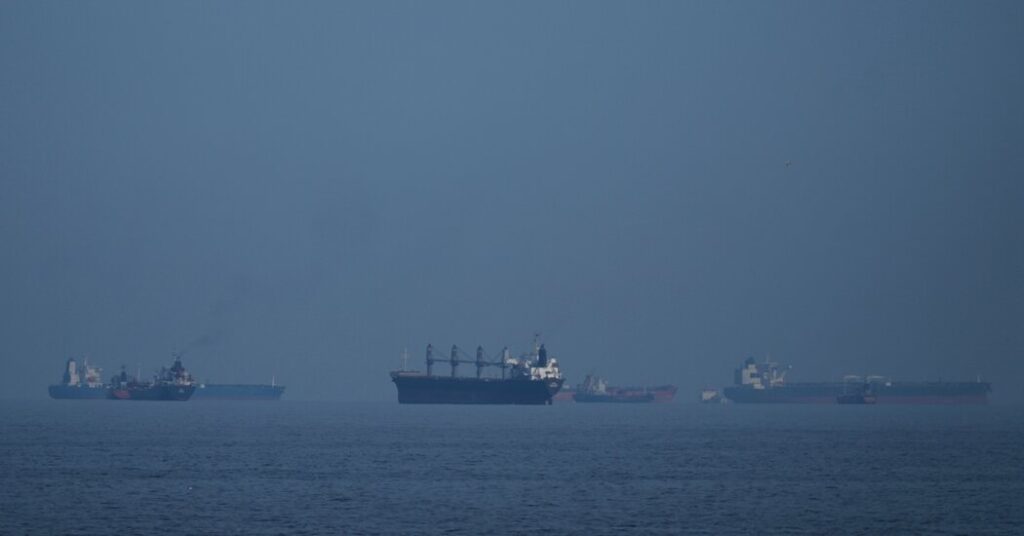
Commercial ships can sail through the Strait of Hormuz after the agreement of a cease-fire in Lebanon, according to statements from Iran and the United States on Friday
The flow of oil and gas through the waterway had slowed to trickle during the war, creating a shortage of gasoline and diesel that had rattled economies around the world. The prospect of the strait reopening prompted a sharp decline in oil prices and a rally in stock markets on Friday.
But Iran and the United States were still at odds over the U.S. military’s blockade of Iranian ships, in place since Monday, and enforced east of the strait in the Gulf of Oman. President Trump said on Friday that the blockade would remain. Iran said that it opposed the blockade, and that it may take countermeasures against it, without saying what those might be.
And there are obstacles to a quick return of ships to the waterway. Shipping executives want to be certain that their vessels aren’t in danger, and they may be reluctant to comply with Iran’s requirement that ships use a route that runs close to its coastline, rather than the two main lanes used before the war. Iranian officials said on Friday that vessels would still need permission to travel through the strait.
Ships had not returned in large numbers to the strait as of Friday, according to shipping analysts.
Still, assertions from Iran and the United States that the strait is open suggest that both sides see the waterway as a crucial part of a wider, permanent peace agreement.
Iran’s foreign minister, Seyed Abbas Araghchi, said in a post on X that the strait would be “completely open” after the cease-fire in Lebanon, which began at midnight.
Shortly after that announcement, Mr. Trump responded in a social media post: “IRAN HAS JUST ANNOUNCED THAT THE STRAIT OF IRAN IS FULLY OPEN AND READY FOR FULL PASSAGE. THANK YOU!”
The statements raised hopes among tanker owners eager to resume moving oil and gas out of the Persian Gulf.
“Assuming this holds, then I think it’s great news,” said Jerry Kalogiratos, chief executive of Capital Clean Energy Carriers, a shipping company that operates oil and gas tankers.
Before the war, a fifth of the world’s oil and a significant share of its liquefied natural gas traveled through the Strait of Hormuz.
Brent crude, the international oil benchmark, fell more than 9 percent on Friday, to $90.38 a barrel, its lowest level in more than a month, though it remains more than 20 percent higher than before the war started. West Texas Intermediate, the U.S. benchmark, fell over 11 percent Friday, to below $84 a barrel.
Stocks, which have rapidly recovered from a war-induced sell-off in March, rose after the announcement. The S&P 500 rose 1.2 percent on Friday.
Ship traffic through the strait plummeted after Iran attacked vessels in the region. By effectively closing the waterway, and cutting off energy supplies, Iran had leverage what it could use against the United States and Israel.
The recent cease-fires have to last.Mr. Araghchi said on X that the strait would be open for the “remaining period of cease-fire.” He did not specify whether that was the 10-day cease-fire that began in Lebanon or the one between the United States and Iran, which is scheduled to end on Tuesday.
Experts said Iran’s demand that ships used a route through the strait that runs close to its coastline would mean that the waterway was not truly open.
“That does not equate to freedom of navigation,” said Martin Navias, an author of “Tanker Wars: The Assault on Merchant Shipping During the Iran-Iraq Crisis.”
Before the war, around 130 ships a day passed through the strait, using two main lanes that are different from the route that Iran has specified. To maximize the flow of tankers through the waterway, shipping analysts said vessels would have to return to the two main lanes. But for shipowners to use the lanes, they would have to be certain that they are free of mines.
According to U.S. officials, Iran has not been able to locate all of the mines it has laid in the strait and lacks the ability to remove them.
On Friday, Mr. Trump said on social media that, with the help of the United States, Iran “has removed, or is removing, all sea mines!”
In normal times, the two lanes operate as a “traffic separation scheme” that the International Maritime Organization, a United Nations agency, adopted in 1968 to avoid collisions.
On Friday, the organization’s secretary-general, Arsenio Dominguez, said it was looking at whether the announcement on the opening of the strait complied “with freedom of navigation for all merchant vessels and secure passage using the I.M.O. established traffic separation scheme.”
The U.S. blockade seeks to stop Iranian and Iran-linked ships leaving the region. Iran had been exporting crude during the war at volumes that were similar to those before the conflict.
U.S. Central Command posted a video on Friday of U.S. officials directing a merchant vessel to return to an Iranian port. It was one of 19 ships that have complied with direction from U.S. forces to turn around and return to Iran, Central Command said on social media. “ZERO vessels have evaded U.S. forces during the blockade,” it said.
Major shipping companies, which have been hesitant to send ships through the strait, even ones that have been stranded there for weeks, said they were assessing whether the waterway had become safer.
“There are still some open questions on our end, but they might be resolved within the next 24 hours,” said Nils Haupt, a spokesman for German company Hapag-Lloyd, the fifth-largest container shipping company in the world. He added that Hapag-Lloyd wanted its six stranded ships to cross the strait as soon as possible, but that it still needed answers on insurance coverage as well as clear orders from the Iranian government on the sea corridor that should be used and the sequence of ships leaving.
“On paper, this looks great,” said Alexis Ellender, an analyst at Kpler, a marine data tracking firm. But he added that he expected it would to take some time — weeks, not days — before there was a significant uptick in the volume of ships going through.
Some smaller companies may be willing to restart traffic if they secure affordable insurance cover. Around 900 ships have been stranded in the Persian Gulf over the course of the war, according to a New York Times analysis of Kpler data.
One Istanbul-based ship operator with a stranded ship, who spoke on the condition of anonymity because he was not authorized to speak to the news media, said that he would consider moving it out of the strait as soon as Friday if he could secure insurance coverage, but he expected it to take several days.
Pranav Baskar contributed reporting.
Peter Eavis reports on the business of moving stuff around the world.
The post Iran and U.S. Say the Strait of Hormuz Is Open but Concerns Linger appeared first on New York Times.