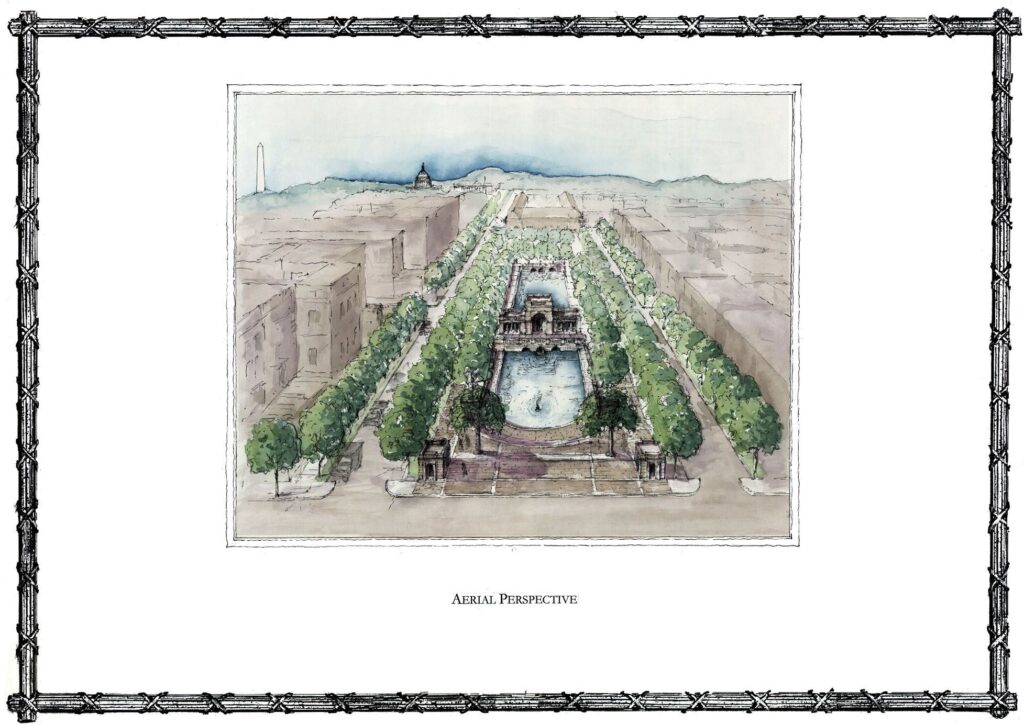
Nearly 30 years ago, Rodney Mims Cook Jr. had a vision: a triumphal arch gracing the streets of Washington. The urban developer persuaded some lawmakers and potential funders; he won encouragement from local leaders and residents. But an arch was never built here.
Now the idea is back, and so is Cook — appointed by President Donald Trump to the Commission of Fine Arts, a federal panel that helps approve the design of monuments and major projects in the capital. The commission on Thursday will review Trump’s proposal for a 250-foot arch, tucked inside the city’s boundaries near Arlington National Cemetery. Trump officials hope to begin construction this year, in honor of the country’s 250th anniversary.
Cook, who founded the National Monuments Foundation and has long promoted classical design, believes the nation’s capital needs an arch, which he says would serve as a majestic gateway to the city.
But he wouldn’t stop at one.
“I think the president should do three,” Cook said in an interview from Italy last week, citing two more potential locations in Southeast Washington that, together, he believed would satisfy architect Pierre L’Enfant’s original vision for the capital. “He wants to complete the L’Enfant plan. No one has.”
Cook declined to say whether he had discussed his three-arch proposal with Trump, a plan that would include two more arches by the Frederick Douglass Memorial Bridge and the John Philip Sousa Bridge that would greet visitors as they enter Washington from the south. He also declined to say whether he would vote for Trump’s proposed 250-foot arch, adding that he had many questions about the plan — and expected to weigh it carefully in his role of chairman of the fine arts commission, having been elected earlier this year.
The White House said it would not comment on the president’s conversations.
Washington is unusual among major western cities for not having a triumphal arch, which the Romans widely used to commemorate victories. They also inspired more recent structures in Europe, most notably the 164-foot Arc de Triomphe in Paris, which Napoleon Bonaparte commissioned in the first part of the 19th century. The White House’s planned arch closely resembles those designs, leading some to dub the administration’s proposal “the Arc de Trump.”
The president has publicly echoed Cook’s laments about Washington’s lack of an arch, vowing to build the world’s largest — an ambition that fits within his broader effort to reshape the capital’s civic landscape and align its monuments more closely with his vision of American power, patriotism and legacy.
“Long after everyone in this room is gone, our children and grandchildren will remain inspired by this national monument,” White House press secretary Karoline Leavitt told reporters on Wednesday.
The idea of a large arch has been cheered by some of Trump’s supporters, who have rallied for the project online and are planning to do so at Thursday’s commission hearing.
ARCH ALERT
— Jared Small
(@jaredsmall) April 13, 2026
Cook’s friends and supporters have also applauded his efforts to build a triumphal arch in Washington, with several calling him a visionary.
“I like the idea of the arch,” Joe Lonsdale, a co-founder of Palantir and a supporter of the National Monuments Foundation, wrote in an email about the 250-foot proposal. “It’s a bold homage to our western heritage and Rodney knows how to build beautiful monuments.”
Their enthusiasm is not universally shared. Polls have found that most Americans oppose the 250-foot project. Military veterans have sued to stop it, saying that a towering structure in Memorial Circle will harm views of Arlington National Cemetery. Democrats have warned Trump that any new monument must obtain authorization from Congress and have vowed to probe the project if it moves forward without lawmakers’ review, a threat that would carry extra teeth if a chamber of Congress flips this fall.
Historic preservationists and architects have also said that a 250-foot arch would distort the intent of Memorial Circle and its surrounding monuments, including Arlington Memorial Bridge, which was intended as a symbolic link between North and South in the wake of the Civil War. The roughly 100-foot-tall Lincoln Memorial sits at one end of the bridge, while a monument to Confederate Gen. Robert E. Lee sits on the hillside of the cemetery. The view between the two memorials would be interrupted by a large arch.
“Memorial Circle was explicitly designed as a solemn processional transition toward Arlington and the nation’s cemetery for nearly 430,000 veterans,” John Haigh, the chair of Benedictine College’s architecture program, who visited Memorial Circle and other sites with his students last year to consider the arch project, wrote in an email. “A triumphal arch located there is the wrong typology: triumph and reconciliation (and its related commemoration of sacrifice) are not the same thing.”
Some historians who have studied L’Enfant, Washington’s original designer, questioned why Cook has invoked him to justify the building of new arches around the city.
“Nowhere in his plan is there a ‘gateway,’” said Caren Yglesias, an architect who teaches on L’Enfant at the University of Maryland. She noted that a later designer, Andrew Jackson Downing, did include a “gateway” arch in a mid-19th century proposal for the National Mall. That arch was never constructed.
“But again, it is not a gateway to the city. It is a gateway between Pennsylvania Avenue and the president’s grounds in front of the White House, as they were called at that time,” said Yglesias, who has written a book on Downing.
Judy Feldman, an art historian who leads the National Mall Coalition, a preservation-focused nonprofit, said she did not see a connection between L’Enfant’s original plans and proposals for an arch now.
“It sounds like an urban designer is trying to reinterpret L’Enfant,” Feldman said.
Cook, touting his own studies, pointed to his readings of L’Enfant’s plans and cited past presidents’ goals for the city.
“L’Enfant stated that his models for the new city included such ‘grand’ cities as London, Madrid, Paris, Amsterdam, Naples, Venice, Genoa, and Florence,” Cook wrote in a text message, citing a 1791 letter that L’Enfant sent to then-Secretary of State Thomas Jefferson. “All of these cities have ‘grand’ arch gates.”
The son of a prominent Georgia politician, Cook has long said that he is trying to keep classical traditions alive, enlisting prominent backers around the world in his attempt.
A monument that Cook helped build in Atlanta in 1996, with the support of England’s then-Prince Charles, became a local rallying point after the death of Princess Diana a year later. A 1999 New Yorker profile of Cook by architect Paul Goldberger — titled “Athens on the Interstate” — captured his further efforts to bring classical architecture to a city better known for its freeways.
Cook took an interest in Washington too, saying that the new millennium occasioned a monument to match it. He won some bipartisan support for a millennium arch in Congress, including from then-Sens. Daniel Patrick Moynihan (D-New York) and Paul Coverdell (R-Georgia), and was cheered on by Washington’s leaders.
“The Millennium Monument can be one of the new success stories for Washington as we begin the 21st century,” Andrew Altman, who served in the mayor’s office as Washington’s planning director, wrote to Cook in a December 1999 letter obtained by The Washington Post. Cook identified a site in Barney Circle, a historically disadvantaged neighborhood near the Anacostia River, proposing a roughly 80-foot arch that he said would serve as a gateway to the nation’s capital city.
Cook and his allies also looked at other locations, such as a site in Navy Yard near South Capitol Street, and spent time cultivating local residents. He told The Post this week that he deliberately focused on underserved communities to “help them restore-renovate the great vernacular that is Washington residential architecture.”
Arol Wolford, a construction-technology executive who is a longtime friend of Cook and was involved in his Barney Circle arch proposal, praised Cook’s desire to elevate a community through architecture with a monument intended to mark peace.
“Rodney is a very progressive civil rights person,” Wolford said.
Cook said the Barney Circle proposal lost steam in the wake of the Sept. 11, 2001, terrorist attacks.
“America was on a war footing,” Cook wrote in an email. “A peace monument was not in the cards.”
There were other hurdles, too. Washington officials stalled the project, telling The Post in 2002 that they realized it would need significant public funding that had not been budgeted.
So Cook took the idea home to Atlanta, constructing a roughly 100-foot arch known as the Millennium Gate Museum, focused on Georgia’s art and culture. His office is in a bronze temple atop it.
Cook was among the classical designers and architects who saw new opportunity when Trump, who has said he values classical architecture, won the presidency in 2016. Trump issued an executive order to promote “beautiful federal civic architecture” and appointed Cook and other classicists to the fine arts commission. The Biden administration subsequently removed Cook and some of his fellow Trump appointees from the commission before their four-year terms were complete, defending the move as an effort to diversify the panel.
Meanwhile, Cook’s long-forgotten arch proposal was resurrected in a series of articles by Cook’s associates and presented to Trump last year as a way to celebrate the country’s 250th anniversary. The president liked the idea — and enlarged it considerably.
Cook’s return to Washington in the second Trump term has been triumphant. As chairman of the fine arts commission, he has weighed in on local school design, voted to support commemorative coins set to bear the president’s face and gotten involved in an array of other projects. In the commission’s most notable move, Cook mobilized the panel to swiftly approve the president’s planned White House ballroom amid public resistance, saying in February that he and his fellow commissioners needed to let Trump get back to his global priorities rather than dwell on the ballroom.
But Cook’s new role in the city has also brought new scars. Feldman, who leads the National Mall Coalition, said it was “extremely unprofessional” for Cook to so swiftly assent to Trump’s ballroom proposal rather than spend more time aggressively vetting it — a complaint echoed by Goldberger in the New York Times.
A Post article on Cook’s interest in changing the columns on the White House mansion also prompted complaints from architects and jabs from comedians.
“It’s even gotten to the point that Stephen Colbert compared me to Willy Wonka yesterday,” Cook said at a March meeting of the fine arts commission, adding that he was simply trying to call attention to the rules of classical architecture.
In an interview last week, Cook said he remains committed to the idea of building an arch, though drawing distinctions between his work and the president’s vision.
“It’s a wonderful gesture of President Trump to task me to try to assist him to complete the L’Enfant plan, as I was trying to do as a private citizen two decades ago,” he said, teasing the forthcoming commission hearing. “We’ll see what he has on his mind on the 16th.”
The post Trump’s top arts commissioner says D.C. needs three arches, not one appeared first on Washington Post.