TOKYO — As a security hawk, Japan’s prime minister, Sanae Takaichi, has initiated a plan to consider changes to the pacifist clause in the country’s constitution, which has constrained its military and defined its national identity since World War II.
After Takaichi’s landslide victory this year and with increasingly menacing China next door, she may have the popularity and political capital to push through a change — but the issue is highly sensitive.
The specific change Takaichi is seeking would be more symbolic than substantive and would not alter the part of the constitution that renounces war. Public pushback, however, is mounting with rare nationwide protests by those wary of the U.S.-Israel war in Iran and fears Japan could get drawn into military conflicts if it drops its constitutional guardrails.
The prime minister is moving cautiously. She said this week that she wants to put forth a proposal in one year — taking the unusual move to declare a timeline — and called on her ruling Liberal Democratic Party (LDP) to mobilize its “full strength” to advocate for the change. But even with a big parliamentary majority, amending the pacifist clause will not be easy.
Takaichi has made the revision a top priority as she bolsters the nation’s defense to counter rising threats in Asia, including an overhaul of national security and defense strategy to increase military spending, develop counterstrike capabilities and loosen a ban on exporting lethal military equipment.
These moves are especially important now that Japan’s only security ally — the United States — has been engulfed in war in the Middle East, leaving Asian middle powers like Japan to confront hard questions, Takaichi’s supporters say.
“U.S. forces are still the number one forces on earth, but it cannot fight plural major wars like against Japan and Germany in World War II any longer,” said Nobukatsu Kanehara, who was a top aide to Takaichi’s mentor, former prime minister Shinzo Abe. “Japan shall be more responsible, shall expand its military capabilities and shall no more be too dependent upon U.S. military protection,” Kanehara said.
Japan’s constitutional restrictions have come under a spotlight since the war in Iran, as President Donald Trump called on allies to help secure the Strait of Hormuz. During a visit to the White House last month Takaichi told Trump that there are things Japan “can and cannot do” because of its legal restraints.
That didn’t stop Trump from complaining last week that Japan “didn’t help us” in the Middle East even though Japan still hosts tens of thousands of U.S. troops.
To those who oppose constitutional revisions, the meeting with Trump underscored why the pacifist clause — known here as Article 9 — should stay as is: It shielded Japan from the American president’s pressures.
“From our perspective … there is certainly a view that Article 9 protected us,” said a fashion designer who goes by the name eri and is an organizer with We Want Our Future, an activist group that has been co-hosting recent protests against the revision and the Iran war.
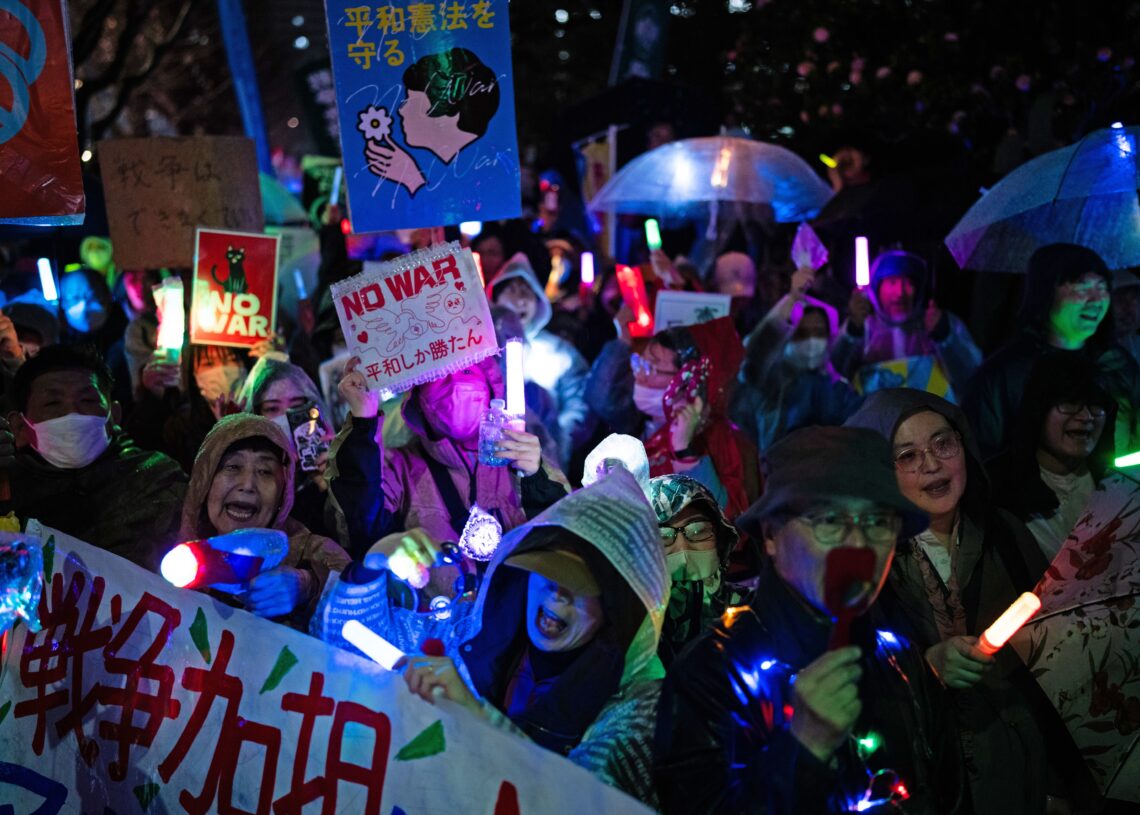
About 30,000 people gathered outside parliament last week for one of more than 130 protests nationwide — an extremely rare show of Japanese political activism. A DJ blasted upbeat music while people chanted phrases like, “Trump, step down!” and “The pacifist constitution is Japan’s treasure!”
“Since the attacks on Iran began, it has been frightening to see how quickly both the world and Japan seem to be heading toward war,” said Jun Takahashi, 36, who attended a protest for the first time. “I also strongly dislike the idea that Japan, through Prime Minister Takaichi’s involvement, might be seen as complicit,” Takahashi said. “I felt I had to take action and raise my voice.”
Bolstering defense
Even without a constitutional change, Japan is already moving to increase its defensive capabilities more than ever in the postwar years — a reflection of the increasingly difficult security environment. As in Germany, where Russia’s war in Ukraine prompted a broad push to rearm the country after 80 years of eschewing militarism, Japan has taken dramatic steps in recent years to shed its postwar pacifist restraints.
Chinese coast guard vessels repeatedly have intruded into Japan’s territorial waters — six times this year so far — near the disputed islands of Senkaku, which the Chinese call Diaoyu.
The Russian war in Ukraine also has alarmed Tokyo about how it could embolden Beijing to invade Taiwan, which could draw the U.S. — and, as a result, Japan — into the conflict. Meanwhile, North Korea is expanding its nuclear program aggressively, and some of its soldiers are now battle-tested from the Russian war.
Making matters more alarming, China, Russia and North Korea have banded together as a loose grouping against the U.S.-led world order — confronting Tokyo with an arc of threats just across its seas. The three countries teaming up is tilting the balance of power in Northeast Asia, experts say.
“That’s quite a force multiplier for their strategic calculus, which makes it even more complex and difficult to find out what would be the optimal answer to this,” said Ken Jimbo, an international security expert at Keio University.
The war in Iran has supercharged Japan’s concerns about U.S. commitments to security in the Asia-Pacific. Japan’s order for hundreds of Tomahawk missiles from the United States — a key part of Tokyo’s defense strategy — will likely be delayed by the Iran war, according to three people who spoke on the condition of anonymity to share knowledge of sensitive matters. Japan may also face delays of SM-6 ship-to-air missiles and Patriot missiles, one of those people said.
“If troop deployments shift rapidly to the Middle East, this could affect security in East Asia,” said Gen Nakatani, an LDP lawmaker and former defense minister. “Japan must both work toward de-escalation and strengthen its own defense capabilities — especially deterrence, strike capability, endurance and intelligence capabilities.”
Japan is poised to take such steps through a national security and defense strategy overhaul under Takaichi, who has called for this change one year ahead of schedule.
Her government aims to revise its three main security and defense policy documents by the end of 2026. The changes are expected to include new forms of warfare using unmanned systems and mechanisms to ensure sustained combat capability. The government also plans to ease defense equipment export restrictions as early as this month.
Japanese officials are especially concerned about asymmetric warfare enabled by advanced technologies like artificial intelligence, said Jimbo, who has been advising the government on the security review.
“We also have to accommodate ourselves into those kind of asymmetrical capabilities, and that’s heavily important for us,” he said, adding that Japan faces limits on increasing its ranks of soldiers because of a rapidly aging population.
Constitutional revision
Takaichi wants to go further by revising Article 9 of the Japanese constitution, which is based on a draft written by Americans during the Allied occupation following Japan’s surrender in World War II. The so-called “no-war” clause is designed to prevent Japan from instigating another war.
The meaning and intent of the clause — and whether to revise it — has been a subject of debate since the 1950s. The Japanese government has taken the position that renouncing war does not refer to its right to self defense. Under this interpretation, Japan has established its Self-Defense Forces, although its constitution does not explicitly allow a military.
Abe unsuccessfully sought to add a sentence to the no-war clause clearly recognizing the SDF. Takaichi is now taking on Abe’s mantle. And unlike Abe, who faced opposition from the LDP’s pacifist coalition partner, the LDP has a new partner, the Japan Innovation Party, that is willing to push the envelope.
Still, it will consume an enormous amount of political capital. A constitutional amendment requires a two-thirds vote from both parliamentary houses and a public referendum.
Although Takaichi has a supermajority in the lower house, the more powerful chamber in parliament, her party is in the minority in the upper house. Polls show there is growing public support for recognizing the SDF in the constitution, but a national referendum would be a gamble.
Nonetheless, proponents see the revision as a necessary first step to remove Japan’s shackles on using force to defend itself, like any other country.
“Japan should be able to act as a ‘normal country’ within international framework,” said Nakatani, the former defense minister. “At the very least, the Constitution should clearly state the existence of the Self-Defense Forces so that there is no ambiguity. That is the first step.”
Others see it as a slippery slope that could undermine the intent of the pacifist clause. Article 9 has also served as a signal to other Asian countries that Japan will not repeat its imperial past, which has helped maintain regional stability, said Shiro Sato, a professor of peace studies at Hiroshima City University.
“I’m concerned that this could lead to a hollowing-out of pacifism,” Sato said. “If it’s revised, that trust could erode, increasing insecurity and potentially worsening the security environment.”
Noah Robertson in Washington contributed to this report.
The post Japan is a pacifist nation, and now a hint of change is drawing rare protests appeared first on Washington Post.