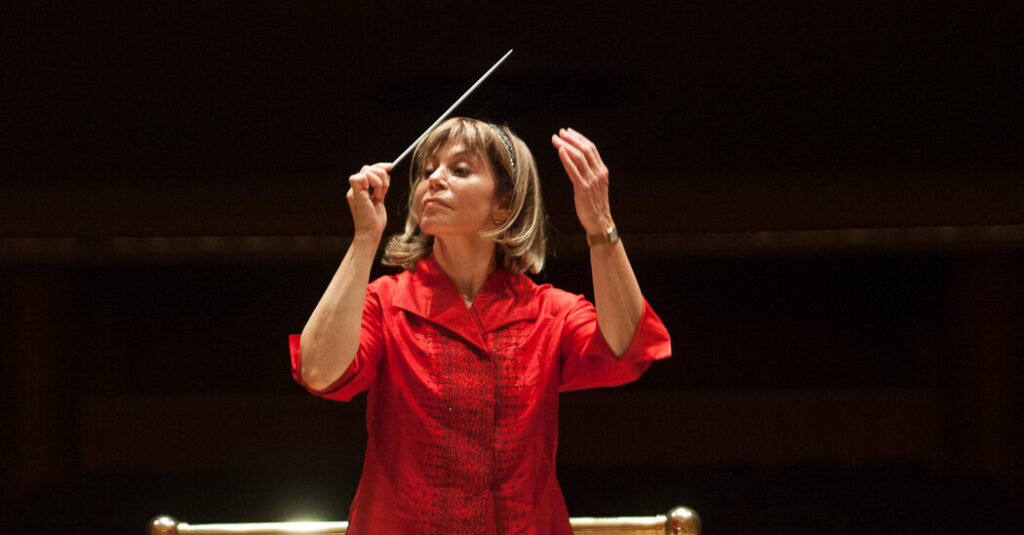
When JoAnn Falletta was appointed the music director of the Buffalo Philharmonic Orchestra 25 years ago, one of her first decisions was to move to Buffalo from Virginia. She wanted to be a presence in the city, to chat with neighbors while shopping for groceries, to field questions (and complaints) about the fall music season while at church or at the theater.
It is a decision she has never regretted. Like many music directors, she conducts other orchestras: She spends 12 to 14 weeks a year as a guest conductor around the world and was music director of the Virginia Symphony Orchestra until 2021. But the Buffalo Philharmonic has been her home orchestra and Buffalo her home. She came to believe, she said in an interview, that an orchestra leader needs to be a visible presence both at the podium and in the community.
“People just come up to you and say, ‘Hi, JoAnn,’” said Falletta, whose home is a seven-minute drive from Kleinhans Music Hall, where the Buffalo Philharmonic performs. “They don’t know me as Maestro. They know me as JoAnn.”
“It makes a difference,” she added. “It means you care. That’s the message it sent to Buffalo: I love the city enough to be living here.”
Falletta, with her strong ties to the community, is in some ways a throwback to another era. But her approach is instructive for conductors and orchestra administrators now as they struggle with defining the role and obligations of a music director. The field today is filled with celebrity conductors who have multiple gigs and residencies, like Klaus Mäkelä, the 30-year-old Finnish star who juggles affiliations with orchestras in Oslo, Paris and Amsterdam.
This question of what a community wants from a music director has taken on new urgency as orchestras look for ways to deal with declining audiences and budget shortfalls. It is clearly a factor for three major American ensembles — Los Angeles, Boston and San Francisco — who are now in the midst of a search for new leaders. A fourth, the Cleveland Orchestra, will need a new leader when Franz Welser-Möst, who has done the job for more than 23 years, steps down at the end of 2027.
Thomas W. Morris, a former executive director of the Cleveland Orchestra and the Boston Symphony Orchestra, said that the question is “who should be responsible for and accountable for the artistic health of the institution.”
“I don’t see how that’s possible with someone who is there just 12, 14 weeks a year,” he said. “If the music director is the music director of two orchestras that compete on the international stage, it dilutes image and impact and individuality.”
Contractually, music directors are typically required to spend 12 to 14 weeks conducting an orchestra, plus time for taking the orchestra on tour. There are rarely residency requirements and the definition of whether a conductor is spending enough time in the community is often a matter of perception — and, not incidentally, the personality of the man or woman holding the baton.
Matías Tarnopolsky, the chief executive and chair of the New York Philharmonic, said where a conductor lives is less important than the sense of presence and passion they convey to their community. He pointed to Gustavo Dudamel, the Philharmonic’s incoming music director, as an example. “Gustavo embraces every aspect of life in New York City,” Tarnopolsky said. “He knows he has a civic role, and it’s important to him. You have got to be here, live it and feel it, and Gustavo does.”
Orchestras may be pushing music directors to make more of a commitment to their communities, but these decades have been marked by the rise of the star conductor with multiple orchestras and a globe-trotting roster of guest appearances.
“The music director role is very different from when I first started almost 60 years ago,” said Leonard Slatkin, who led the National Symphony Orchestra in Washington from 1996 to 2008. Music directors, he said, “were the cultural face of a city, more than just the leader of the orchestra. This is just not the case today.”
Still, the debate about how much time a conductor should spend on the road is hardly settled. It was one of the main factors behind the chaotic circumstances surrounding the recent decision by the Boston Symphony Orchestra to part ways with its music director, Andris Nelsons. The orchestra’s board has declined to discuss in detail the reasons for his dismissal, effective when his contract expires in summer 2027. But it came amid complaints that Nelsons spent too many weeks touring and leading another orchestra, the Gewandhaus Orchestra in Leipzig, leaving less time to tend to the needs of Boston and the Boston Symphony.
By contrast, Dudamel, who starts in New York in the fall, made a pledge to be a visible and prominent community presence. Dudamel, who is also the artistic director of Simón Bolívar Symphony Orchestra in Venezuela, has made a point of finding an apartment within strolling distance of Lincoln Center. “This area is wonderful,” Dudamel said during a recent interview at Geffen Hall. (Nelsons, who declined requests for comment, also kept an apartment in Boston, orchestra officials said.)
Kim Noltemy, the chief executive of the Los Angeles Philharmonic, which is searching for a successor to Dudamel, said the public now expects orchestra leaders — music directors, but also executives like Noltemy — to “show up at all kinds of things beyond our organizations — and participate in the community. We should not just be in our beautiful concert hall.”
“It has changed,” she said, adding: “In today’s environment, the music director has to be both an artistic visionary and a collaborative leader. They have to understand the role of the orchestra in their community, but also on the global stage.”
This is something the Boston board will consider in replacing Nelsons, said Chad Smith, the chief executive of the Boston Symphony who previously held that job at the Los Angeles Philharmonic. “As we think about the future, as we launch a music director search, we are going to be asking those questions about what a music director is,” Smith said. His thinking on this was influenced by his time in Los Angeles, during Dudamel’s tenure, “where I saw the orchestra become beloved by the community.”
Still, while orchestras might try to put more restrictions on the outside work of their music directors — either explicitly in contracts or in the course of hiring negotiations — it seems unlikely that the era of the traveling conductor is coming to a halt anytime soon.
The lure of touring and conducting multiple orchestras is strong, for artistic but also financial reasons, particularly because of the decline of the relatively lucrative recording industry over the past 15 years. The itinerant life has allowed conductors like Mäkelä, Esa-Pekka Salonen and Nelsons, to name just a few, to experience different cities, cultures, musicians and music. And having a music world celebrity at the top of the orchestra can be good for the stature and self-worth of the ensemble as well as the community.
“We are not in an age when music directors stay in a city and don’t travel anywhere else,” said Mark Volpe, a former chief executive of the Boston Symphony. “It is a benefit to all of us to have conductors who are internationally renowned.”
That said, music directors in charge of more than one orchestra or who spend months touring the world as guest conductors are forced to juggle tastes and demands of audiences in different cities, as well the skills and needs of a clarinetist in one place and an oboe player in another. Some conductors and industry leaders said that is inevitably a distraction from a music director’s first obligation — the home orchestra.
Delta David Gier, the music director of the South Dakota Symphony Orchestra, said his decision to move to Sioux Falls from New York City 20 years ago was important to the South Dakota orchestra’s evolution into one of the most respected symphonies in the nation. (“Before that, I couldn’t have put South Dakota on a map,” Grier said. “And I hated winter.”) It allowed him to focus on hiring musicians, working with the ones who were there and developing programming that has been praised as innovative.
Gier said that, had he been a commuting conductor, it would not have been possible to create the Lakota Music Project, where he and orchestra members travel South Dakota performing with Native American musicians, deepening the orchestra’s ties with the community.
“I believed in exploring how an orchestra serves a community as opposed to just giving concerts,” he said. “Living here really enabled me to build relations with Native partners, which would have been much more difficult if I were flying in and out and staying only a week at a time. I would not have done that if I had stuck with my 14 weeks a year.”
“You have to spend time there,” Gier said. “You have to develop relations. In the end it’s all about relationships with people. It’s not simply about selling tickets.”
Adam Nagourney is the classical music and dance reporter for The Times.
The post In an Era of Frequent Fliers, Is a Conductor’s Place at Home? appeared first on New York Times.