A Florida law set to take effect in January prompted officials in Delray Beach this month to pre-emptively cancel the city’s St. Patrick’s Day parade, drawing national headlines and outrage across the political divide.
The decision was but one example of how governments and cultural organizations across the state are hustling to comply with the law, which Gov. Ron DeSantis, a Republican, signed in the spring as part of a broader crackdown on diversity, equity and inclusion activities. But Republican lawmakers and Mr. DeSantis, who likes to say Florida is “where woke goes to die,” may not have expected quite this much upheaval.
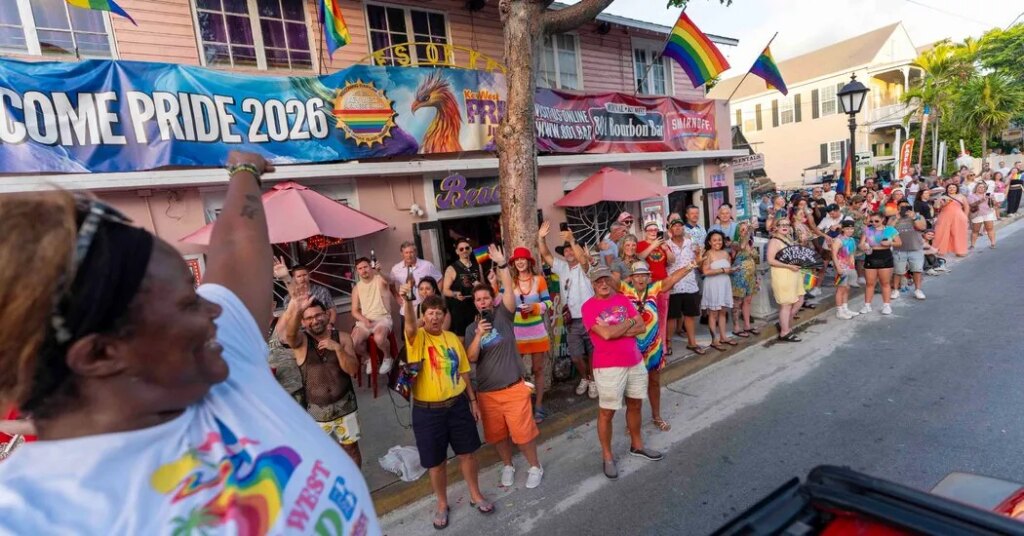
In the Florida Keys, officials have cut grants for Pride events, drag shows and an Italian heritage organization, while a decades-old women’s flag football tournament added a men’s division to keep its public funding. Broward County can’t fund a Greek film festival, a boy’s choir or a women’s tennis tournament, according to one commissioner, citing legal advice from the county attorney’s office.
Officials in Fernandina Beach, near Jacksonville, issued a proclamation celebrating a Hispanic heritage festival, only to learn minutes later from the town attorney that doing so will be illegal next year.
The law bans local governments from directly or indirectly funding, promoting, or taking official action related to D.E.I.-related activities. And it defines D.E.I. as anything promoting or providing preferential treatment or special benefits based on “race, color, sex, ethnicity, gender identity, or sexual orientation.”
Mr. DeSantis called Delray Beach’s parade cancellation “malicious compliance” aimed at scoring political points; the city’s mayor told The South Florida Sun-Sentinel that its legal department deemed the parade an “ethnic” event that promotes a certain group.
Critics say the law has enough ambiguities that local officials are erring on the side of caution to avoid its penalties: It allows residents to sue if they think their city or county is violating the law, or the governor to remove officials who violate it.
“The ambiguity of the law is already having a chilling effect,” said Jon Harris Maurer, general counsel for Equality Florida, an L.G.B.T.Q. rights group that opposes the law.
Mr. DeSantis, who leaves office in January because of term limits, has molded Florida into a conservative bastion, making his “war on woke” a top priority. During his tenure, Florida has restricted public school lessons on gender and sexuality, overhauled standards on teaching African-American history, and cracked down on rainbow art on crosswalks. More than a dozen Republican-led states have passed anti-D.E.I. laws, typically centered on educational issues.
Mr. DeSantis, speaking after Republicans were drubbed nationally in the November midterm elections but retained power in Florida, said the state “took care” of addressing so-called woke overreach while acknowledging many voters now have different concerns. His office did not respond to a request for comment.
Florida’s Republican-dominated Legislature passed the anti-D.E.I. law in part to restrict cities’ and counties’ spending on diversity training. Dean Black, a Republican state representative, said at the time that such efforts “fostered resentment instead of good will, mediocrity instead of merit, and divided our society against itself.”
The law does not prevent local governments from recognizing or promoting federal holidays, or groups honored by monuments, memorial and museums that have been authorized by Florida law. That allowed Delray Beach to keep funding the Spady Cultural Heritage Museum, for example, which is dedicated to Black culture and history in Palm Beach County.
Yet a lawyer for the city concluded that continuing to fund its popular St. Patrick’s Day parade — which draws revelers and bagpipe players from around the nation — would create “meaningful legal risk.”
Alex Andrade, a former Republican state representative from Pensacola who voted for the bill, said that he thought some local governments were interpreting the law too broadly, though he acknowledged that “the language could be made sharper.”
Clay Yarborough, a Republican state senator who sponsored the bill, wrote on X that when the bill was being debated, “the specific question was asked related to whether St. Patricks Day observances would be prohibited. The answer was and still is no.”
Critics said such an interpretation amounts to an admission that white heritage celebrations meet the law’s guidelines, while those recognizing other ethnicities do not.
“It’s a slap in the face to feel that we are not worthy of support,” said Calibe Thompson, the executive director of Island SPACE Caribbean Museum in Plantation, Fla., which celebrates Caribbean culture in a county with a large population born on the islands.
In October, Broward County denied the museum a nearly $25,000 grant — a meaningful amount for an operation that runs on a shoestring budget, she said.
Across Florida, government lawyers and elected officials have been searching for legal footing to justify continuing longstanding support for some events.
Commissioner Steven Geller of Broward County said that as a hypothetical, the county might get away with supporting an event on French cooking because it represents a style of cuisine, but not one that incorporates elements of French culture.
He said the county feels it must tread carefully. It is overwhelmingly Democratic, and state Republicans have previously criticized its diversity practices.
“We are an obvious target,” said Mr. Geller, a lawyer and Democrat who formerly served as the State Senate minority leader.
Some arts and cultural organizations in Broward are scaling back. Florida Singing Sons, a five-decade-old boy’s choir, lost $45,000 in grants because of the law and plans to reduce performances. Other groups are rebranding or broadening their mission statements to keep public funding.
Miami has historically provided about $90,000 to sponsor the annual Gay8 Festival, an annual Latin L.G.B.T.Q. music, food, and arts event in the Little Havana neighborhood.
Now, the festival has refashioned itself as the 8 Freedom Festival, its website devoid of mentions of L.G.B.T.Q. advocacy. “We’re entering the realm of the theater of the absurd,” said Damian Pardo, the first openly gay city commissioner in Miami history, who helped found the event before he was elected.
Miami commissioners next month will consider an ordinance that would gut an L.G.B.T.Q. advisory board and other equal-opportunity programs.
While legal uncertainty reigns, organizations that have long counted on public funding are looking elsewhere.
An arts nonprofit in Delray Beach said Friday that it hopes to revive the nearly six-decade-old St. Patrick’s Day Parade, in part with GoFundMe contributions.
In the Keys, county officials eliminated more than $200,000 in annual grants to the Key West Business Guild to market L.G.B.T.Q. events during the slow summer months. Also gone is a $4,800 monthly stipend to the Gay Key West Visitors Center, run by the guild, which paid its rent on the city’s famed Duval Street.
A newly formed nonprofit, Southernmost Alliance for Equality, is asking people to consider donating $19.78 per month to help pay the visitor center’s rent; the amount is a tribute to 1978, the year the business guild started. So far, it’s raised about $4,000.
“We still have a long way to go,” said Dustin Bass, the alliance’s president.
The post St. Patrick’s Day Parade Canceled as Florida Figures Out D.E.I. Law appeared first on New York Times.