By 2005, the use of performance-enhancing drugs had become rampant, with players adding 20 to 30 pounds of new muscle. Home runs were flying out of ballparks. Mark McGwire slammed a record 70 home runs in 1998 (while conceding that he had used a supplement that was a steroid precursor). Three years later, a bulked-up Barry Bonds hit 73.
It was all great business for Major League Baseball, as many more fans bought tickets and watched television to keep track of the steroids-fueled homer circus. The league’s officials seemed resistant to addressing the widespread use of illicit drugs.
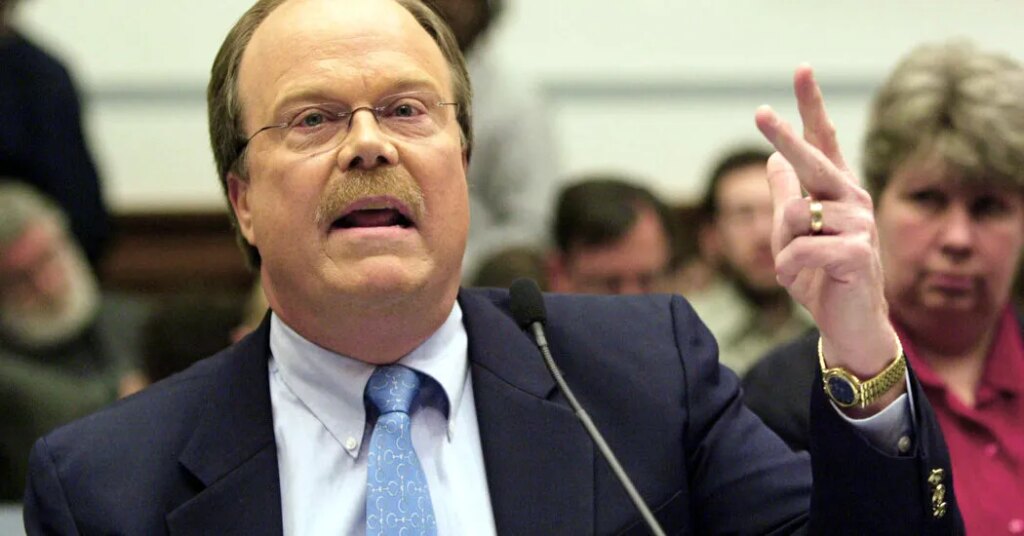
Then, on March 17, 2005, in a Congressional hearing room, the tide turned.
The slippery testimony that day by some of baseball’s biggest stars — Mr. McGwire, Sammy Sosa and Rafael Palmeiro — only worsened baseball’s public-relations nightmare.
But it was the impassioned testimony from a lesser-known witness, Donald Hooton Sr., a grieving father from Texas, that resonated beyond baseball.
Mr. Hooton’s son Taylor, a high school pitcher, had hanged himself two years earlier, after several months of taking steroids that he hoped would make him bigger.
Mr. Hooton put some of the blame for his son’s and many other teenagers’ use of the drugs on professional athletes.
“Players that are guilty of taking steroids are not only cheaters — you are cowards!” Mr. Hooton told the House Committee on Government Reform, which was investigating the use of performance enhancing drugs in Major League Baseball.
“You’re afraid to step on the field to compete for your positions and play the game without the aid of substances that are a felony to possess without a legitimate prescription,” he said, “substances that have been banned from competition at all levels of athletics.”
He added, “What message are you sending our sons and daughters? That you’re above the law? That you can continue to deny your behavior and get away with it? That somehow you’re not a cheater unless you get caught?”
Another parent, Denise Garibaldi, also testified that day, about her son Rob, who died by suicide after using steroids.
A few days after the hearing, baseball’s commissioner, Bud Selig, called Mr. Hooton at his home in Plano, Texas. He told Mr. Hooton that he had been moved by his testimony.
“It broke my heart,” Mr. Selig told The New York Post in August 2005, when he announced that Major League Baseball would pay $1 million over two years to be a founding sponsor of the Taylor Hooton Foundation for Fighting Steroid Abuse. In all, M.L.B. has contributed $8.5 million to the foundation.
Mr. Hooton started the nonprofit in 2004 to educate young people, including athletes, as well as the adults who influence them, about the dangers of performance-enhancing drugs, including steroids, human growth hormone and dietary supplements.
The foundation’s small staff delivers some 200 programs a year at middle schools, high schools and colleges; at M.L.B. ballparks with the Professional Baseball Athletic Trainers Society, and to law enforcement officers who work at schools, according to Don Hooton Jr., Taylor’s older brother and the foundation’s president.
It also collaborates with Major League Baseball — players from its 30 teams sit on the foundation’s MLB advisory board — on public service announcements that appear in team programs. The Yankees have held 16 Give a Hoot Benefits in a suite at Yankee Stadium.
Under continuing Congressional pressure, baseball and the players’ union greatly stiffened its existing drug-testing program by increasing penalties for a failed steroid test to suspension for 50 games for a first violation, 100 games for a second and a lifetime ban for a third.
It brought some satisfaction to Mr. Hooton.
“No, I honestly didn’t think it would move that fast,” he told The Baltimore Sun after the drug-testing program was announced. “It’s a great step forward. I couldn’t be more pleased.”
Don Hooton Jr., said that his father was inspired to create the foundation by a line from Genesis: “You intended to harm me, but God intended it for good to accomplish what is now being done, the saving of many lives.”
Mr. Hooton died on Nov. 10 at his home in McKinney, Texas. He was 76.
Don Jr. said the cause was cancer.
Donald Milton Hooton was born on March 30, 1950, in Longview, Texas, and grew up mostly in Lafayette, La. His father, Claude, was an accountant for Exxon, and his mother, Mary Julia (Reinberger) Hooton, who managed the home, was a volunteer church bookkeeper before her marriage. One of Don’s cousins is Burt Hooton, who won 151 games with three M.L.B. teams in the 1970s and ’80s.
After earning a bachelor’s degree in business administration and economics from the University of Southwestern Louisiana (now the University of Louisiana at Lafayette) in 1972, Mr. Hooton began a sales and marketing career with telecommunications and technology companies, including Hewlett-Packard, where he was a director of worldwide marketing. He retired from corporate work to run the foundation.
A right-handed pitcher, Taylor was 16 when he began injecting himself with steroids in late 2002. A junior varsity coach had counseled him to get bigger and more muscular — Taylor stood 6-foot-1 and weighed 175 pounds — to better compete for a spot on the varsity team in his senior year. The coach didn’t tell him how to get bigger, but Taylor believed the best path was through steroids, which several of his teammates were using.
He soon developed telltale signs of steroid abuse: severe acne on his back; weight gain of about 30 pounds; puffiness in his face; and emotions including euphoria, aggression and depression.
Mr. Hooton said that he and his wife, Gwen, recognized the physical and emotional changes in Taylor but were unaware they could be related to steroid abuse.
While seeing a psychiatrist, Taylor confessed that he was using steroids and quit the drugs nearly two months before he died. But he fell into a depression that Mr. Hooton attributed to ending his use of steroids.
On July 15, 2003, when Taylor didn’t respond to his mother’s question about what he wanted for lunch, she found him hanging from a belt from his bedroom door.
When the police inspected Taylor’s room they discovered vials of steroids, as well as syringes and needles. An autopsy found the presence of two steroids in his system.
Mr. Hooton quickly delved into research to understand the connection between steroids and their side effects. “It was right there in black and white,” he recalled on a 2019 podcast on his foundation’s website.
Once he felt knowledgeable enough, he asked the principal of Taylor’s high school in Plano if he could speak to students and parents. In the school’s gymnasium less than two months after Taylor’s death, Mr. Hooton and a doctor addressed about 600 people in the gymnasium.
“Parents, I want you to imagine for a moment how horrifying it was to go through his room after the funeral and find his stash of needles and syringes,” Mr. Hooton said, according to The Dallas Morning News. “For some of you in this audience, this horrifying activity is going on in your homes right now.”
The article led to a whirlwind of media attention, which included a front-page report in The New York Times and a segment on CBS’s “60 Minutes II,” and invitations to testify to Congress.
In addition to Don Jr., and his wife, Gwen (Hopkins) Hooton, Mr. Hooton is survived by his daughter Mackenzie Hooton; four grandchildren, and his brothers James and Richard. In 2009, when Alex Rodriguez, then a Yankee, admitted that he had used steroids while playing for the Texas Rangers years earlier, Mr. Hooton said that news like Rodriguez’s was beneficial for his foundation.
“When it’s in the headlines, we get to talk to people,” he told The Kansas City Star. “As long it’s on the front pages, the public has some appetite for talking about this. As soon as it’s not on the front pages, nobody wants to talk about it anymore. It’s painful for the public, but this is reality.”
The post A Father Who Crusaded Against Steroids in Sports Has Died appeared first on New York Times.