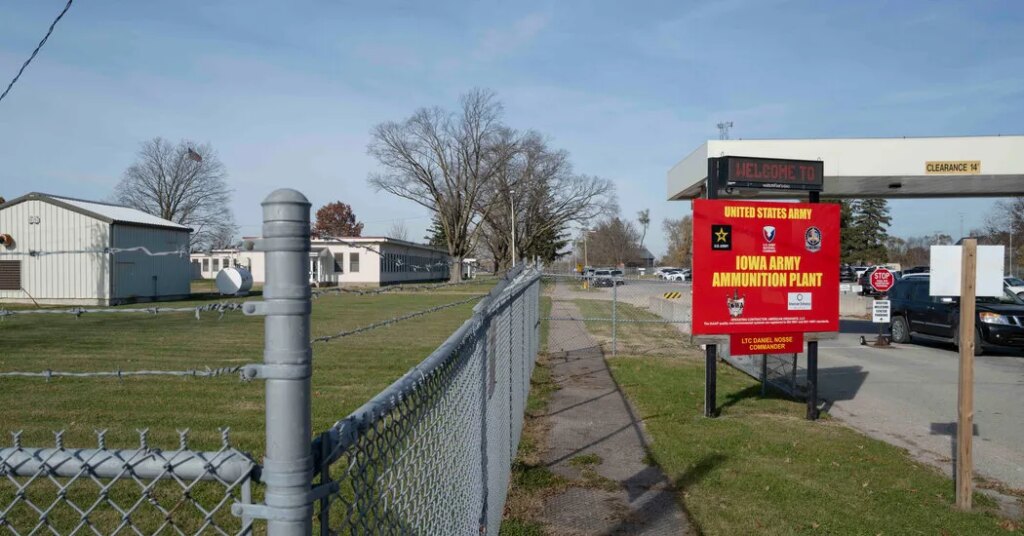
As the U.S. Army prepares to detonate a cache of dangerous chemicals in southeast Iowa, sending a plume of lead dust over miles of farms and homes across the region, new details have emerged about how the situation at a munitions storage facility deteriorated to the point of crisis.
The blast is now scheduled to occur on or by Tuesday, the Justice Department said in a court filing late Saturday night. The Army intends to invoke an “emergency exclusion” to federal law in order to proceed with the blast, according to the filing, despite an administrative stay issued by a federal court. Environmental groups have challenged the plan in court.
If the detonation moves to Tuesday, that would be a second delay in the plan to blow up the dangerously unstable material at the Iowa Army facility. Originally the detonation was set for last Friday, but then it moved to Monday after objections and concerns from environmental groups, elected leaders and many in the local community.
Whenever it occurs, the blast threatens to send a plume of toxic lead dust over residential areas, communities, farmland and rivers that could deposit lead in Iowa and neighboring Illinois, according to the latest plume estimates from National Oceanic and Atmospheric Administration. The direction of the plume could change with weather conditions.
The Army has said that it must act quickly because 68 drums containing more than 9,770 pounds of the explosive have become unstable and could blow up if moved.
The court filing included new details that shed light on how the situation at the Iowa Army Ammunition Plant in Middletown, Iowa, deteriorated to the point of crisis.
In a signed declaration accompanying the Justice Department filing, Col. Aaron C. Teller, commander of the 71st Ordnance Group and a senior Army explosive ordnance disposal officer, said that the plant’s contractor, American Ordnance, “historically does monthly visual inspections” of the areas where lead azide is stored. Company technicians also open the 55-gallon drums each September to check the levels of stabilizing solution, a mixture of water and ethanol, and add fluid as needed, according to the filing.
In April, Army personnel discovered crystallization on 58 of the 68 barrels, Col. Teller wrote. As a result, the barrels were not safe to open, and American Ordnance did not refill them with stabilizing solution in September, leading more to evaporate, according to Col. Teller. That made the material more susceptible to freezing, which he warned could lead to an uncontrolled “explosive chain reaction.”
Col. Teller said that temperatures in Middletown are “currently dipping below 30 degrees,” and the conditions “greatly increase the risk of an unintended detonation.”
In its filing, the government said that such an accident would be far more dangerous than a controlled blast. An unintended blast “could result in a random dispersal of explosive material” that risks a second spontaneous explosion.
“The real choice, in other words, is not between a detonation and no detonation,” the Justice Department wrote in its filing. “It is between a planned and mitigated detonation and an unplanned and unmitigated explosion.”
The Justice Department said that the blast doors to the bunkers housing the explosives have already been removed to prepare for the blast, and cannot be replaced, making the area where the lead azide is stored “more vulnerable” to temperature changes.
The controlled detonation will use a combination of bulk C4 explosives, shaped charges, and diesel fuel, Col. Teller said.
Michael Schmidt, general counsel for the Iowa Environmental Council, said the problem appeared to be significantly worse than the Army had originally shared.
“It appears that detonation may be, at this point, the only feasible option due to how long this problem was allowed to persist,” he said. “The public deserves to know immediately which communities will be impacted and how residents can most effectively protect themselves and mitigate impacts on their health and homes.”
Elected leaders in Iowa and Illinois have complained that the Army has not been transparent about the situation and gave the public just a few days’ notice for a release of toxic lead dust they fear could harm public health, farms and livestock.
In a signed declaration filed early Sunday morning by the law firm Earthjustice, which is representing environmental groups challenging the detonation permit given to the Army by the Environmental Protection Agency, Ranajit Sahu, a combustion expert, said that the detonation could release toxic hydrazoic acid and other volatile gasses, along with lead dust.
Dr. Sahu said that the “release of such dangerous chemicals and their impacts have not been fully assessed in planning for this detonation.”
“The Army seemed more concerned over the weekend with finding a way to sidestep the judicial process than doing what the public has been demanding: do better at being transparent and notifying potentially affected communities, and do much more to protect people, property, and the environment from serious harm,” said Thien Chau, an attorney for Earthjustice.
There is no safe level for exposure to lead, a neurotoxin, and it poses a particular danger to children and pregnant women. Lead can interfere with fetal brain development, cause permanent cognitive and behavioral harm and increase the risk of premature births or miscarriage.
For decades, the military has disposed of unneeded or unstable ordnance by blowing it up in the open air. It is also possible to heat it on site in specialized enclosed chambers. In recent years, chemical processes have been developed that can break apart explosives at the molecular level, neutralizing them. The resulting byproducts are typically nonhazardous and can be buried in landfills.
A January 2025 guide to detonation alternatives from the Environmental Protection Agency lists chemical neutralization as a valid treatment technology for lead azide. But the process can be slow and would take days or even weeks to treat the stockpile in Iowa.
The Army hired a company to chemically neutralize the lead azide earlier this year but canceled the contract two months later, citing safety concerns.
Hiroko Tabuchi contributed reporting from New York.
The post Court Filing Shows How Iowa Explosives Crisis Grew appeared first on New York Times.