THE PEN: A Human History, by Simon Garfield
Sigmund Freud’s fountain pen of choice was a Montblanc — a “safety pen” in which the nib, with a twist, could retract inside the barrel to prevent leakage. Make of that what you will.
Nowadays, when most of the writing we do takes place on a keyboard, an expensive fountain pen often functions principally as a status symbol — or, as Freud might note, a fetish object: more admired than used, perhaps part of a collection.
In “The Pen,” Simon Garfield sets out to tell us the story of this stylus from the Middle Ages to the present day. But what Garfield is most interested in — and sometimes guilty of — is this modern fetishization. The punchline to a typical anecdote here is a price tag: the 35-cent Bic Cristal; the Montblanc Orient Express, $2 million.
At its best, this formulation can be instructive: “The global pen industry is slightly larger than the global candle industry (about $18 billion in 2024 compared to the candle’s $14 billion).” Is it the pen’s inevitable fate, then, to follow the candle’s trajectory from indispensability to fallback for gifts and exigencies?
At other times, however, the numbers feel gratuitous, a distracting fascination with wealth itself. “The Pen” opens with a bizarrely irrelevant anecdote about the auction sale of an ancient manuscript. It was written with a reed pen, an implement that Garfield will soon inform us is beyond the scope of his present work. Still, he gives us the auctioneer’s voice and the bids ticking upward: “$2,400,000. Shall we try $2,450,000?”)
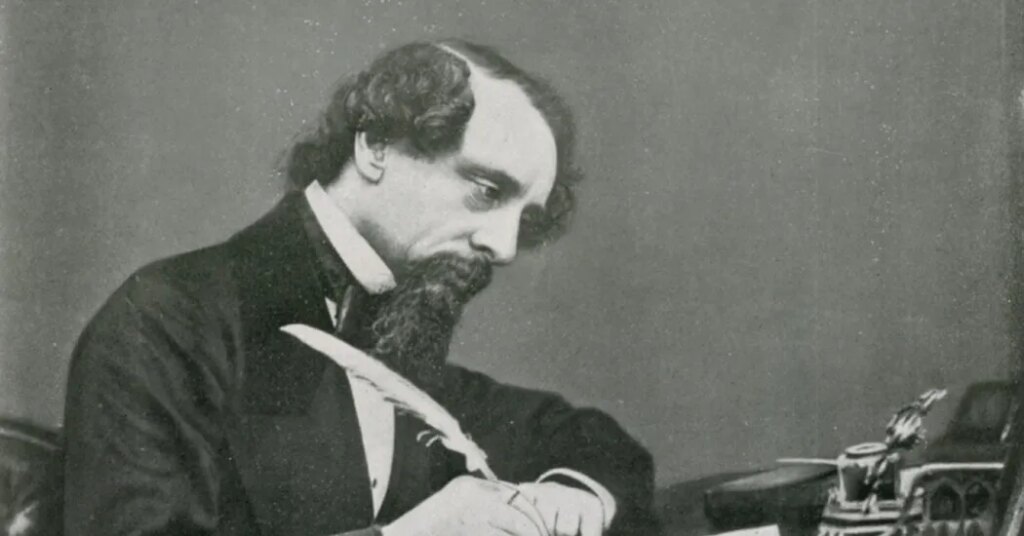
Our word “pen” comes from the Latin “penna,” meaning feather, and the goose-feather quill proved a remarkably enduring invention. Garfield tells us that the earliest image of a quill pen is found in an Italian mosaic portraying St. Matthew at his writing desk, dating from the middle of the sixth century. It was the quill that gave us the works of Chaucer and Shakespeare, the Declaration of Independence. Even Dickens, who died in 1870, wrote his entire oeuvre using a sharpened feather.
But he was an outlier. A new innovation — the steel nib — had become a commonplace during Dickens’s lifetime. Cheap, mass-produced and more durable and reliable than a quill, a steel-nibbed dipping pen was the first step toward the pens we recognize today.
In the final decades of the 19th century, a flurry of patents clustered around the same basic idea. Instead of dipping your nib into an inkwell every few words, a widened hollow body would contain a refillable reservoir of ink. The fountain pen was born. Kenneth Parker, whose sleek, Bauhaus-inspired Parker 51 was ubiquitous in the mid-20th century, memorably described the fountain pen’s operation as “a controlled leak.”
Over the last century, most refinements in pen design have been about making that leak more controlled. Pens that don’t leak on an airplane; pens that won’t leak in your handbag. But the technology is still far from perfect, as demonstrated by the recent viral video of an inky-fingered King Charles losing his temper at a signing ceremony (“Every stinking time!”).
Perhaps Charles should switch to a ballpoint. As an expression of good taste, he could certainly do worse: The Bic Cristal is a stone-cold design classic. Its hexagonal barrel mirrors the grip of a wooden pencil; the pinhole halfway up the shaft equalizes air pressure inside and out so that ink continues to flow; the eminently gnawable cap has a hole in the top — added in 1990 — to prevent choking if accidentally inhaled.
Since its debut in 1950, Bic has produced some 150 billion such pens. Garfield raises an eyebrow at how the company website pays lip service to environmental sustainability. Disposability, after all, is at the root of the company’s enormous success. Nevertheless, we users could be more conscientious ourselves: “We will not only fail to mourn a lost Bic, but we will rarely see the ink down to its lees.”
Garfield’s book has charm and anecdotes in spades. As a history, however, it is patchy and unpredictable. “The Pen” is concerned only with the quill, the fountain pen and the ballpoint. How the ancients wrote, or how pens have looked in non-Western cultures, is beyond Garfield’s purview; there are a few pages on the Sharpie — because of you-know-who — but without any broader history of the marker pen. The result is a book that is witty and personal but often frustrating.
In the course of writing this review, I carried a galley of “The Pen” with me for a few days, scribbling ballpoint notes in the margin as I read it in cafes, on the underground, at my desk. Once or twice, I thought of something I wanted to say while out walking, and I dictated a note onto my phone. After I’d finished note-taking, I began to organize my thoughts into sentences and paragraphs on my laptop.
The reason I mention all of this is that, for many of us, it’s quite natural to “write” in a number of different ways in the course of the same day — the same task, even. Sometimes technologies move not in a succession, like governments replacing or deposing the one that came before, but in a layering. The new way of doing things is an improvement in some, but not all, situations. An accommodation is reached. A pen is often more convenient than a laptop; a presidential signature — even in Sharpie — denotes a legislative authority that we are uncomfortable delegating to an autopen.
At a moment when A.I. agents offer to finish our sentences or respond to our correspondence for us, it’s hard to predict what the future of electronic writing will look like. But for shopping lists, margin notes, cards and letters, I’m confident that I’ll always have a biro in my pocket. After all, the pen is mightier than MS Word.
THE PEN: A Human History | By Simon Garfield | Crown | 294 pp. | $33
The post Mightier Than the Sword? A New Book Gives the Pen Its Due. appeared first on New York Times.