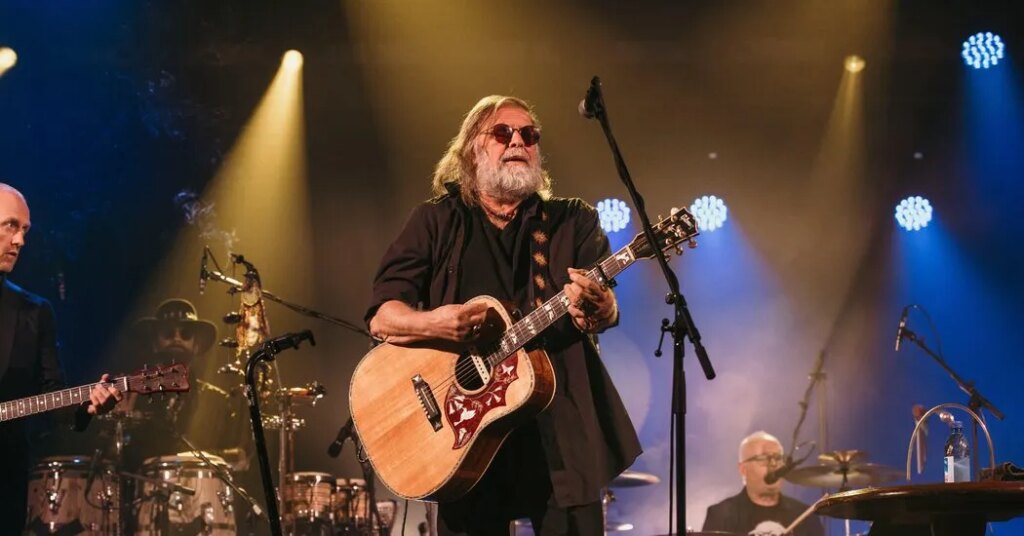
At one time, Boris Grebenshchikov was a god of underground rock.
It was in the 1970s and 1980s, in the Russian city then called Leningrad. Amid furtive concerts and fervent fans, the band he founded, Aquarium, created not only music but a lifestyle that existed slightly apart from the oppressive state.
“In the Soviet Union, all the world was an enemy and everyone was living poorly,” Mr. Grebenshchikov says in a new epilogue to “The Long Way Home,” a rollicking documentary about him from those years that was reissued last month on major streaming platforms in the United States and Europe.
“Aquarium was a way to say” no to that, he says in the film, using an expletive, and that “we are going to live like normal people regardless of what you are going to do to us.”
Fast-forward more than four decades. Mr. Grebenshchikov has evolved into what music critics describe as one of his country’s most original, magnetic, enduring musicians. He, like Russia, seems to have come full circle. Because of his outspoken criticism of the war in Ukraine — he has called its instigators “criminals” — he has been labeled a “foreign agent” and lives abroad. The state again banned his music.
“This is more than stupid, this is hysterical” and much tougher than in Communist times, Mr. Grebenshchikov said in an interview last month from his home in London. “We were fighting idiocy, but now it is not idiocy, it is a much more serious illness.”
The war has cleaved Russia’s artistic community. Right after the full invasion of Ukraine in 2022, about 17,000 musicians, painters, actors and others signed a pacifist petition, but criticizing the conflict then became professional ruin, at least domestically. Expressing antiwar sentiments can bring a 15-year prison sentence.
Mr. Grebenshchikov, 72, is among the rare superstars who have denounced the war in public and through their art. Dave Stewart, the singer-songwriter most famous as half of the Eurythmics, asked Mr. Grebenshchikov and a Ukrainian musician, Serhii Babkin, to collaborate on a song called Face to Face about a teenager naïvely going off to war. Each composed lyrics in his own language.
One of Mr. Grebenshchikov’s latest songs mocks a Kremlin propaganda line: “No one is forgotten, nothing is forgotten.” The slogan links the Ukraine war to revering the memory of World War II. “Nobody remembers that nothing is forgotten” is the song’s retort.
The musician has been chased through the Russian courts. Fines levied in absentia for the equivalent of more than $1,200 stem from various charges, including discrediting the military.
Mr. Grebenshchikov (pronounced greh-ben-SHIH-kov) was born in Leningrad to a father who designed ship instruments and mother who worked in fashion design. She appears briefly in the documentary, advising her grown son that his music should be wilder. He was an only child, and his life was transformed in the early 1960s when he caught three-second snatches of the Beatles on Western broadcasts jammed by the state.
He started writing and performing songs at his English-language high school and eventually switched to Russian lyrics. He enrolled in Leningrad State University to study applied mathematics, but his real interest was playing guitar and singing with friends.
Thus Aquarium was born. It was an acoustic folk band partly because electronic gear was unavailable, and it became what some critics call the most popular underground band of that era. Mr. Grebenshchikov has often been described as the Russian Bob Dylan, although he demurs at affirming the comparison.
In 1980 in Tbilisi, Georgia, at the Soviet Union’s first rock concert, the band performed an aggressive set that included punk rock, considered particularly abhorrent. Mr. Grebenshchikov lost his job at a state institution, and Komsomol, the Communist youth organization, expelled him. “I thought, If they exclude me from society, that makes me free,” he said.
Throughout the 1980s, the band experimented, ranging from folk to hard rock to blues reggae. The musicians earned a pittance for albums that circulated widely on underground cassettes.
In the late 1980s, under the “openness” policies of Mikhail Gorbachev, a couple of American music producers hunting for Russian talent found Mr. Grebenshchikov — a charismatic, eloquent, prolific singer-songwriter who spoke fluent English. He was also ruggedly handsome, with blue eyes, a long, ash-brown pony tail and a mischievous spirit.
In 1988, they convinced the Soviet government’s music agency that it could earn money by allowing Mr. Grebenshchikov to make an album in the United States.
“I am probably the first person ever who has been sent on a mission by the Soviet government and the mission is having fun, as much fun as you possibly can,” he told an interviewer at the time. “I want to do everything, I want to experience everything.”
The entire odyssey became “The Long Road Home,” which was filmed by Michael Apted, the British director famous for the “Up” series of documentaries as well as feature films. The documentary premiered in the United States at the Sundance Film Festival in 1990 but soon disappeared. The old version was remastered by Steven Lawrence, the original producer, from a grainy print.
The film catalogs in close detail how Mr. Grebenshchikov’s newfound freedom proved both exhilarating and disorienting.
He jammed with musicians whom he had idolized, like Mr. Stewart, Annie Lennox, Lou Reed and Chrissie Hynde. He and Mr. Stewart, who produced the album, worked out of a small house in Los Angeles, seeking to record music completely different from his previous work.
Tensions ratcheted up as the deadline for the recording approached and Mr. Grebenshchikov wrestled with working in a music studio, something new. Being filmed constantly added to the pressure.
The resulting album, Radio Silence, contained slicker, more electronic rock than his earlier music. He performed the hard-driving title song on David Letterman’s show. Both the song and the album made the charts, although they were not smash hits. “It was fine, but it was not a masterpiece,” Mr. Grebenshchikov said in the interview from London.
Music executives abandoned the idea of transforming Mr. Grebenshchikov into a crossover star. “They wanted him to be the Bruce Springsteen of Russia,” Mr. Stewart said in a recent interview. “He just wasn’t that person.”
Western audiences initially found Soviet bands exotic, but they lost interest after discovering that the music was somewhat mainstream, Alexsandr Gorbachev, a music journalist and editor at Novaya Gazeta Europe newspaper, said in an interview last month.
Back home, some fans were intrigued but many were alienated. Followers had long covered the stairwell of Mr. Grebenshchikov’s Leningrad apartment building with messages like “You were sent to us by heaven.” After he came back, the notes were less worshipful: “Boris, you betrayed us, go back to your stinking America.”
The epoch depicted by the movie might be compared to the Woodstock era for Americans — a moment in time, with a particular spirit, that disappeared when the world changed.
Aquarium eventually disintegrated, riven by artistic differences, vying over women and newfound public stardom.
Mr. Grebenshchikov toured Russia on his own and then released “The Russian Album,” which critics hail as a masterpiece. The songs explored dark folk tales and the mystical side of the Russian Orthodox Church, incorporating traditional instruments like the accordion. The album was a metaphor for Russians’ searching for their post-Soviet identity, Mr. Gorbachev, the music journalist, said.
Some of Mr. Grebenshchikov’s phrases, drawn from his lyrics, have entered everyday language. Russians will interject “Rock ‘n’ roll is dead, but I am not” into a conversation, for example, to mean that life endures amid the struggle.
Mr. Grebenshchikov left Russia on a previously scheduled flight a day after President Vladimir V. Putin invaded Ukraine. He had already shifted his base to London from St. Petersburg, seeking to play with more varied musicians.
Married three times, with four grown children, he became a British citizen this year, making travel much easier for his roughly 60 concerts per year and decreasing the risk of arrest. From Istanbul to Riga to Chicago, he plays to countless fans who have fled Russia. For those still there, he regularly posts new songs on Instagram.
A heart attack a couple of years ago slowed him a little, but the spirit that first inspired Aquarium has not faded. As he says at one point in the movie, “I don’t think the need to rebel will ever go away.”
Alina Lobzina contributed reporting from London.
The post A Russian Rock Musician With a ‘Need to Rebel’ appeared first on New York Times.