The downfall of Jensen Huang following revelations of extramarital affairs—including one involving a suspected Chinese spy—and the turmoil that has engulfed Nvidia in its wake have gripped the world’s attention over the past week.
Given their national AI ambitions are strongly tied to investments in Nvidia and access to its coveted chips, Gulf countries will be vulnerable to any dramatic changes in its future strategy.
During U.S. President Donald Trump’s Gulf tour in May 2025, the UAE unveiled plans to develop a 5-GW joint AI Campus in Abu Dhabi. Once complete, it will be the largest facility of its kind outside the U.S. At the heart of the project is Stargate UAE, a 1-GW computing cluster developed by Abu Dhabi-backed G42 in partnership with a host of U.S. companies, including Nvidia, which will supply its Grace Blackwell chips (GB300s).
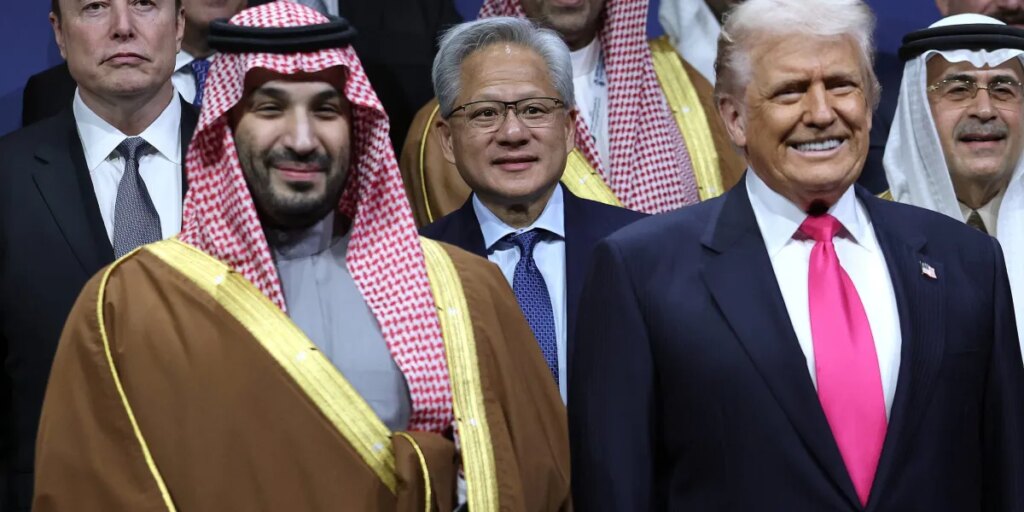
Nvidia has also forged a strong commercial alliance with Saudi Arabia, with Huang among a select group of U.S. tech leaders invited to meet with Saudi Crown Prince Mohammed bin Salman during his much-feted visit to the White House last November.
During the visit, Elon Musk announced a 500-MW data center in partnership with Saudi government-backed AI company, Humain, which will be powered by Nvidia’s computing chips.
Trump also hosted Mohammed bin Salman, alongside Huang and Elon Musk, at the U.S.-Saudi Investment Forum on November 19 last year.
Just hours later, the U.S. Commerce Department authorized the export of up to 35,000 Nvidia Blackwell GB300 chips to both G42 and Humain. Earlier in the day, Humain said it planned to purchase 600,000 Nvidia AI chips.
This relationship was deepened last month when Humain announced plans with Nvidia to deploy around 27,000 GPUs and develop up to 84-MW of AI computing capacity in the kingdom across a multi-phase program starting in the fourth quarter of this year and followed by planned large-scale deployments beginning in mid-2027.
The existing partnerships Nvidia holds with the UAE and Saudi are unlikely to be threatened by Huang’s departure, according to Mohammed Soliman, senior fellow at the Middle East Institute, where he focuses on technology and geopolitics, but it could weaken the relationship’s momentum.
“The relationship with Nvidia is pretty solid and institutional at this point,” he said. “The deals with G42 and Humain sit on government-to-government agreements that were already in place. That said, Jensen matters a lot and his leaving will have an impact. The overall direction doesn’t change, but losing him as the main driver takes something off the table.”
Sam Winter-Levy, a senior fellow in the Technology and International Affairs program at the Carnegie Endowment for International Peace, expects that the change in leadership at Nvidia could make the company more circumspect in its business dealings with the Gulf.
“Huang was the public face of Nvidia’s sovereign AI pitch and had his own relationships with Gulf leaders, which will be hard to replace quickly,” said Winter-Levy, whose research focuses on the geopolitics of AI.
“I would assume Nvidia will honor its existing contracts with the Gulf, probably with more attention to compliance and things like end-use checks, but to make fewer splashy announcements of new deals.”
In July, Washington relaxed export restrictions on the UAE, granting approved organizations greater access to Nvidia chips and other advanced technologies.
For Gulf governments, a more immediate concern is whether the upheaval at Nvidia could make Washington more reluctant to approve further exports of advanced chips, thereby slowing the pace of the region’s AI buildout.
The upheaval has given U.S. lawmakers fresh ammunition to push for the inclusion of a series of chip-control bills, such as the AI Overwatch Act, the Chip Security Act and the MATCH Act, in this year’s National Defense Authorization Act (NDAA).
Last week, Senate Democratic leader Chuck Schumer urged Congress to pass the bills, while House Select Committee on China Chairman John Moolenaar called for chip export controls to be included in the annual defense policy bill.
“Congress has limited direct power here, since export licenses lie with the executive branch, and the administration has removed many of the license requirements that slowed chip deliveries to the UAE in the past,” said Winter-Levy.
“But oversight raises the political cost of new Gulf deals, and Congress can attach conditions such as chip location verification to new bills like the NDAA.”
Chip location verification is a technical and regulatory method used to track the physical location of advanced processors—such as GPUs—to ensure they do not get smuggled or diverted to restricted countries.
However, on Monday, the U.S. Department of Commerce’s Bureau of Industry and Security issued an interim rule that requires licences for global transfers of AI chips and servers to data centers worldwide.if the equipment could be used by 22 embargoed countries which includes China. The move aims to close a loophole that has allowed Chinese companies to lease Nvidia’s computing power from locations in other countries.
“The new remote access rule primarily affects Gulf companies if they are renting large amounts of compute to Chinese-parented firms, but otherwise does not fundamentally change the situation for the UAE,” said Winter-Levy.
“It does, however, signal that the administration is increasingly prepared to crack down on chip diversion and remote access if it becomes politically salient enough.”
Looking ahead, it seems increasingly likely that the Gulf will become more vulnerable to U.S. export controls given that, even before Huang’s abrupt departure, Democratic lawmakers had already pushed back against what they viewed as its preferential treatment. They frequently cited fears that China could access sensitive U.S. technology through the Gulf.
“There will probably be more political noise out of Washington that could slow some deliveries or stretch timelines,” said Soliman.
However, the region’s growing role in financing and supporting America’s AI infrastructure could also give the region some leverage in return, according to Winter-Levy.
“The dependence isn’t entirely one-way,” he said. “Gulf capital is now part of the American AI buildout, which gives them some leverage. And if U.S. companies come to rely on large quantities of compute housed in the Gulf, that will give the Gulf a degree of leverage over those companies. But the asymmetry is large, since Washington can slow the Gulf’s AI plans with a regulatory notice.”
Ultimately, Nvidia’s upheaval is unlikely to derail the Gulf’s AI ambitions, but it exposes just how dependent those ambitions remain on decisions made in Washington and Silicon Valley.
The UAE and Saudi Arabia have invested heavily in positioning themselves as global AI powerhouses, but their ability to deliver on those plans hinges on continued access to U.S. technology and political goodwill.
As scrutiny of chip exports intensifies, the challenge for both countries will be to maintain their strategic partnerships while reducing their exposure to shifting U.S. political priorities. For the Gulf, the question is no longer simply whether Nvidia can deliver the chips, but whether Washington will continue to let them.
The post Does the Nvidia turmoil spell trouble for the Gulf’s AI ambitions? appeared first on Fortune.