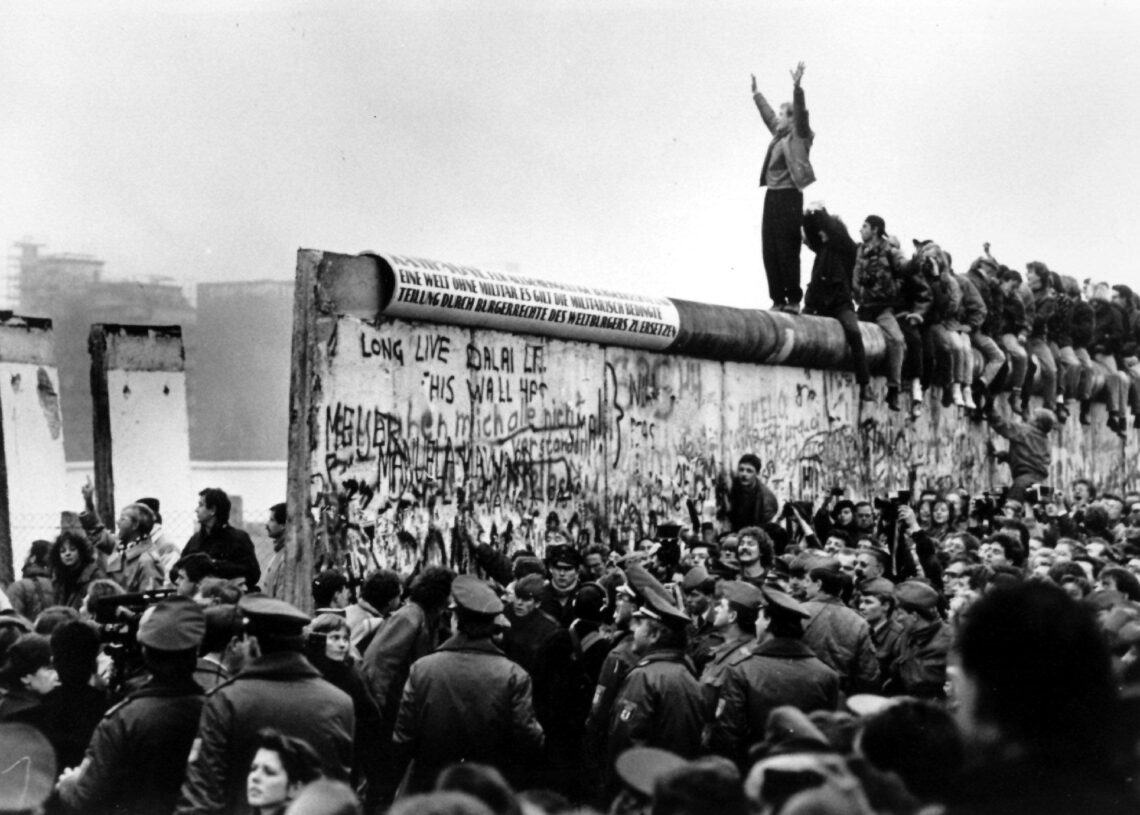
The agenda for the East German government’s daily news conference on the evening of Nov. 9, 1989, included the results of a recent vote by the ruling communist party, the removal of two officials from a regional committee and planned electoral forms.
But shortly before spokesman Günter Schabowski faced reporters at the International Press Center, Egon Krenz, the leader of East Germany’s communist party, handed him a memo.
Party leaders, under growing public pressure, had agreed to ease the Cold War restrictions that had prevented most East Germans from traveling to the West. Citizens would be allowed to leave the country without being required to prove a family emergency or other urgent need. The government would begin accepting applications the following morning.
Schabowski had not been part of the discussion and had not been briefed. Nevertheless, near the end of the hourlong news conference, broadcast live to a radio audience, he read the details of the note aloud.
Asked when the policy would start, he paused, and shrugged.
“To my knowledge,” he said, “this takes effect … immediately … without delay.”
Communism had already fallen that year in Poland and Hungary; in East Germany, a growing protest movement was demanding “an open country with free people.”
Now, on hearing Schabowski’s words, tens of thousands of people surged toward the Berlin Wall. At the Bornholmer Straße border crossing, Stasi Maj. Harald Jäger had a decision to make.
Officially the Anti-Fascist Protection Rampart, the 100-mile barrier that encircled West Berlin inside East Germany, was the embodiment of the Iron Curtain that divided communist Eastern Europe from capitalist Western Europe.
When the East German government built it in 1961, officials said it was necessary to keep out Western spies, and to prevent West Berliners from coming to buy goods in East Berlin at state-subsidized prices.
Its real purpose was to stanch the flow of professionals and skilled workers from East to West. Soldiers in watchtowers fired on East Germans who tried to breach it. At least 140 people, from Ida Siekmann, a 58-year-old nurse in August 1961, to Winfried Freudenberg, a 32-year-old electrical engineer in March 1989, died in the attempt.
For 28 years, Western politicians pointed to the wall as a symbol of Soviet bloc repression. West Berlin Mayor Willy Brandt, a future West German chancellor, called it the “Wall of Shame.” President John F. Kennedy, expressing solidarity with the city in 1963, declared “I am a Berliner.” President Ronald Reagan, at the Brandenburg Gate in 1987, addressed himself to the Soviet premier: “Mr. Gorbachev, tear down this wall.”
Jäger, the ranking officer at the Bornholmer Straße crossing 37 years ago Monday, had been listening to the news conference while breaking for dinner. When he heard Schabowski’s impromptu announcement, he later told his biographer, he nearly choked on his sandwich.
There had been no update to the standing orders: “Trespassers” were to be captured or eliminated. But now thousands of people were at Jäger’s crossing, one of nine in the wall, pushing to get through.
Concerned they would be crushed and refusing to order lethal force, he directed guards to begin processing individuals to pass. When that didn’t ease the pressure, he opened the gate.
Over the next hour, an estimated 20,000 people streamed unchecked from East to West. Other border crossings followed, standoffs giving way to celebrations. West Berliners welcomed East Berliners with champagne, flowers and joy. It was a Thursday evening; the revelry lasted through the weekend.
The fall of the Berlin Wall was a turning point in the collapse of communism in Europe. It was the domino theory in reverse: After East Germany came Bulgaria, Czechoslovakia and Romania. The Soviet Union itself dissolved in 1991.
The barrier would be dismantled and city streets reconnected. Within the year, Germany would reunify, with Berlin once again its capital.
Photo Almanac is an occasional series from The Washington Post using photo archives to examine where we’ve been to understand where we are.
The post The two East German officials who accidentally brought down the Berlin Wall appeared first on Washington Post.