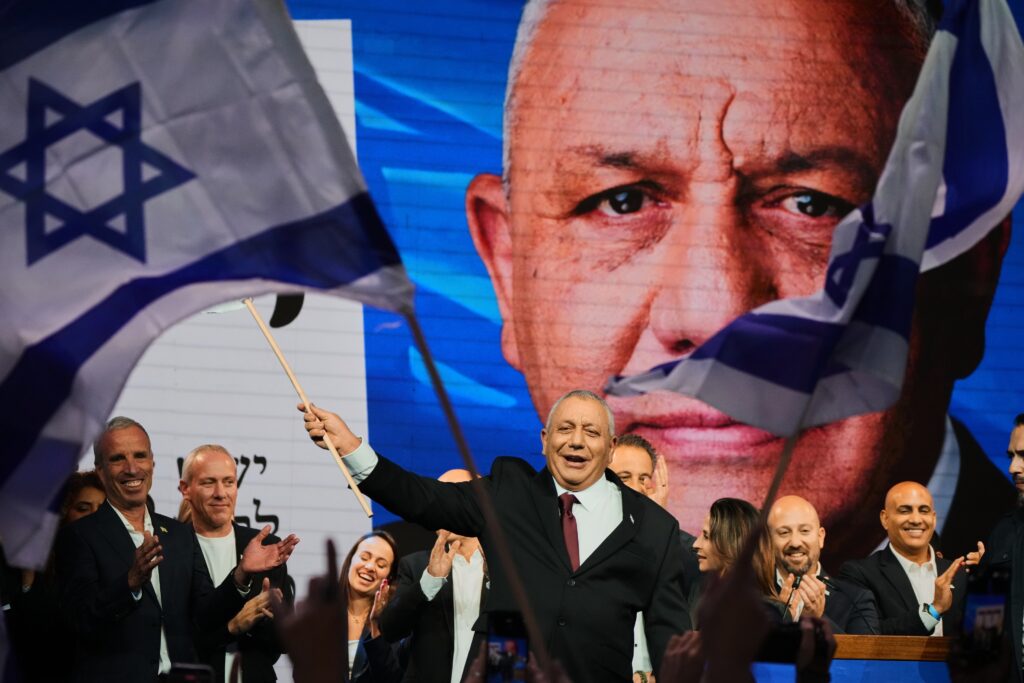
JERUSALEM — As he seeks to crack the complicated math of building a new Israeli government coalition that will oust Prime Minister Benjamin Netanyahu, ex-military chief Gadi Eisenkot is eyeing a potentially controversial alliance with ultra-Orthodox Jewish parties.
A deal with the ultra-Orthodox would bring a sea change to Israeli politics. And the push for it shows the bloc led by Eisenkot, a centrist security hawk known as a pragmatic battlefield tactician, seeking every option to avoid a potentially even more controversial partnership with Arab parties.
For more than a decade, the ultra-Orthodox — many of whom reject secular jobs, military service and even the Zionist concept of a Jewish state — have backed the right wing led by Netanyahu in exchange for state financing of their seminaries and exemptions from the draft.
Now, Eisenkot and his allies are exploring whether they could flip the support of the ultra-Orthodox, also called Haredi, by reaching a deal on military conscription. It is a politically risky move after the ex-general spent months on the campaign trail vowing to enlist Haredi men.
Religious exemption from military service is one of the most divisive and emotional issues in Israeli society, especially after the Oct. 7, 2023, attack by Hamas, with the Israel Defense Forces and many families with service members saying they are stretched to a breaking point.
As he accepted the mandate from Israeli President Isaac Herzog to form a new government on Sunday, Eisenkot reiterated that he would welcome the support and partnership of every parliamentary faction that accepts his four conditions, which include mandatory service for all.
But he also hinted that compromises might be necessary. “We must form a national emergency government,” Eisenkot said in a speech at the president’s residence. “This will require creative and unconventional political steps.”
Those unconventional steps could include a carefully worded deal on a universal draft law that would be palatable to ultra-Orthodox religious leaders, who view military service — and integration with secular Jewish society — as a threat to dedicated religious study and their way of life.
At the urging of Haredi leaders in 1948, Israel’s first prime minister, David Ben-Gurion, agreed to exempt 400 yeshiva students from military service so that they could focus on preserving Jewish religious tradition in the wake of the Holocaust.
Over the decades, the number of Haredi men skipping army service ballooned. In May, the IDF’s workforce division chief, Brig. Gen. Shay Tayeb, said that 90,000 Haredi men were eligible to serve but not enlisted while the military faced a shortfall of 12,000 soldiers.
Political observers say that Eisenkot’s bloc could offer to pass legislation that requires universal mandatory service but sets an age limit, so that yeshiva students in their mid-20s do not have to join the military.
Other options include waiving a strict quota for Haredi enlistment or softening some punishments for draft evasion, which include arrest and imprisonment.
Whatever the deal, analysts say, Eisenkot could seek to entice the ultra-Orthodox to join his coalition while still making the case to his base that he is fulfilling his promise to crack down on “draft dodgers” supported by Netanyahu.
“If there’s a deal to be had, the devil’s going to be in the details,” said Shalom Lipner, a senior fellow at the Atlantic Council in Jerusalem and former Israeli government official.
Lipner noted that the talk of the two Haredi parties, United Torah Judaism and Shas, about abandoning Netanyahu reflected his weakening grip on power.
In Herzog’s consultations last week with party leaders, United Torah Judaism abstained from making a recommendation about who should lead coalition talks — a blow to Netanyahu.
For years, the relationship between Netanyahu and the ultra-Orthodox proved “symbiotic” because the prime minister dominated Israeli politics and the ultra-Orthodox “were plenty happy to continue working with Netanyahu and pressing their demands within his coalition,” Lipner said.
“But,” he added, “they read the tea leaves and saw his chances of coming back with a majority were slimmer and slimmer.”
Immediately after the Oct. 27 election, most attention was trained on the possibility that Eisenkot would turn to the Arab parties, which won a record number of 19 seats in the Knesset, to form his government.
Forming a majority government requires 61 seats. Eisenkot and his bloc won 48 in all.
But the trajectory of talks shifted in recent days after Israeli media reported that an Eisenkot ally, Avigdor Liberman, had already spent months holding secret meetings with ultra-Orthodox parties about a possible compromise.
The revelations were surprising because Liberman, a hawkish former defense minister, was long seen as a staunch backer of the Israeli military and a critic of the Haredim, and he faced an immediate backlash.
It is also not yet clear if Liberman’s outreach could strain his relations with Eisenkot, who had appeared inclined to pursue collaboration with Arab parties instead. Liberman has opposed partnering with the Arab parties.
On Sunday, a day before he was set to meet Eisenkot for further coalition talks, Liberman defended his shifting stance in a lengthy post on X.
“Being willing to compromise does not mean abandoning values and principles,” Liberman said. “In the current circumstances, to prevent another election and put an end to the Netanyahu era, there is no choice but to make difficult decisions and resolve issues where flexibility is possible and understandings can be reached.”
Yehoshua Pfeffer, a Haredi rabbi and the editor of an online journal on Haredi thought, said that the opposition bloc may have to absorb a hit with their voters to achieve its top goal of ousting Netanyahu.
“It’ll be walking back a lot of policy directives and a lot of their criticisms of the right,” Pfeffer said. “But at the same time, if the main objective is to replace Netanyahu, then perhaps these parties are willing to go far.”
The post Israeli opposition eyes deal with ultra-Orthodox Jewish parties to oust Netanyahu appeared first on Washington Post.