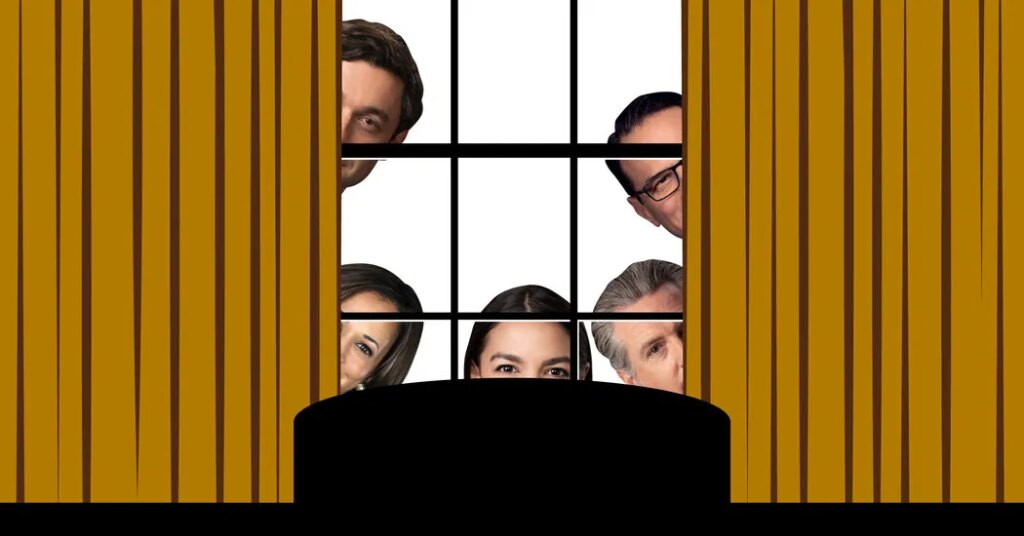
Although the contest for the Democratic presidential nomination in 2028 began well before last week’s elections, it now enters a new, accelerated phase. And the party’s phenomenal midterm success indisputably changes what comes next. While the field of contenders was always going to be populous, given the absence of any clear front-runner, the midterm wave will probably make it even larger, with sharper disagreements among those aspirants.
That’s because Democrats just won by such huge margins in so many different places and in so many different ways that any and every would-be presidential candidate can selectively parse the results to claim validation for his or her demographic profile, temperament, experience or ideological leanings.
Some politicians have already generated more speculation than others, and below I look at an incomplete bunch of them, chosen because their fates, should they run, depend on dynamics that will be crucial in the race and that bear close attention. In no particular order:
Kamala Harris: Will she even throw her hat into the ring? Many party insiders say no. But due in significant part to her superior name recognition, she placed first in many early polls of Democratic voters. And she’d be the only possible nominee with the experience of playing that grueling part before.
I think many Democratic leaders and voters will regard her as a painful look backward — to the deceptions about President Biden’s fitness and the clumsy rush to replace him — when they’d prefer to look forward. But another question hovers over her. Will Democrats want to nominate a woman again?
When Harris lost, more than a few pundits, analysts and strategists pointed to sexism as a primary reason (as many observers had also done eight years earlier vis-à-vis Hillary Clinton). They insisted that Harris had run a good race. They noted Donald Trump’s enormous vulnerabilities. But they said that those advantages were blunted by her gender.
If so, shouldn’t they want the party to steer clear of a female nominee in 2028? And shouldn’t any voters who believed them feel the same? The answers would affect not only Harris but also Representative Alexandria Ocasio-Cortez of New York, Senator Elissa Slotkin of Michigan and others.
My own view is that every candidate is different, every race peculiar and every moment unique. Harris had shortcomings galore. And last week’s results — which included victories by Democratic women in the governor’s races in Texas, Ohio and Georgia — demonstrated an openness to women trailblazers.
Gavin Newsom: Most of the smartest political analysts I know say that Newsom’s biggest problem is heavily regulated, highly taxed, crushingly expensive California, which he has governed for the past eight years. It’s the antithesis of affordability — an issue that powered Democrats’ midterm triumphs — and his rivals would have a field day with that.
But he contradicts the spirit of the midterms in an additional way. All around the country, voters seemed to be rebuking the nastiness, pettiness and mockery that President Trump modeled and that so many of his aides and acolytes imitated. Voters cringed at that vile ad that Vivek Ramaswamy ran against Amy Acton on his way to losing the Ohio governor’s race to her (and possibly dragging other Republicans in Ohio and elsewhere down with him). They rejected Republicans’ relentless smearing of James Talarico, a Christian seminarian who notched a sensational victory in the Senate race in Texas after a campaign in which he emphasized loving one’s neighbor. They rewarded Democrats who traded partisan vitriol for something gentler and for a focus on voters’ everyday problems.
Newsom has at times asserted himself as the dauntless Democrat who can summon the snark and spite to match the meanest Republicans insult for insult and meme for meme. But might Democratic voters prefer a leader who can credibly pledge to make America civil again?
Pete Buttigieg: No Democrat is a nimbler thinker or more fluent communicator, and those attributes, along with the youthful optimism about America that he often radiates, have won him legions of devoted admirers. In 2020, he came from nowhere to win the Democratic caucuses in Iowa and to place a close second to Bernie Sanders in the New Hampshire Democratic primary.
But he never caught fire with Black voters, who are an essential Democratic constituency — the midterms demonstrated that as well — and who will be hugely important in 2028, when the new primary calendar puts the first contest in South Carolina, where Black voters resurrected Joe Biden’s beleaguered candidacy in 2020. It’s hard to imagine anyone becoming the nominee without significant Black support, a dynamic that could improve the chances of, say, Senator Raphael Warnock of Georgia.
That new calendar puts Nevada second and New Mexico fourth, perhaps elevating the sway of Latino voters. That, too, could affect certain candidates’ prospects. Gov. Andy Beshear of Kentucky, the current head of the Democratic Governors Association, rankled some Latino leaders by not directing more midterm money toward such candidates as Gina Hinojosa, who won Texas anyway. On the other hand, Democrats’ successes in governor’s races in general reflect favorably on Beshear.
Ocasio-Cortez: No potential 2028 candidate has been more fascinating to watch over the past year. She worked hard to promote progressive candidates, putting particular muscle behind the successful Senate bid of Abdul El-Sayed in Michigan, and collected a whole bunch of chits. But she simultaneously made all sorts of statements and gestures to moderate her image and send a signal to centrists that her views aren’t doctrinaire and her tent is big. She’s savvy beyond her years.
But, ah, those years. Aren’t that many of them. She’s 37 now and would be 39 when the next president is inaugurated. Too young for voters’ comfort? Or an emphatic repudiation of the Democratic gerontocracy and a powerful symbol of generational change — which many midterm results also seemed to endorse? The measures of seasoning or freshness that voters prefer could boost or diminish any bids by members of the younger crowd: Senator Jon Ossoff of Georgia, 39; Buttigieg, 44; Beshear and Gov. Wes Moore of Maryland, both 48. Ditto for possible contenders who are over 60, including Gov. JB Pritzker of Illinois, 61; Harris, 62; Senator Mark Kelly of Arizona, 62; and Rahm Emanuel, 66.
It’s interesting to imagine Pritzker and Ocasio-Cortez squaring off. They would be separated not only by a nearly 25-year age difference but by also by economic station. She was working as a waitress and bartender just before she was first elected to Congress in 2018; he’s an heir to the Hyatt hotel empire who’s worth more than a billion dollars. How much will such attributes matter at what seems to be a time of rising economic populism?
Ossoff: As he focused on winning re-election to the Senate — which he just did, by an impressive 18-point margin — he proclaimed “zero interest” in a presidential campaign. Polymarket doesn’t believe him: As of Friday afternoon, it placed him atop the potential Democratic field, with a 27 percent chance of winning the party’s nomination. I promise you that he’s powerfully tempted to run.
And he emerged over the past year as one of the Trump administration’s most effective detractors. But the race for the Democratic presidential nomination won’t be about neutering Trump, now a lame duck quacking into the void. Who among the president’s sharpest critics can become the sharpest architects of a Democratic vision for the future? That’s a different task, a separate skill that some potential candidates haven’t yet honed. An exception: Emanuel, who, for better or worse, has spent the past two years giving speeches and writing opinion essays that lay out what his policy agenda would be.
Ro Khanna. The 50-year-old House member from California has, like Emanuel, been more detailed than some of his peers about where he thinks the country should head and how it should address Americans’ economic frustrations. He, too, is a geyser of oratory and essays.
But something else about Khanna catches my eye and speaks to an important variable in any presidential election: Which Democrats can fold the agenda they put forward into a succinct and accessible narrative that stirs feelings as it kindles thoughts? Khanna seems acutely conscious of the need to do that, as he showed with his leading role in demanding the release of files related to Jeffrey Epstein. He cast the Epstein case as emblematic of rich, powerful elites doing as they pleased and evading accountability — and he turned that into a metaphor for many of government’s failings.
Josh Shapiro: The Pennsylvania governor, 53, should be formidable. He was just re-elected — by a staggering 22 points — in the nation’s most populous battleground state, which Trump won in 2024. He’s bright, measured, sensible.
But his obvious presidential ambitions are hostage to two forces perhaps more consequential than his virtues. As Democrats move on from the midterms, will the party’s progressives or moderates come to the fore? Shapiro has presented himself as a proud, practical-minded consensus builder who eschews extremes.
And how important will a candidate’s views of Israel be? In both political parties, there are voters more insistent than ever that America downgrade its alliance with Israel. But Shapiro, who has written and spoken extensively about the importance of his Jewish faith, takes a less censorious, more nuanced position. That might not be a big obstacle in the general election, but Democratic primaries are a different matter.
Forward this newsletter to friends …
… and they can sign up for themselves here. It’s published every Monday.
For the Love of Sentences
In Rolling Stone, Matt Bai traced Republicans’ woes to their leader’s exceptionalism: “Trump is the only president in our lifetimes to be placed at the helm of a fundamentally seaworthy economy and immediately chart a course for the nearest field of icebergs.” (Thanks to Tom Shpetner of Stanfordville, N.Y., and Judy Trujillo of San Jose, Calif., for nominating this.)
In a letter to the editor of The Boston Globe, Mary Skorczeski linked voters’ Democratic turn to Trump’s insatiable need for attention: “What happens when you suck the oxygen out of the room for 10 years? People turn blue.” (Michael Smith, Georgetown, Ky.)
In The Atlantic, Helen Lewis provided her own analysis of Trump’s implosion: “The lesson that Trump took from his popular-vote win in 2024 was that he could do whatever he liked — that what voters wanted was Maximum Trump, the full-fat version of the pallid Diet Trump he was forced to be in term one.” She also reacted to the outcome of key midterm Senate races: “How about Georgia? There, the Democrats had Jon Ossoff — the closest a white person will ever get to being Barack Obama.” (Lynda Love, Denver, and Bob Stein, Downingtown, Penn., among others)
Also in The Atlantic, Alexandra Petri imagined a wounded MAGA stalwart’s reaction to what just happened and to what, with Democrats in charge, comes next: “Each city is being issued its own Mayor Zohran Mamdani; check your bus or train schedules (the only permissible forms of transportation) to see when yours will arrive. Go quietly to turn in your guns and flannel; one will be destroyed and the other will be redistributed to people with Subarus. In Blue Texas, people must now shout ‘Remember the Alamo — in its proper historical context,’ and ‘Lonesome Dove’ is being rereleased as ‘Dove Involved in Community Organizing.’” (Howard Caro, San Francisco, and Corrie Sias, San Rafael, Calif. among others)
In The Toronto Star, Justin Ling characterized the midterm results as a “productive cough for democracy in the United States.” (Amy Brown, Wilmington, Del., and John Rapos, West St. Paul, Minn.)
In The Times, Shawn McCreesh recounted Trump’s decision, on the day after voters rebuked him, to give a tour of the ballroom he’s constructing: “Inside his concrete chrysalis, everything was still beautiful.” (Katheryn Doran, Clinton, N.Y., and Barbara Sloan, Conway, S.C.)
Also in The Times, Michelle Cottle looked ahead: “Expect Mr. Trump’s relations with Congress next year to make the partisan hostilities of his first term look like a meditation retreat.” (Sharon Gold, Manhattan)
In SFGate, Jessie Fisher explained why many Americans might want to escape into exotic subcultures and magical thinking: “There is plenty to be unsettled by, and precious little to take comfort in. Wars rage overseas, cars are robots, and the barista would like to know if you’d care to tip 30 percent.” (Mark Renner, Alameda, Calif.)
In The Washington Post, Ashley Fetters Maloy remarked on the widely circulated images of Pope Leo, who was dressed all in white, meeting Bob Dylan, who was eerily hooded and dressed in black: “Together, the pair looked uncannily like the duo you don’t want to see at the end of your hospital bed.” (Susan Savia, Wilmington, N.C., and Matt Bai, Bethesda, Md.)
In The New Yorker, Nick Paumgarten surveyed the construction of colossal houses and other “displays of extreme wealth” in Lake Tahoe: “The tech billions flow uphill from the Bay Area. The hills are alive with the sound of nail guns.” (Patricia Cose, Nanuet, N.Y.)
On the VinePair website, Andi Burrows defended his delight upon spotting Hpnotiq — with its flamboyant color and tropical fruit flavors — on the shelves behind the mixologist stirring his cocktail: “A bottle of radioactive blue liqueur sitting next to your $90 amaro tells me you’re confident enough to be a little silly, which is exactly what I want in a bar. Not everything needs to be rare, bitter, or made by a monk. Sometimes it should just be blue.” (Steve Letourneau, Virginia Beach)
In The Times, Dwight Garner savored the richness of Annie Proulx’s short stories. “Her densities put you in mind of all the great, clanking accumulators: James Joyce’s associations, stacked like pancakes; Gustav Klimt’s encrustations of paint; Charles Ives’s garage-sale polytonalities,” he wrote. “Stephen King once said that his stuff was the literary equivalent of a Big Mac and fries. If that’s true, then Proulx’s writing is the equivalent of a platter of gizzards, chicken feet and deviled kidneys.” (David Miller, Minneapolis)
Also in The Times, Reis Thebault evaluated some Arizonans’ resistance to recycling wastewater: “A ritzy Arizona enclave is facing water cuts, and the most divisive idea to offset them begins with millions of gallons of sewage. Call it affluent effluent.” (Steve Elliott, Las Vegas)
Franz Lidz pondered the pronounced quivering in a popular dog breed: “A casual observer might assume Chihuahuas are descended from angry electric toothbrushes.” (Ruth Craig, Eagles Mere, Pa., and Sari Ruskin, Princeton, N.J., among many others)
And Jeffrey Eugenides, like other writers observing the 175th birthday of the newspaper, examined — and reflected on — its front page on the day of his birth (March 8, 1960): “The dull gray page brings back the ubiquity of newsprint itself, the smell of the ink, which came off on a reader’s hands, like proof of participation in a sacred rite. The familiar sight of a commuter on a crowded train courteously manipulating his kite-size newspaper into a more manageable size by deft flicks of the wrists. And the civic communion that resulted from everyone’s gazing at a shared reality rather than into the private portal of a smartphone.” (Suzanne Hayes, Venice, Fla.)
To nominate favorite bits of recent writing from The Times or other publications to be mentioned in “For the Love of Sentences,” please email me here and include your name and place of residence.
The post Is A.O.C. For Real? Can Ossoff and Buttigieg Compete? A Democratic Primary Primer. appeared first on New York Times.