Hi Readers: I wanted to remind you that my limited-run newsletter has started. I’d love you to join me — sign up here.
Nobody wants to accept that they are a woman of a certain age, but according to Amy Schumer’s ads for Midi Health it happens sooner than you think (“I’m only 36,” insists a woman trying to slink out of Schumer’s health class). While pondering whether this meant I, too, had unwittingly joined this sorority, and while simultaneously recovering from a respiratory illness from hell, I have discovered the most perimenopausal show on television, and it is “The Gilded Age.”
The fourth season of Julian Fellowes’s period drama premiered last week on HBO. If you haven’t seen any of it, I highly recommend coming down with a moderate case of bronchitis — or catarrhal fever, if you will — and watching the first three seasons while consuming several cups of milky tea. Put on your bustles and ready your most disapproving opinions about Grover Cleveland and the upstart Metropolitan Opera. Only then are you prepared to swish into 1880s New York and the society ladies who run it.
The old guard, i.e. rich families who made their money from land acquisition, are represented by the Van Rhijns: tart widow Agnes (Christine Baranski) and sweet former spinster Ada (Cynthia Nixon), who knock about a stately Upper East Side mansion and debate whether curtains without tassels are too scandalous.
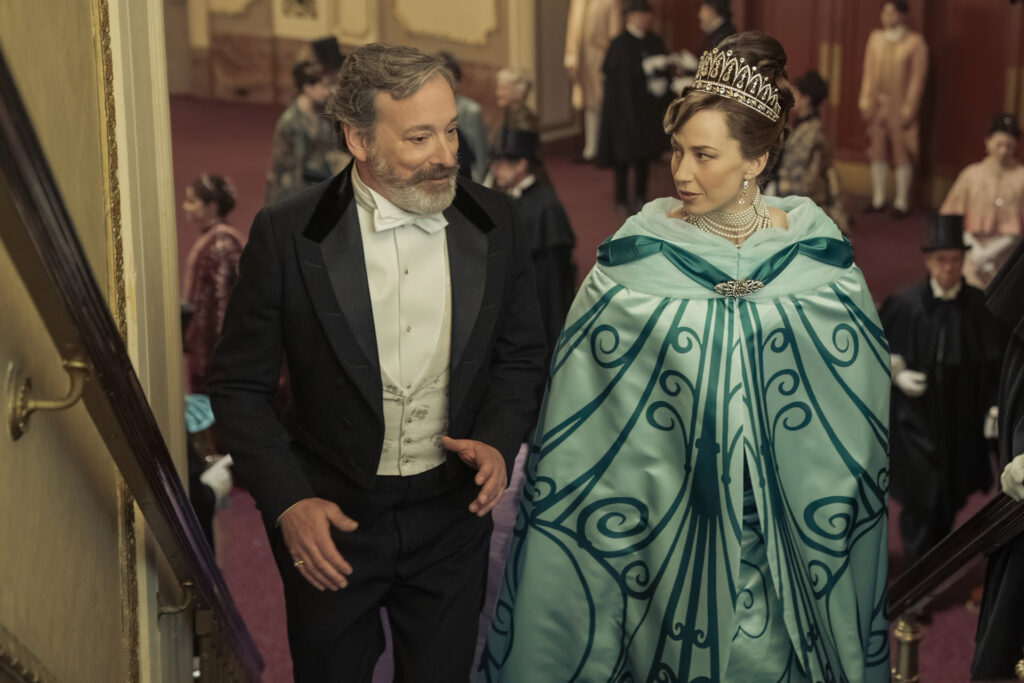
Across the street, the new-money Russells (Carrie Coon and Morgan Spector) have made their vaster, gaudier fortune in railroads and are putting the finishing touches on their own marble palace. While appearing classical in every way to a modern viewer, Bertha and George’s monstrously large house is considered the height of garishness to the more established characters on the show, which just goes to show that after enough decades pass, the things that used to be tacky eventually become tasteful.
To explain the money of the show in modern parlance we can all understand: the Van Rhijns are the kind of rich who fund libraries and global health initiatives; the Russells are the kind of rich who build rockets that look like penises.
The show is a celebration of being the age where you are old enough to know what you want (the show’s most uninteresting characters are Marian and Gladys, two 20-somethings who never do anything conniving, which is to say they never do anything interesting), and still scrapping enough to plot how to get it — there are no smug dowagers here, only middle-aged baddies.
Who earned all the money around which this world revolves? The men did, and one recurring plotline is George Russell gradually losing his soul in his pursuit of industrial domination.
The answer to that question also depends, though, on how you define “earned.” Agnes Van Rhijn, in order to keep her genteel family afloat, stalwartly married “the kind of man you would not want to be alone in a room with.” Bertha Russell schemes and claws her way to social relevance in a way that feels both heinous and heroic (we can’t all be born into wealth, Lady Astor), but is also financially important: George cannot force the New York City aldermen into his boardroom, for example, but Bertha might be able to cajole them to her dinner table for an ostensible social visit.
“The Gilded Age” is largely a show about middle-aged-and-older women, without calling attention to the fact that it is a show about middle age. I watched it in conjunction with “Youth,” an excellent Sharon Horgan comedy in which every joke and plot conceit revolves around the 50-ish heroine’s relationship with her age. She wants to date, but she hates how saggy the men in her demographic are; is she this saggy, too?
But in “The Gilded Age,” nobody is getting hot flashes or worrying about their necks or whether cleavage and a tiara are appropriate for a gray-haired woman (obviously). They’re just bedazzling the bejesus out of themselves, trying to convince their exhausting children that nobody knows everything at age 22, and enjoying the heights of their power.
Do they define power in utterly ridiculous rich-lady ways? Oh, you bet. Consider the scene in the first season in which Bertha smashes her breakfast tray to the floor because she learns that a charity auction will be held at a hotel instead of in her own ballroom.
But the scene is not played for laughs. The scene is played as if Bertha alone is fully aware of how the domestic realm has always shaped the political: she has gobs of money, but there’s no point to wealth if she can’t use it to help her family (a good marriage for her daughter, a good profession for her son) and shape her country. The future of New York depends, apparently, on whether a table is set the English way or the American.
And her husband George respects this. Does he understand guest lists, luncheon invitations, and seats on the board of foundations that help widows and orphans? No, but as diabolical as he might be in his professional life, at home he is a consummate wife guy: sternly dismissing the comely housemaids who try to hit on him, and believing that his spouse knows what she is talking about. He is the hero who shows up to the charity auction and buys every damned item, ordering that the whole kit and caboodle be promptly moved to Bertha’s ballroom as she originally desired. Season 4 tumult aside (no spoilers), for multiple seasons this was the best marriage on television.
Television has come far enough that it’s no longer remarkable to have shows exploring the inner lives of women on the back-end of 40. Hell, “The Gilded Age” isn’t even the only one co-starring Nixon (Let us never speak of “And Just Like That” again).
But “The Gilded Age” does a damn fine job of inhabiting the world of perimenopause without congratulating itself for doing so. It simply drops us in on Baranski deadpanning “Seems to me the ship is sinking. Let us follow the example of rats” and brings out another vat of Roman punch.
The post I have found the most perimenopausal show on television appeared first on Washington Post.