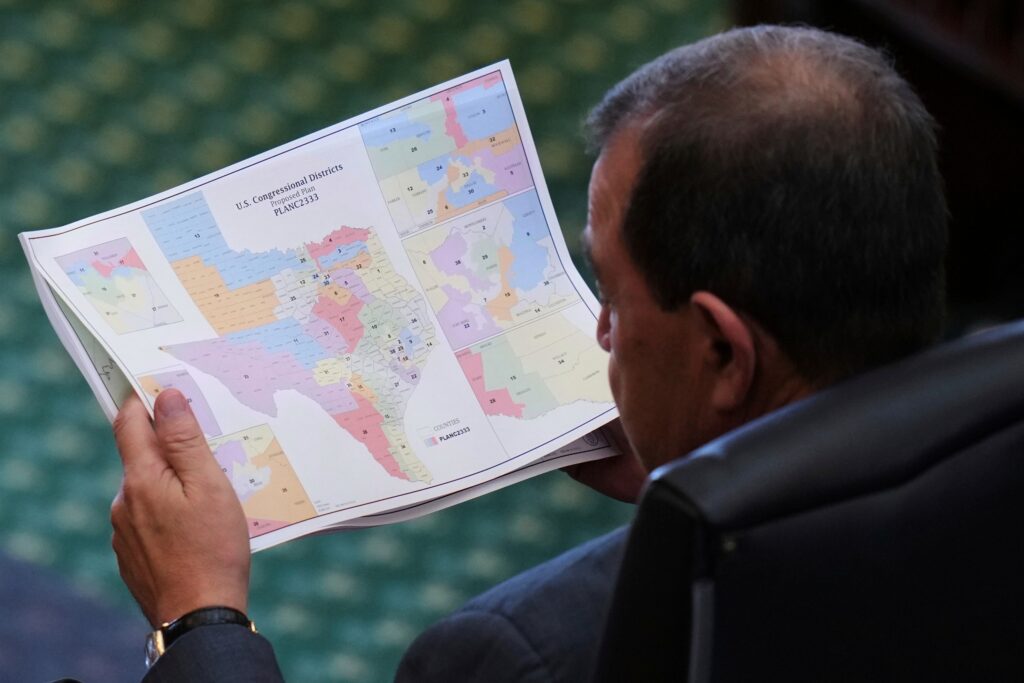
An underappreciated and entirely pleasing aspect of the Republicans’ demolishment on Tuesday was the utter failure of their attempt to preserve a GOP House majority through outlandish gerrymandering. Not only did Democrats retain almost all the Republicans’ redrawn seats, but they also nabbed a few previously safe GOP strongholds in North Carolina that the new maps made more vulnerable.
That outcome offers a valuable lesson for both parties: Redistricting is an extraordinary tool that can help expand a party’s power, but it can also spell disaster for cocky operatives who believe they can control America’s wild political tides. Fortunately, the midterm results also provide a path to de-escalate the gerrymandering war that Republicans, at President Donald Trump’s direction, declared last year.
Democrats, drunk on their astonishing midterm victories, might not be in the mood to think about the dangers ahead, but deep down they must be at least somewhat aware that their wave will be an aberration. They are unlikely to generate the same level of enthusiasm in 2028 or later elections, meaning the GOP will almost certainly reap the rewards of their gerrymandered maps eventually.
That leaves Democrats with two options. The first is what they were already planning to do: try to squeeze out as much partisan advantage from their maps as they can in the next year to offset Republican maps. Indeed, voters in Maryland on Tuesday approved a ballot measure allowing state officials to erase the state’s last remaining Republican district. Democrats in states such as New Jersey, New York and Oregon are also likely to push for changes.
But such a strategy could easily run into legal challenges, as happened to Virginia’s gerrymandering effort. Plus, as Tuesday’s results show, there’s no guarantee that aggressive Democratic maps would produce the results they seek.
Democrats’ second option may be harder to accomplish, but it would be a triumph for the country: roll back the tit-for-tat gamesmanship that marked this election cycle.
Doing so is possible thanks to Democrats’ extraordinary success in state races on Tuesday. They flipped several chambers across the country, including the House of Representatives in Texas and North Carolina, both of which engaged in mid-decade gerrymandering. Crucially, they will also occupy the governor mansions in those states.
Republicans in those states are still on track to control their respective Senate chambers, but Democrats might just have a chance to undo recent GOP gerrymandering there or devise maps that better represent the will of their voters. Republicans would certainly resist the changes, but perhaps a few might be willing to go along if Democrats in other states agree to lay down their arms. California legislators, for instance, could help generate some goodwill by undoing their gerrymandered map; after all, they did promise that their power grab would only be temporary.
An encouraging sign was Republican Georgia Gov. Brian Kemp’s announcement on Wednesday that he won’t try to rush through redistricting before his elected Democratic successor, Keisha Lance Bottoms, is inaugurated. Might others in his party see the wisdom in that decision and similarly agree to defuse the conflict?
Sure, such a grand bargain might be a pipe dream in this era of hyper-partisanship. But both sides must perceive the pernicious effects of gerrymandering. It raises the barrier by which the minority party in a state can influence elections, which not only discourages people from participating in the democratic process but also reinforces political polarization. That’s because elected officials in gerrymandered districts have less reason to try to win over constituents outside of their political base.
It isn’t hard to imagine the redistricting battles that preceded this year’s midterms becoming the norm for U.S. elections. Indeed, the worst aspect of those fights was the normalization of politicians’ trying to tailor maps whenever they want. Imagine a future in which parties across the country are regularly scrambling to rework political lines to their electoral advantage.
Of course, returning to the norm of redistricting every decade wouldn’t solve America’s persistent gerrymandering problem. Electoral systems based on geographic boundaries are inherently imperfect, and without broader reforms, partisans will always be tempted to mess with maps in their favor.
Still, it isn’t impossible for elected officials to institute fairer political maps, nor is it unreasonable for voters to demand that they do so. Trump broke America’s democratic norms with his gerrymandering ploy, but Trump is not forever. The midterm earthquake is forcing both parties to consider what the country’s electoral system will look like once he is gone. This is a chance to rebuild.
The post How to de-escalate the gerrymandering war appeared first on Washington Post.