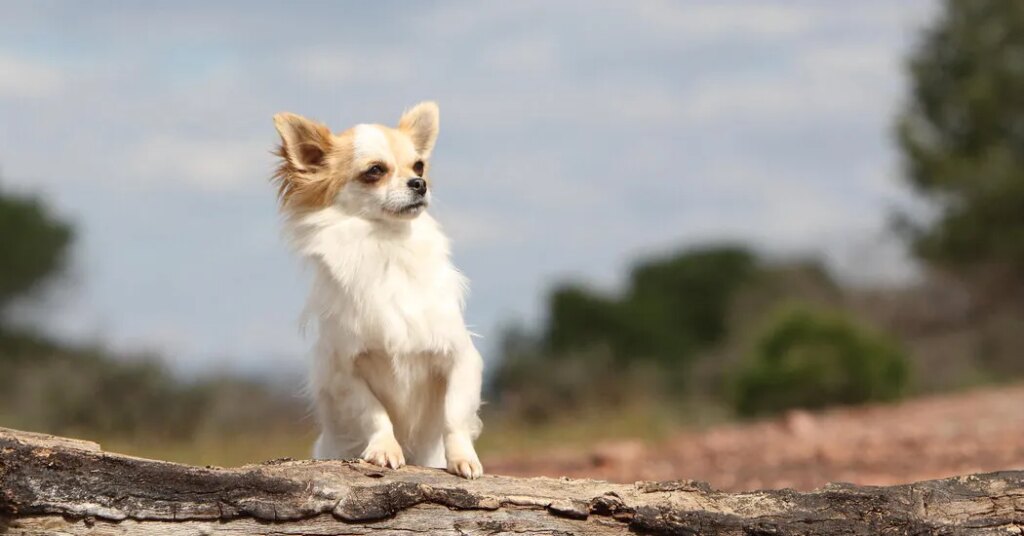
A casual observer might assume Chihuahuas are descended from angry electric toothbrushes. The breed’s characteristic quivering has historically been chalked up to garden-variety neurosis or a low tolerance for chilly drafts.
But a new study published in the journal Nature Communications suggests a more poetic explanation: Tucked inside that 4-pound frame is a microscopic shard of a coyote, trying to break free.
Researchers at Stanford University were testing a new software algorithm designed to analyze the genomic ancestry of any species at high resolution. By happy accident, the team discovered that, unlike almost every other dog breed, Chihuahuas carry distinct hints of coyote DNA, most likely embedded long before Europeans set foot in the Americas.
The Chihuahua lineage is believed to wind back to the Techichi, a small, barkless companion animal domesticated by the Toltec civilization around the turn of the first millennium that has since gone extinct. Alexander Ioannidis, a Stanford geneticist who collaborated on the paper, notes that contemporary Chihuahuas still retain roughly a 4-percent slice of their ancestry from these pre-contact pooches.
And buried deep within that fraction are even smaller, hidden remnants of an ancient tryst between those native dogs and coyotes.
“Because the genetic deck is randomly shuffled and sliced with every new generation, ancient pairings leave behind far smaller ancestral crumbs,” Dr. Ioannidis said. “The minuscule nature of these fragments confirms that this interbreeding happened in the distant past.”
While the concept of early canine hybridization is not entirely novel, the precision of the finding is, said Adam Boyko, a canine geneticist at Cornell University and the founder of Embark, a dog DNA testing company based in Ithaca, N.Y.
“This isn’t the first evidence we’ve seen of pre-Columbian interbreeding between dogs and coyotes,” he said. “But it is the first time we’ve pinpointed these mixed genetic segments in modern New World dogs.”
Today, that pairing survives only as a phantom howl — a sliver of the wilderness trapped inside a creature that, Dr. Ioannidis noted, can comfortably fit in a tote bag.
Additional proof that these segments are ancient relics rather than modern anomalies lies in the Chihuahua’s family tree, Dr. Ioannidis said. Identical genetic fragments were identified in the Chinese crested, confirming that the two breeds are close evolutionary relatives.
“I suspect these coyote DNA fragments trace back to ancient dog-and-coyote encounters in Mexico among the foundational dogs that eventually sired both of these modern breeds,” Dr. Ioannidis said. But researchers would need to sequence more Chihuahua genomes to gather a larger library of these hybrid fragments, along with a comprehensive map of coyote genomes from across North America, to prove this regional origin hypothesis.
“Every domestic dog can track its lineage back to Old World wolves,” Dr. Ioannidis said, adding that coyotes occupy an entirely separate branch of the evolutionary tree. “The genetic calling cards found in the Chihuahua are unmistakably coyote, not some long-lost signature unique to ancient American dogs.”
Historical records suggest that a union between coyotes and indigenous canines was no accident. The literature points toward an intentional breeding program in pre-Columbian Mexico, Dr. Ioannidis said. The size disparity between a standard coyote and the much smaller Techichi makes natural interbreeding difficult to imagine, but the mechanics are not impossible. Wild canines of very different sizes do successfully mate, Dr. Ioannidis said.
Owners of Chihuahuas know that their pets routinely display the audacity of apex predators, so it may be tempting to credit this ferocity to their wild coyote blood. But science loves to spoil a good story.
Even traits that seem simple, such as height, are actually quite complex, Dr. Ioannidis said. Like most pint-size lap dogs, the Chihuahua owes its stature to a specific genetic hiccup that puts the brakes on cellular growth. Over generations, human breeders selectively paired the smallest animals to cultivate a permanent state of canine dwarfism.
The same complexity is true for behavioral traits. “Because coyote DNA constitutes a mere 10th of 1 percent of the Chihuahua genome, its contribution to behavior is likely negligible, if it exists at all,” Dr. Ioannidis said.
But isolating those specific genomic clusters and clarifying what role they do play remains possible. “I would be surprised if that fraction yielded absolutely nothing, but confirming it requires a vastly larger sample size than the three sequenced Chihuahuas analyzed in our current study,” Dr. Ioannidis said.
Elinor Karlsson is a geneticist at Darwin’s Ark, a citizen-science project mapping pet dog genomes. She said she liked the study because it peers past modern breed ancestry to trace individual DNA segments back to ancient global populations.
The results also call attention to the disappearance of indigenous dogs after European colonization, which remains an enduring historical puzzle, Dr. Ioannidis said. Well before Spanish horses ever trotted across the Great Plains, indigenous canines were ubiquitous fixtures of everyday life, serving as sturdy pack animals that dragged cargo across the continent in the manner of prehistoric huskies.
After colonization, that sprawling population seemed to vanish entirely, leaving behind little more than genetic echoes hidden inside the world’s smallest dogs.
The post Tiny Chihuahuas Hold a Big Surprise: A Sliver of Coyote DNA appeared first on New York Times.