After 28 years, the gamer’s game is getting a big remake.
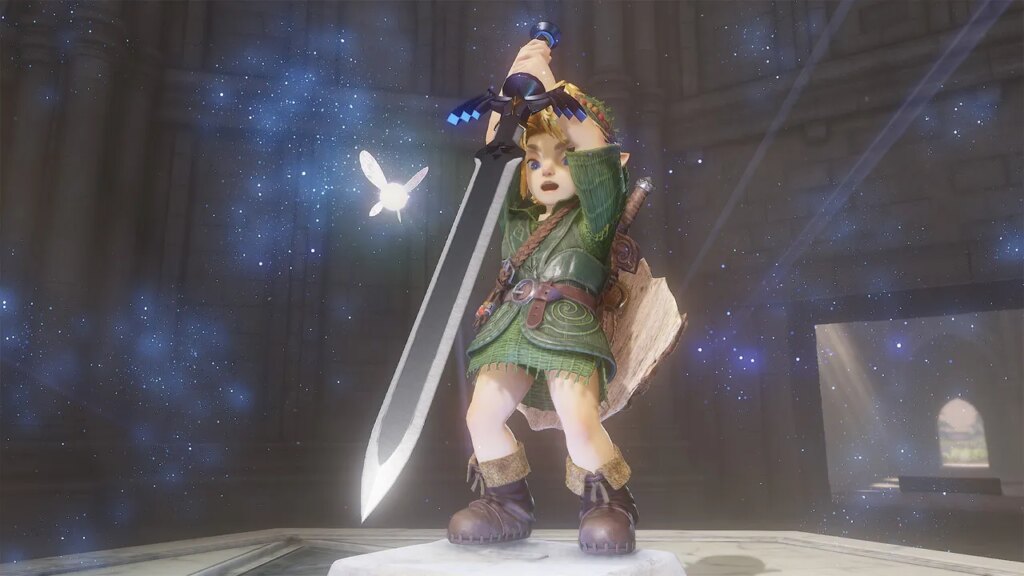
A fully redone version of The Legend of Zelda: Ocarina of Time arrives Thursday exclusively on the Switch 2. Nintendo has been releasing trailers and screenshots in the run-up to the launch, and the imagery, while whetting appetites, has also left fans with an overwhelming question: Why does Link look like that?
Specifically, child Link. Ocarina of Time allows players to time-hop and explore levels as child and adult versions of the game’s main protagonist. Gameplay starts as child Link in the Kokiri Forest, which looks more lush and verdant than ever in the remake. But aesthetic upgrades have also been applied to child Link, resulting in a curled-eyelash, laminated-eyebrow, douyin-lipstick yassified elf boy.
Fans have been quick to compare the design to the human-vampire hybrid Renesmee from Twilight and the Gerber Baby. “He looks so microwaveable,” one Reddit user wrote.
The changes feel all the more stark when juxtaposed with the remake’s background nonplayer characters, who remain noticeably simpler and more reminiscent of the original game’s character designs.
The original Ocarina was limited to minimal polygonal shapes and textures because of the small storage capacity in N64 cartridges, and these technical limitations produced what became a recognizable and beloved visual style. Thanks to the Switch 2’s larger storage capacity and higher memory bus speed, designers have been able to add details to Link and the other main characters that wouldn’t have been possible in the original.
Beyond better technology, though, people have different expectations of video games from major publishers. Interconnecting level designs, intricate storylines, and highly realistic environment and character model details are table stakes for contemporary AAA games. Video games are also more mainstream, and once-regional media like anime and manga have become global phenomena over the past three decades, influencing taste in the larger culture.
Clayton Lundgren, a former quality assurance tester for the game developer Naughty Dog who currently streams Ocarina of Time along with other games on Twitch, sees nothing accidental about Link’s new look. “For a decision as important as the key art for the main character, this is the kind of thing that is gonna go past a lot of quality inspection higher up than the person that drew it,” he says. “This is 20-plus years of merchandising that you’re committing to.”
Links to the Past
Since The Legend of Zelda launched the franchise in 1986, Link has existed in many forms. Though his long hat, pointy ears, blond hair, green tunic, and Master Sword are staples of his design, none of these characteristics have been stable across his 40 years. He’s had pink hair, his tunic has been blue and red. He’s even been a tree.
The remake takes the evolution a step further, though. Lundgren, who has at least 1,000 hours in Ocarina across speed runs, challenge runs, and community competitions, immediately realized that this week’s release is a ground-up remake when he watched the game’s new trailer. For many fans, the rich detail of the underbrush and sunbeams in Kokiri Forest visible in the teaser video were proof this isn’t the same Ocarina. But Lundgren saw something else: The undulation in the ground was different.
Unlike the 2011 Zelda remake for the 3DS, which uses the same underlying geometries as the original, the 2026 remake is a complete overhaul, from the superficial textures to the bones underneath. And if everything is different, how is this the same Link we’ve played and loved before?
Luke Cuddy, a philosophy professor at Southwestern College who has edited books about The Legend of Zelda, offers the “Ship of Theseus” thought experiment as a way to think through the conundrum. The famous philosophical riddle asks whether the true ship is the one Theseus is currently sailing or the original constituent parts that have been replaced over time. If one thinks the true ship is the one Theseus is currently sailing, they believe there is something beyond the physical body that makes something what it is.
“There are only a few minimal features that are continuous over time with Link,” says Cuddy. Aside from a few visual and narrative touchstones—and the occasional “Hyah!” or “Hyup!” voice line—there isn’t much else that Link is. “For me, that allows for a lot of malleability.”
That malleability is cushioned by other forms of continuity. Beyond aesthetic similarities and a shared title across Zelda games, contemporary games that were influenced by the original Ocarina are now shaping the remake in turn, and norms of play set by speedrunners and challenge runners of the original continue to shape engagement across gaming communities.
But another force is fueling the current scrutiny and anxiety over the remake, one that haunts every contemporary artistic endeavor: Was generative AI involved?
Artificial intelligence has long been part of video games designed to respond in real time to players’ actions. But these days, when the topic of AI use in video games comes up, it’s usually in reference to AI tools being used to make the visual parts of a game, the storyboards, the written scripts, or the spoken dialog.
The backlash to these tools is growing, rooted in concerns about the environment, artists’ intellectual property, and aesthetic taste. Players are increasingly worried that they’re engaging with media that betrays their values, and for a game like Ocarina, the possible juxtaposition of the original’s groundbreaking design with derivative and cannibalistic tools feels like a long way to fall.
Cuddy compares the “super-enhanced version of Link” in the remake to the output of an AI filter, and other fans are questioning why the designs look like they were run through DLSS 5, an animation upscaling tool that uses generative AI. Nintendo has confirmed its use of AMD FSR, a competing upscaling tool, though when WIRED asked if generative AI tools were also used in the character design process for the new game, the company declined to comment.
When one of the most beloved entries in a beloved game franchise gets a new coat of paint, fans of the game are of course going to scrutinize every aspect of the remake’s design. But Lundgren predicts that, based on Zelda fans’ history of embracing Link’s many incarnations in the past, “in two years we’ll think it looks great.”
The post The ‘Ocarina of Time’ Remake Is Finally Here, but Why Does Link Look so Yassified? appeared first on Wired.