Southern Californian stargazers should get ready for a month packed with astronomical events, starting with fireballs and ending with a supermoon.
The Southern Taurid meteor shower put on a show early Thursday morning. But those who missed it still have the Northern Taurid shower in store, peaking overnight on Nov. 11, said Tim Thompson, the science director at Mt. Wilson Observatory. That means you’ll have a higher-than-usual chance of catching a glimpse of what scientists call a fireball — which is any meteor that appears brighter than Venus in the night sky.
At the peak of the Taurid meteor shower, observers in areas with little light pollution can typically expect to see a modest 10 to 15 meteors per hour, Thompson said.
“It doesn’t have lots and lots of meteors, but sometimes it gets some of the bigger and slower and more interesting ones,” he said. Some refer to them as “Halloween fireballs,” he added.
On Nov. 15 and 16, Southern California’s early risers can look to the pre-dawn eastern sky for a rare sight: Jupiter and Mars will appear next to each other in a planetary conjunction, said Bruce Betts, chief scientist at the Pasadena-based Planetary Society.
Look for a bright white Jupiter near a red-orange Mars between 4 and 6 a.m., Betts said. You’ll want to find an open space without trees or mountains blocking your view of the eastern sky.
Planetary conjunctions occur periodically, but a conjunction between Jupiter — the night sky’s third-brightest natural object after the moon and Venus — and Mars only happens once every few years, according to Betts.
Then, the annual Leonids meteor shower is expected to peak on Nov. 17 and 18, according to the Planetary Society website.
When you see a meteor shower, what you are actually looking at is the debris stream from a comet, Thompson said.
The Taurids are associated with the Comet 2P/Encke, which was first discovered in the 1700s. They can be seen each year when the Earth passes through a denser clump of the comet’s debris during its orbit around the sun, Thompson said. The Leonids are associated with the comet 55P/Tempel-Tuttle.
For the best view of a meteor shower, you’ll need to head to a place without light pollution — think of desert sites, such as Joshua Tree National Park, a range such as the San Gabriel Mountains, or a beach, though marine fog might pose visibility challenges.
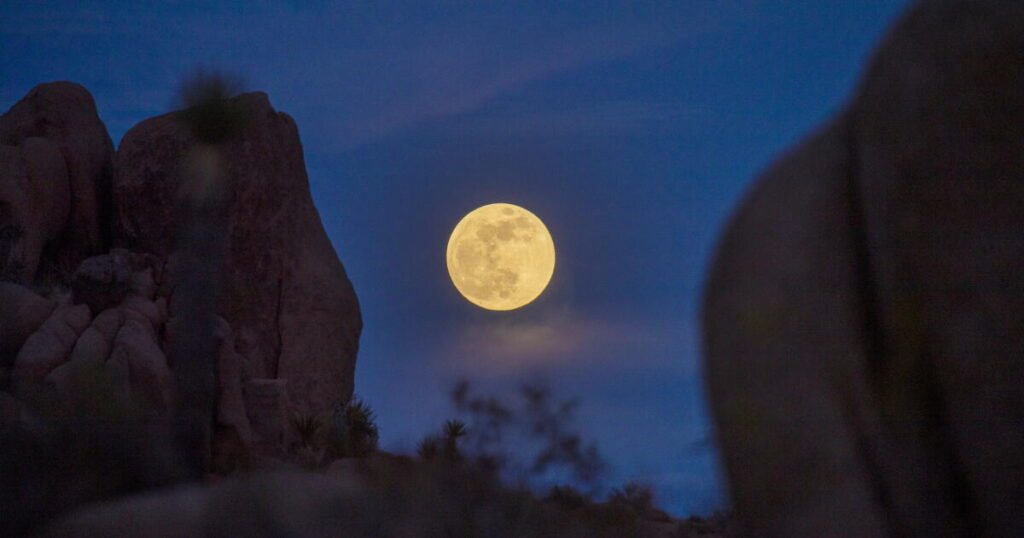
Closing out a busy celestial month, a “supermoon” will be visible on Nov. 23 and 24. The term refers to a full moon that takes place when the moon is close to the Earth in its oval-shaped orbit. They are larger and brighter than regular full moons.
Betts said supermoons happen several times a year and are slightly overrated.
“Supermoon has much better PR than than planetary conjunctions,” he said. “You’ll be hard-pressed to tell any difference just looking with your eyes and not measuring it in some way that it’s different than a normal moon.”
But to maximize the experience, scientists say the best time to observe a supermoon is when it’s close to the horizon. So around sunset, look east to see the moon rise. The “horizon illusion” makes the moon appear larger in comparison to familiar sights on the horizon. The sun sets just after 4:45 p.m. on Nov. 23 and 24.
The post Fireballs and a supermoon: SoCal stargazers should brace for a busy month of astronomical events appeared first on Los Angeles Times.