In the 4th century B.C., Greek historian Herodotus gave an account of an unusual ritual among a nomadic group known as the Scythians: smoking weed.
He described them throwing cannabis seeds onto red-hot stones.
“It smoulders and sends forth so much steam that no Greek vapour-bath could surpass it,” he wrote in “The Histories,” according to the 1920–1925 Loeb Classical Library translation. “The Scythians howl in joy for the vapour-bath.”
Now, a study published Thursday in the peer-reviewed journal Science presents evidence that the Scythians may have used cannabis for mind-altering purposes as far back as 400 years before Herodotus — or about 2,800 years before our time.
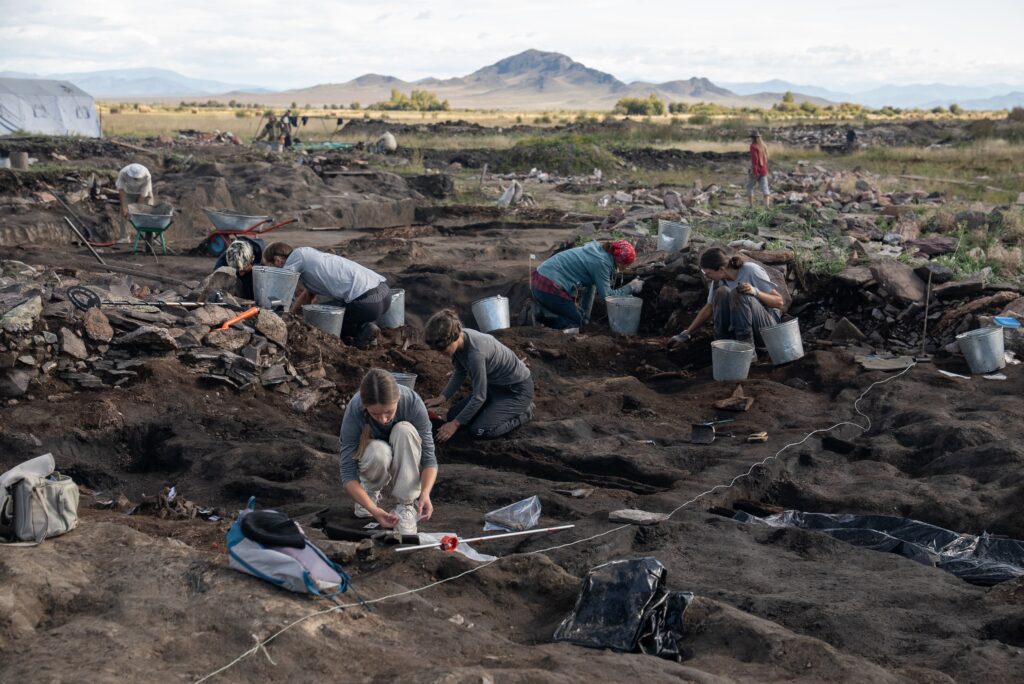
The researchers reported finding 1,000 cannabis seeds, some of which they dated to the first decade of the 8th century B.C., at a Siberian burial site.
They also tested hair found at the site and said they detected traces of cannabinol (CBN), a mildly psychoactive compound that comes from when THC — the primary component of cannabis responsible for making people feel high — is exposed to air, heat or light.
“One does not very often get to drug test a person who has been dead for nearly 3,000 years,” Gino Caspari, an archaeologist at the University of Bern and the study’s lead author, said in an email. “That’s even unusual for an archaeologist.”
During an earlier expedition at the site, called Tunnug 1, Caspari and other researchers found the fragmented remains of as many as 18 horses and at least one human, suggesting that a sacrifice of some sort took place there.
Herodotus, too, wrote of witnessing a rather grisly scene: The Scythians strangled people and horses, then mounted the bodies on stakes — man on top of beast — around a tomb and rode away.
Caspari said such sacrifices may help explain the use of cannabis.
“While we cannot prove this,” he said, “we can speculate based on the context that it might have been beneficial to sedate some of the victims before bad things happened to them.”
The oldest written description of cannabis, used as a rope, is dated to an Egyptian text from around 2350 B.C.
Cannabis is mentioned in a Hindu script from around 1600 B.C. as one of five herbs employed to “release us from anxiety.”
But recent field research is helping to build the case that cannabis was used even earlier, including for religious or spiritual purposes.
Several other relevant sites have been identified in China.
In 2008, researchers published findings from a 2,700-year-old grave of a shaman at the Yanghai tombs in northwestern China that included 789 grams of ancient cannabis. They suspected the plants were cultivated, rather than collected from the wild, because of the high presence of CBN.
In 2016, archaeologists found a 2,500-year-old burial shroud made of cannabis in northwestern China’s Jiayi cemetery. Then, in 2019, a group of researchers that included Caspari identified cannabis residues at a site called Jirzankal in the mountains of western China. They concluded that cannabis was ritually smoked in that area 2,500 years ago.
Caspari acknowledged that researchers were not able to test directly for quantitative concentrations of THC on the hair at the Siberian site. He said narcotics laws in Germany, where the analysis was performed, prevented them from buying the samples they would have needed to calibrate the measurements.
Marilyn Huestis, a toxicologist not affiliated with the study, called that omission “poor science.”
Ethan Russo, a neurologist and cannabis researcher not affiliated with the study, also said he found the levels of CBN detected “hard to believe” when wild cannabis — as the material at the site appeared to be — should have far less THC than modern counterparts.
Caspari said he and his colleagues weren’t certain how to account for the “significantly enhanced” levels of CBN detected in the prehistoric samples when calibrated against modern samples. But he said that CBN was a relatively stable compound and that as the THC degraded, it would have become more CBN. The mechanism, though, would “merit a closer look” in future research, he said.
“There are very few cases where we even have preserved hair and fewer where we have cannabinoids present, so it is hard to speculate how degradation processes play into this,” he said.
Rob Clarke, a cannabis researcher who was not involved in the study, said it added another piece to the puzzle of broader cultural traditions of cannabis use.
“With the two Chinese cemetery sites, and recent find at Jirzankal to the west, the range of early psychoactive use spread,” he said in an email.
The post The curious case of ancient cannabis use appeared first on Washington Post.