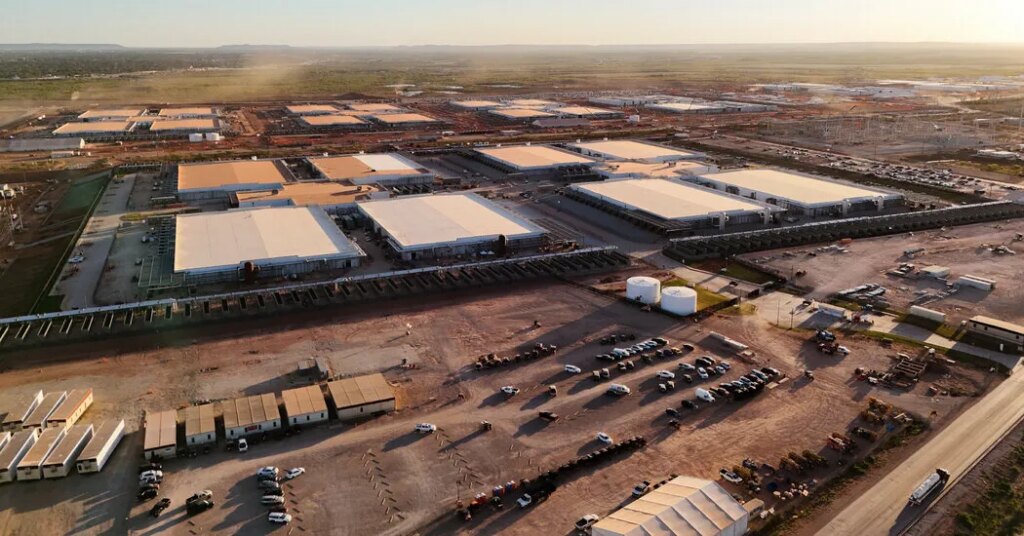
Two days after voters widely supported ballot measures meant to limit the artificial intelligence construction boom, OpenAI said on Thursday that it would change how it dealt with the communities where it built its giant data centers, which it now calls “compute campuses.”
Under what it called a National Community Compact, each future campus that OpenAI owns and operates will have its own local agreement and an annual public report. The company pledged in a statement to pay the full cost of the electricity it uses and the grid upgrades needed to serve it. It will also post financial guarantees so that local households and businesses are not left paying for grid upgrades if a project is canceled.
OpenAI said it would publish water and power use for each site and stop requiring public officials to sign nondisclosure agreements, except for narrow security and trade-secret exceptions. The company said it voided such an agreement in Effingham County, Ga., in July.
The pledges cover only sites that OpenAI owns. Partners such as Oracle build and own much of OpenAI’s computing capacity.
A companion policy blueprint asks lawmakers to mandate similar rules across the industry. It calls on utility regulators to make large power users pay the costs they add to the grid, and it asks governments to disclose tax incentives publicly, with clawbacks if companies fall short. It also asks Congress to restore clean-electricity tax credits.
OpenAI said the effort had grown out of commitments it began making in January, but the timing follows a sharp political turn. On Tuesday, Democrats won governor’s races in Texas, Georgia and Ohio with candidates who had pledged to pause new data center permits and tighten construction rules.
OpenAI also promised on Thursday to make local investments of $80 million in Effingham County and $40 million in Pike County, Ohio. County officials project that the Georgia site will pay about $66 million a year in lieu of taxes once it is fully built.
(The New York Times has sued OpenAI and its partner, Microsoft, claiming copyright infringement of news content related to A.I. systems. The two companies have denied the suit’s claims).
Chris Lehane, OpenAI’s chief global affairs officer, said in an essay published on Wednesday that A.I. would be the defining issue of the 2028 presidential race.
The shift is awkward for a company whose leaders have courted President Trump, who has scoffed at local resistance to data centers. Sam Altman, the chief executive, gave $1 million to Mr. Trump’s inaugural committee, and Greg Brockman, OpenAI’s president, gave $25 million to a pro-Trump super PAC last year, though he backed out of another $25 million donation planned for this year.
The post After Midterm Rebuke, OpenAI Pledges to Give Data Center Towns More Say appeared first on New York Times.