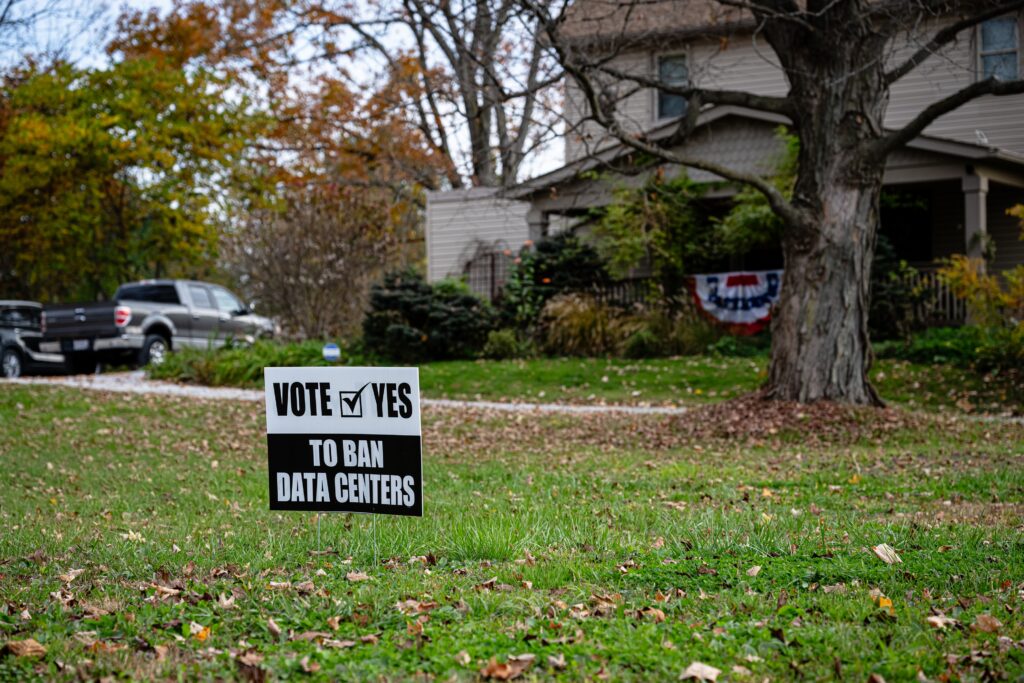
Markets are reeling in the aftermath of the midterms as investors, already nervous about the artificial intelligence build-out, weigh the implications of voter hostility toward data centers. Thursday saw the largest one-day destruction of value, about $2.5 trillion, in the history of the Nasdaq.
A lazy takeaway from Tuesday’s elections is that Americans have given politicians a mandate to halt AI development. Look closely at the results, and you’ll see the public is not rejecting the technology wholesale. Instead, voters are demanding better terms — and more obvious, immediate upside — from the technological revolution already well underway.
Of the 41 local ballot measures on data centers across 10 states, 40 went against development. Voters approved bans and restrictions, rejected proposals to facilitate construction and, in some cases, registered their opposition in nonbinding votes. The revolt also reached statehouses. Candidates promising moratoriums on new data centers won governorships in Texas, Ohio and Georgia, three major destinations for AI investment. Moratorium supporters also won in Michigan, Maine and New Mexico, where Democratic legislative majorities give them a clearer path to enacting restrictions.
But not all of the measures that passed on Tuesday were written the same way. Some demanded financial guarantees from data center developers seeking special tax breaks. Others required public approval for large developments consuming substantial amounts of electricity or water, along with enforceable protections. In Maine, seven towns approved temporary moratoriums rather than permanent bans.
Texas offers a glimpse of what might come next. Even before losing reelection, Republican Gov. Greg Abbott temporarily halted data center approvals, demanded that developers cover their own electricity infrastructure costs and proposed ending their tax breaks. His Democratic successor, Gov.-elect Gina Hinojosa, wants to go further, freezing approvals until lawmakers establish protections for county governments, water supplies and electricity customers. In other words, the moratorium is going to be used as leverage.
Much of the backlash is based on misconceptions about how much water is consumed by data centers, how AI will change the nature of work and how electricity markets function. Rising demand for power is a signal to produce more. If data centers need more electricity, America should make it easier to build generation, transmission and storage rather than ration power by blocking the customers willing to pay for it. That’s one of the reasons permitting reform is so essential.
The hyperscalers are making counterbids to win over critics. On Thursday, OpenAI announced a new framework for negotiating with any communities to host future data centers, promising to cover the full costs of electricity and related infrastructure, disclose water consumption, abandon broad nondisclosure agreements with public officials, and give residents a say in local investments. Amazon, whose executive chairman, Jeff Bezos, owns The Post, made similar commitments last month. The other major players, including Meta, Microsoft and Google, have also started to do a better job of touting the considerable benefits they deliver for the jurisdictions where they operate.
Generating additional computing power could cost more if localities require more concessions. That would have downstream consequences for the economy, including higher prices for customers of the frontier labs. In its recent S-1 filing with the Securities and Exchange Commission, Anthropic disclosed nearly $900 billion in spending commitments to secure computing capacity and identified its scarcity as a major challenge. Executives at OpenAI, which has a content partnership with The Post, are reportedly discussing whether the election results might force them to revise their estimates for data center capacity next year. With so much of the economy reliant on the AI sector, these new price signals could lead to turbulence.
At the same time, higher prices for compute will also drive innovations in efficiency. Chinese AI labs, long constrained by American export controls, have demonstrated how much can be accomplished by making models work well with less compute. American developers will now have even stronger incentives to do the same.
Several places voted to ban data centers outright, as is their democratic prerogative, but a local vote against a particular industrial development is hardly a national mandate to throw sand in the gears of technological progress, much less to ban superintelligence, as some lawmakers demand. The communities that find a way to get to yes, negotiating deals that win public buy-in, invite a windfall of tax revenue and economic flourishing. Those that shun development risk becoming backwaters in a dynamic 21st-century American economy.
The post Voters want to feel like they’re getting a better deal from data centers appeared first on Washington Post.