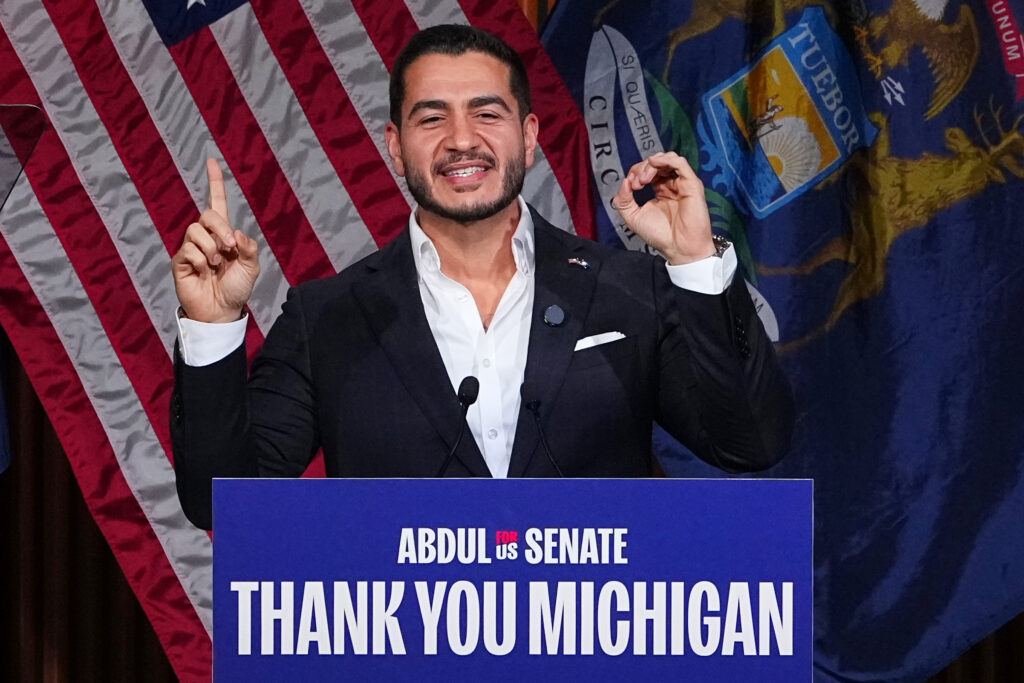
Abdul El-Sayed ran well behind other Michigan Democrats in places with more Jewish voters, according to a detailed POLITICO analysis of precinct-level results.
Statewide, the progressive senator-elect only ran two points behind Democratic Gov.-elect Jocelyn Benson, getting 52.5% of the vote compared to her 54.5%. But the gap was much larger in heavily Jewish communities: In Huntington Woods, a Detroit suburb that is roughly two-thirds Jewish, El-Sayed ran nearly 15 points behind Benson, getting 65.3% of the vote compared to Benson’s 80%.
In West Bloomfield, the site of the March synagogue attack that shook the Senate primary and a town where roughly a quarter of residents are Jewish, El-Sayed ran 8.8 points behind Benson.
El-Sayed faced blowback from some Jewish Democrats during his campaign, particularly over his calls to end U.S. military support to Israel and his remarks after the synagogue attack that “hurt people hurt people,” for which he later apologized.
El-Sayed, who will be the first Muslim senator in U.S. history, told POLITICO on Wednesday that he hoped he could “earn support” from Jewish voters who hadn’t backed him in this election.
“One of the big issues of disagreement that kept showing up when it came to the Jewish community was my position on Israel,” El-Sayed said. “I’m not going to change my position, but …I intend to lead on all the issues that we agree on — whether it’s the right to a union or the right to health care, clean air, clean water, or religious pluralism, and respect for the Constitution — and I hope that over time I can earn [their] support on those issues.”
El-Sayed had worked to make inroads with Jewish voters over the course of his campaign, pledging to stand up to antisemitism and for Jewish safety. Still, some Jewish leaders and activists in the state urged voters to blank their ballots in the Senate race, or back Republican former Rep. Mike Rogers.
His former Democratic primary rival, Rep. Haley Stevens, also switched her endorsement from El-Sayed to Rogers days before the election, citing concerns over antisemitism and the Democrat and his allies’ views and rhetoric around Israel. She pointed to an ad put out by a prominent El-Sayed supporter tying high grocery prices to U.S. aid to Israel, which El-Sayed and his campaign distanced themselves from.
Jewish voters, who make up roughly 1.4% of the Michigan electorate, have historically backed Democrats by large margins. But disagreements over support for Israel and how the party should respond to rising antisemitism are testing that voting bloc — both in Michigan and across the country.
A poll of Jewish early voters in the state found that a majority still backed El-Sayed, but roughly one in four who had supported Sen. Elissa Slotkin in 2024 switched to back Rogers.
With Michigan in Democrats’ early primary window for 2028, El-Sayed said his statewide win showed voters were aligned with his positioning on Israel — and that he hopes the next presidential nominee takes note.
“If you want to be where the voters are, if you want to be on the side of peace and on the side of justice and transparency, I believe that that is around holding Israel accountable to its war crimes and on making sure our tax dollars get used to do good things here rather than bad things somewhere else,” he said.
In a post-election memo, El-Sayed’s campaign touted an outside analysis finding that he only ran slightly behind Slotkin’s 2024 performance in predominantly Jewish precincts. The memo also noted he was outspent heavily in both the primary and general elections, including by “MAGA billionaires, AIPAC, Elon Musk, and corporate interests determined to elect candidates who would defend the status quo.”
But he won in a blue wave while Slotkin, who is Jewish, overcame a tough year. El-Sayed’s margins were far better than Slotkin’s numbers across nearly all of the state, suggesting Jewish voters moved in the opposite direction of most Michiganders.
On the other hand, El-Sayed particularly surged in areas with more Muslim voters, who make up roughly 2.4% of Michigan’s electorate. In Dearborn, for example, he won 82.5% of the vote compared to 78.7% for Benson. Two years ago, Slotkin won 41.4% in the city while former Vice President Kamala Harris received just 36.3% of the vote.
Lansing Mayor Andy Schor, a Jewish Democrat who supported Stevens in the primary and did not endorse El-Sayed, said he was unsurprised by that split screen. He expressed hope about El-Sayed’s relationship with the Jewish community going forward, but also said Jewish leaders should continue to raise their concerns to the incoming senator.
“Everybody has to keep talking to him. His views aren’t going to change, and we know what they are,” Schor said. But, “I hope he’s open to hearing the concerns of some of his constituents.”
Nonnegotiable Michigan, a group of Jewish activists that pushed El-Sayed on issues of Jewish safety and Israel, also said in a postelection statement that it was “prepared to work with” El-Sayed “even as we continue to hold elected leaders accountable when antisemitism enters our politics or political discourse.”
El-Sayed made clear he has no plans to change his views on Israel, but said he will be straight with voters — and that he’ll “show up for you when you need me” regardless of their differences.
“With me, what you see is what you get. And I’ve never once gone and told somebody that I was anything but what I am,” El-Sayed said Wednesday. “We’re going to disagree. I’m going to be honest, specific and direct. And over time, I hope that I can earn support for leading on the issues on which I hope to lead and [by] serving everybody.”
The post Abdul El-Sayed underperformed with Jewish voters. Here’s what he has to say about it. appeared first on Politico.