To the beat of a Zulu rap song, the polished, 1990s-era BMW convertible rolled into the political rally in Johannesburg, greeted by delirious cheers from hundreds of South Africans. The car, known as a “gusheshe,” became synonymous with the hip culture that emerged from the largely impoverished townships where Black people were forced to live under apartheid.
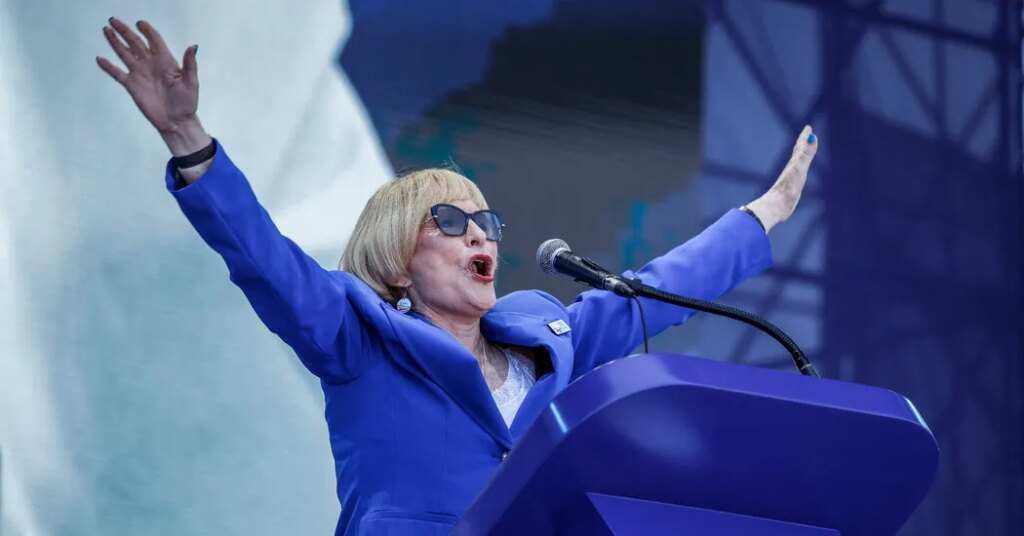
But sitting atop the gusheshe (pronounced GOO-shay-shay) was someone South Africans may hardly associate with Black culture. It was Helen Zille, 75, a white grandmother who has been criticized for her stances on race, including past statements suggesting that colonialism had its benefits, denouncing affirmative action in South Africa and embracing American right-wing terms like “wokeness.”
Yet, as she campaigns to lead South Africa’s largest city, Johannesburg, ahead of Wednesday’s election, Ms. Zille is betting that race no longer guides many South Africans’ decisions in the voting booth.
Instead, she argues, South Africans are more concerned with quality-of-life issues like water shortages, crumbling roads and public safety. And her blunt, rugged style, she says, is best suited to getting Africa’s wealthiest city working again.
With an outsize persona and social media outreach that feels more Gen Z than baby boomer, Ms. Zille has injected excitement, and some controversy, into the typically bland, predictable ritual of South African electioneering.
“Lots of people don’t like me,” Ms. Zille, the mayoral candidate for the Democratic Alliance, or D.A., said in an interview. “It’s fine. You don’t even have to like the D.A. You just have to love Johannesburg to consolidate your vote behind us.”
Ms. Zille’s strategy has put her ahead in the polls in Johannesburg, the biggest prize in an election in which millions of voters are expected to choose mayors and city councilors across the nation. The local elections could have important repercussions for the national political landscape, analysts said.
The African National Congress, the party of Nelson Mandela that led South Africa out of apartheid, has experienced a sharp electoral decline. In the country’s past two major elections, less than half of South Africa’s voters chose the A.N.C., an unheard-of development for the party since it came to power after apartheid ended in 1994.
Polls and analysts suggest an even further slide is coming this election, with the A.N.C. projected to be surpassed as the largest party in most of South Africa’s eight major metropolitan cities. (It’s currently the largest in six of them.) The A.N.C.’s diminution could deepen fighting within the party, experts say, and intensify tensions in the national government coalition led by the A.N.C. The party could also be forced to moderate its policy ambitions and accede to some of its rivals’ demands.
Most metro areas in South Africa are not projected to have clear-cut winners in the election, raising fears among some analysts that parties will form unstable governing coalitions that will make life harder for ordinary South Africans.
“I’m really pessimistic about the future of this country,” said Bheki Mngomezulu, a political science professor at Nelson Mandela University.
Historically, the A.N.C. had not announced mayoral candidates before elections, instead relying on its brand to attract voters. This year, with Ms. Zille’s popularity presenting a possible threat, the A.N.C. broke with tradition and announced three finalists for its mayoral candidate in Johannesburg, a sprawling city of nearly five million people.
But the party bungled that effort when its leadership failed to formally submit the name of one of those finalists, Frank Chikane, to the electoral commission. That means he is currently not eligible to become mayor.
The A.N.C. has turned to Cyril Ramaphosa, South Africa’s president and the party’s leader, in an effort to defy the grim projections about how it will fare in the elections. He is the party’s most respected figure.
Mr. Ramaphosa has been barnstorming the country trying to persuade voters to stick with the party. Last month, he waded through crowds in the township of Soweto, speaking with voters complaining that they lacked water, electricity and jobs.
“When you do the balance, when you look at the balance sheet, there’s more positive than negative,” Mr. Ramaphosa told a crowd gathered on the street, referring to the A.N.C.’s governing record.
In South Africa, voters select parties that then form coalitions to pick the mayor. About 80 parties are competing in Johannesburg. But Ms. Zille is polling way ahead of other candidates, though still less than the 50 percent needed to become mayor outright.
Her campaign has been hyper-focused on making the A.N.C.’s governing failures go viral.
She has posted to social media videos of her “snorkeling” in a huge pothole filled with water from a burst pipe; paddling an inflatable boat in flooded Soweto streets; and directing traffic at a broken traffic light. She conducted an unannounced “oversight” visit to a crumbling, abandoned municipal building, unveiling a dramatic video that included being chased by security guards.
Shortly before the political rally last month in which she rode on the back of the convertible, she posted a video of herself screeching a gusheshe in circles, kicking up smoke and leaving skid marks. Spinning cars is a popular activity in South African townships.
“Other parties will spin you stories,” she said into the camera. “We’ll spin into action.”
The comments section lit up with laughing emojis, clapping hands, flames and praise for “Gogo Helen.” (Gogo is the term used for grandmother in Black communities.)
“You know what, take my vote,” one commenter wrote.
Critics, though, have accused Ms. Zille of pandering to Black communities by reaching for caricatures and stereotypes. Some have called her stunts gimmicks that avoid the hard work of engaging Black voters.
And Dada Morero, the current mayor of Johannesburg and a member of the A.N.C., has criticized the D.A. for fomenting inequalities in the cities it has governed and cast doubt on Ms. Zille’s commitment to Johannesburg.
“This sudden interest in Johannesburg by the D.A. is not about residents; it is about politics,” he told a South African news outlet in response to one of Ms. Zille’s viral social media posts.
Most public polls have Ms. Zille shy of 40 percent of the vote, a tally that may make it difficult for her to pull together a coalition of parties to become Johannesburg’s next mayor. But some analysts say her path to office could run through a coalition with the A.N.C., which the D.A. is already partnering with in the national government.
Before entering political office in the late 1990s, Ms. Zille was a journalist for a newspaper that was critical of the apartheid regime. She famously debunked the apartheid government’s claim that the activist Steve Biko had died from the effects of a hunger strike. Her investigation found that he had sustained extensive brain damage and bruising, suggesting that he had been killed in police custody.
In 2007, Ms. Zille became the mayor of Cape Town, South Africa’s second-largest city, and she later served a decade as the premier of Western Cape Province. It seemed as if Ms. Zille’s political career was approaching its twilight last year, when, as a top D.A. official, she was tasked with leading the party’s selection of a Johannesburg mayoral candidate.
She surveyed the field, she said, and thought about her own experience in cutthroat municipal politics.
“People get killed here, and you are always being attacked and then your name gets dragged through the mud on social media and in mainstream media,” she said. “So it’s not a job that many people want.”
Ms. Zille found that the party “didn’t have anyone who could quite rise to that,” she said.
It struck her, she said, that as a woman whose aunt lived to 104 and whose mother smoked but made it to 95, she had a lot left to give.
So she threw her hat into the ring.
The post This Grandma Believes She Can Fix Africa’s Richest City appeared first on New York Times.