Matt Nelson wasn’t looking for fame, exactly, when he rated his first dog on Twitter in 2015. He just thought it would be funny to post a Yelp-style critique of a friend’s shepherd mix lounging on the stairs: “8/10 would pet,” he wrote in the caption.
Now he presides over a social media juggernaut. Nelson’s company, WeRateDogs (Tagline: “your only source for professional dog rating”), is one of social media’s most successful dog-centric accounts, with some 20 million followers across X, Instagram, YouTube and TikTok. It has a thriving merchandise business, a podcast called “The Dogs Were Good (Again)”; and a charitable foundation that has raised nearly $5 million for needy dogs this year.
WeRateDogs has no real rivals per se (“We’re very lucky not to have direct competition in the dog-rating industry,” Nelson said). But it does have an existential enemy: A.I., in all its dystopian manifestations.
These days, you click one heartwarming video of an A.I. dog jumping over a T.S.A. barrier to be reunited with a member of the military and your algorithm floods your feed with dozens of similar videos: fake dogs running across airports, through train stations, and down streets, leaping onto fake sobbing people.
They make you happy until you realize you’ve been duped, and then they make you furious. It’s a particularly cruel joke for animal lovers who rely on videos of cute animals to escape from our human troubles.
Nelson has a strict policy on this issue: No A.I., anywhere.
“With our community and our relationship to dogs, it is a uniquely human experience,” Nelson said. “To inject anything artificial in it just doesn’t belong in what we do.”
All Dogs Are Good Dogs
As the face of the operation, Nelson, 30, enjoys a niche position in a cultural Venn diagram. He has been the subject of profiles in both Influencer Update, which covers the world of social-media influencers, and Modern Dog, a magazine about dogs.
“People resonate with me and the account because we’re a bridge to their understanding their own dog,” he said in a recent interview at his small apartment in North Hollywood, Calif.
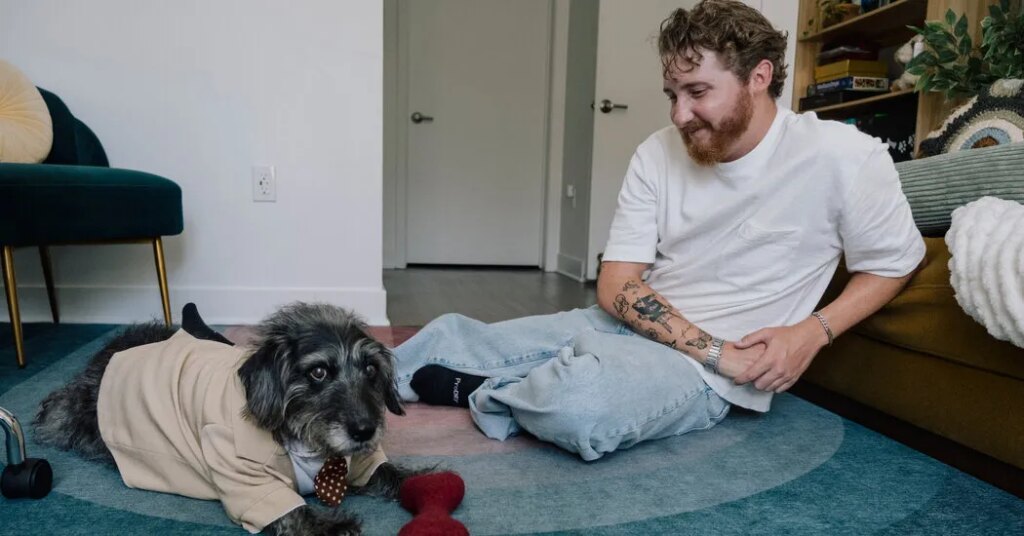
He has an office at home but sometimes takes meetings at a neighborhood coffee shop, accompanied by the WeRateDogs’s current chief executive, a dog named Javier. (It is mostly a ceremonial position.)
Normally the trip takes about 15 minutes. But it is impossible to walk briskly with Javier, an elderly wire-haired dachshund mix with a pleasingly disheveled beard who has trouble navigating the sidewalks of L.A., on account of the curbs.
Nelson and his fiancée, a therapist, adopted Javier, a street dog from Tijuana, from a rescue organization in L.A. several years ago. “He was found in the trash, but not in, like, a bad way,” Nelson said. “He was just rummaging through the trash and loving it.”
One of the company’s foundational principles is that all dogs are good dogs, and good dogs are often very funny, especially when filtered through Nelson’s antic analysis. A case in point: “Puppy Court,” in which Nelson adjudicates cases of dogs charged with offenses like pushing their siblings out of the dog bed or conspiring to hide the crimes of a fellow dog ripping up the wallpaper. (None are found guilty, obviously, even if they did it.)
When WeRateDogs began, Nelson was an 18-year-old college freshman studying golf management at Campbell University, in North Carolina.
“I didn’t have many other interests at the time,” he said. (He currently has a 1.2 handicap and plays golf regularly with a group of video-game-industry friends.)
Like many people who joined Twitter in its earlier, pre-vitriol days, Nelson enjoyed experimenting with writing humorous content for his 10,000 or so followers.
His dog posts — which often featured his parents’ golden retriever, Zoey, plus a funny caption — attracted the most attention. “I realized that, oh my God, maybe the entire internet has the same connection to dogs that I do,” he said.
WeRateDogs had zero followers when Nelson started it in 2015 with a post of his friend’s dog. Four months later, it had amassed 250,000.
The numbers kept creeping up, as Nelson changed his system so that no subject would be given a less-than-perfect rating. “When we did our first 15/10 I was like, OK, inflation,” Nelson said. “We’re gonna have to dial it back.”
Soon he was getting more than 1,000 unsolicited dog pix a day. To help handle the work of sorting them out, he enlisted the help of John Ricci, a University of Pennsylvania student, who had messaged him on Twitter. At the same time, fans were asking him to publicize GoFundMe appeals for dogs who needed medical care, and he saw how much influence the account had.
“I was like, ‘This is worth my complete attention,’” he said.
Also, he realized that he liked rating dogs more than he liked golf management.
He dropped out of college and moved to California with Ricci and Brian Canterbury, the third co-founder of what was now a real company.
WeRateDogs began selling merch — including hats, T-shirts and mugs printed with the slogan “Tell Your Dog I Said Hi.” It courted sponsors and partners, and set up a new video operation. It now has about 20 employees.
Nelson’s videos are lighthearted and funny, but he has a deep commitment to the neediest sorts of dogs: shelter dogs whose age or health problems makes them unlikely to be adopted. In 2020, WeRateDogs started a separate charitable arm, the 15/10 Foundation — the name comes from the highest rating ever given to a WeRateDogs dog — which is financed with merchandise sales and fund-raising.
Since 2021, 15/10 has raised some $14 million, paid the vet bills for 4,648 dogs, and helped find homes for thousands of dogs. It spent $1.7 million on direct dog care this year, said Nicole Burroughs, its executive director.
Ellen Sue Ballon, founder of Deity Animal Rescue, a foster-based organization in Los Angeles, said that Nelson has had an “immeasurable” impact on the world of dog rescue.
In October, he received the Lee B. Walker Guardian Award from the Austin Humane Society, for “exceptional contributions to shelter animal care.”
Real Dogs, Guaranteed
After some coffee out in L.A., Javier and Nelson returned home, slowly. Javier is the successor to Doug, a German shepherd mix Nelson adopted through Deity who had served as the previous chief executive. Doug suffered from arthritis and chronic ear infections, had a mortal fear of the stairs and was aggressive toward other dogs, which made him a less-than-ideal city pet but a perfect 15/10 dog, on the grounds that all dogs deserve homes.
From his office, Nelson fired up his computer and, via video, huddled with WeRateDogs’ social media manager and chief community manager to select the week’s Top Five Dogs, another regular feature.
They had an array of videos to consider, some of them submitted directly by fans, others pulled from the vast ocean of the internet. Before they’re posted, the videos are subject to a series of checks: Are they real? Can WeRateDogs get the rights to post them? Are the animals featured safe and happy? Often, members of the team contact the videos’ makers to authenticate them and to add context to the posts.
Finally, they made their selection. Five Top Dogs. The No. 1 dog that week: Barley, whose epilepsy medication had left him depressed and listless until he met Louie, a duck who became his closest friend and cheerleader, Prozac manifested as waterfowl.
Louie and Barley were 100 percent real, they determined, which set them apart from so many dogs (and ducks, for that matter) being served up online lately. A.I. dogs being rescued by other A.I. dogs after being swallowed by the snow, A.I. dogs carrying ridiculously big sticks, and A.I. dogs competing with humans to eat food off the floor. There’s at least one podcast “hosted” by A.I. dogs.
“When it comes to A.I., our biggest challenge is to make sure that we stay away from it,” Nelson said. While it’s getting harder to sniff out fake videos, WeRateDogs’s team prides itself on its anti-A. I. forensic skills. Some tells: videos with repetitive movements, strange glitches on the edges of the picture, physical details that don’t add up, like a dog walking on the snow but not leaving tracks, and videos coming from accounts full of variations on a single theme, an indication of A.I. trying different approaches to generate the most engagement.
“It’s getting scary,” Nelson said, of A.I., in a podcast episode devoted to the topic earlier this year. “I do not want WeRateDogs or its audience to participate in it, willfully or by accident.”
He pledged that if an A.I. image or video found its way onto his platform, “we will announce that we’ve been had, reaffirm our stance on A.I., and delete it.”
There is nothing like a real dog, he said.
“I promise you can trust us.”
The post WeRateDogs Loves All Dogs. A.I. Puppies Are Another Story. appeared first on New York Times.