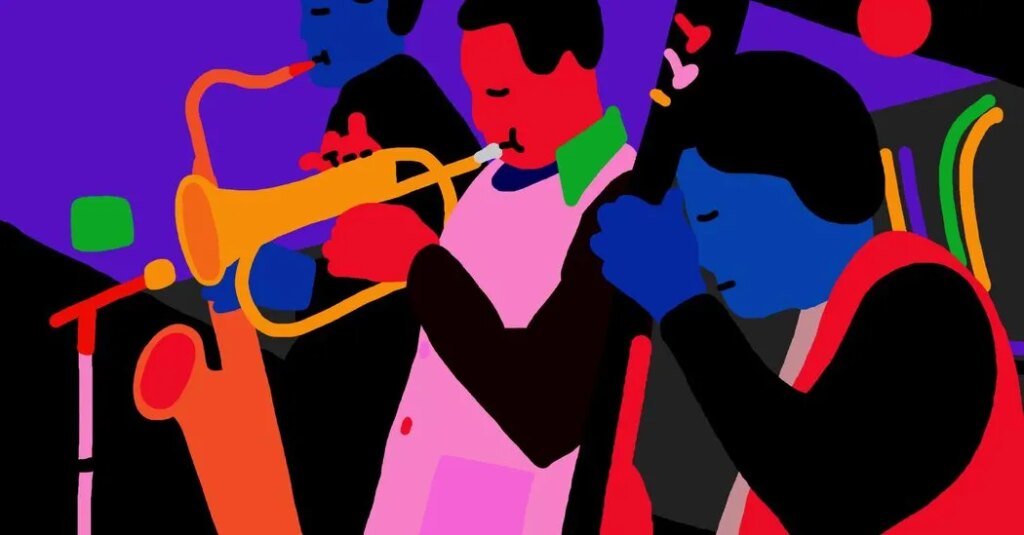
In the late 1960s, musicians began blurring the boundaries between jazz’s improvisational freedom and funk’s deep, unrelenting groove. Jazz-funk emerged: music that was expansive but grounded, sophisticated but not stuffy.
At its core, jazz-funk was a conversation between tradition and the future — sounds that drew from the rhythmic ingenuity of Sly Stone, the spiritual searching of John Coltrane, and the electric experimentation of Miles Davis and Herbie Hancock. Synthesizers, electric pianos, muscular bass lines and intricate drum patterns sent jazz back to the dance floor without abandoning its appetite for risk.
The results were as varied as the musicians themselves. Some leaned into nightclub ecstasy; others pursued cosmic visions, political consciousness or meditative transcendence. Yet the best jazz-funk always understood that complexity could coexist with pure pleasure.
Its influence remains everywhere, from hip-hop producers mining old records for elusive breaks to contemporary musicians like Thundercat and Ezra Collective reshaping its sounds for new generations. Jazz-funk reminds us that innovation occurs when artists listen across boundaries, trust their instincts and let the groove settle in.
Give this music five minutes and you might hear a history lesson, creative evolution, or the sound of a band finding its pocket. Ideally, you’ll hear all three. Read on for a primer in jazz-funk and be sure to leave your own favorites in the comments.
◆ ◆ ◆
Weldon Irvine, ‘Mr. Clean’
LaFrae Sci, musician/executive director at Willie Mae Rock Camp
Weldon Irvine was a liberated brother. A poet before he became a pianist, and notably the musical director for Nina Simone, he penned the song “To Be Young, Gifted and Black.” Based in Jamaica, Queens, Irvine surrounded himself with younger players like Marcus Miller, Bernard Wright and Tom Brown, mentoring and establishing the musical language of a Queens jazz-funk movement, blending spirituality, jazz improvisation, synthesizers and Black cultural identity. An advocate for musicians owning rights to their own music, Irvine self-released his first solo album, titled “Liberated Brother,” in 1972, and in the spirit of self-actualization, even wrote his own liner notes (worth a read!). Rooted in blues and the Black diaspora, every track is a journey, but I love “Mr. Clean” — a future-forward jazz-funk piece that encapsulates the new sonic textures of that moment, grounded by organic elements inviting us, the listeners, to free our minds!
 Listen on Spotify, Apple Music and YouTube
◆ ◆ ◆
The Awakening, ‘Convulsions’
Damon Locks, musician and visual artist
“Convulsions” by the Awakening is a relatively new jam to me in the grand scheme of things. The album “Hear, Sense and Feel” was released on Black Jazz in 1972 but wasn’t on my radar before eight years ago, when I met (my now wife) Tara Aisha Willis and her father, the bassist and A.A.C.M. elder Reggie Willis — a surviving member, alongside Ari Brown, of the Awakening. Black Jazz recently rereleased their two albums.
“Convulsions” is one of those songs with such conviction; the opening melodic phrase is a mission statement that sets up the song wonderfully. It confidently steers its way through the composition at the speed of a stunt-car driver. The snare fills punctuate wonderfully, rooting the song to the ground so it doesn’t fly off the foundations.
When I asked Reggie about his bass playing on the album he was quick to give credit to his bass influences: Ray Brown, Oscar Pettiford and Scott LaFaro. The Awakening is a gem that sparkles even brighter now than when it first released music into the world.
Listen on Spotify, Apple Music and YouTube
Jon Lucien, ‘Listen Love’
Gilles Peterson, D.J., broadcaster and record producer
This is the portal to the world of jazz-funk, a world of music created by musicians and singers that to my ears has always felt pure and authentic in its intention — free of outside influence or commercial concern. While at the time of release it possibly missed the target, with the benefit of time and the help of D.J. culture this type of music became the architecture of a whole new connection with dancers and music lovers. So a song like “Listen Love,” by the Virgin Islander Jon Lucien — which I first heard in a pub in Kingston (South London, not Jamaica) played loud and danced to by a bunch of diverse working-class kids wearing spats, Adidas track suits and berets — blew my mind. From the cosmic intro to the soaring vocals, through a rising tide of percussion, rippling Rhodes and persistent bass throb, this was the holiest of holy grails. There are other songs more identifiable in this genre (Lonnie Liston Smith’s “Expansions” and Webster Lewis’s “Barbara Ann” — both equally majestic!), but this was the one that activated all the senses in the deepest way. So just do what I did that first time — close your eyes and listen.
Listen on Spotify, Apple Music and YouTube
◆ ◆ ◆
George Duke, ‘For Love (I Come Your Friend)’
Lovie, D.J. and radio show host
I was on a trip to Portland, Ore., a few weeks ago when I stopped by the listening gallery Mono Space — the curator there wanted to play me a selection that would truly show the depth of their custom OJAS system. He places George Duke’s “The Aura Will Prevail” (1975) on the turntable, and lets it breathe. As I sink into a love seat, “For Love (I Come Your Friend)” rushes in. An opening crescendo builds into a fast-paced groove, and then suddenly, it drops into an off-kilter pocket. For about 16 bars, the bass stylings of Alphonso Johnson take center stage, and Leon “Ndugu” Chancler riddles off sloppy ad-libs reminiscent of Bootsy Collins. Before long, the track returns to its initial groove: from jazz to funk, then back again. I’m hearing Thundercat, of course I’m hearing MF Doom. I’m in a listening room, but I’m also somewhere else — on a trip through George Duke’s genre-defiant universe, witnessing the creation of a singular gift that keeps on giving.
Listen on Spotify, Apple Music and YouTube
◆ ◆ ◆
Flora Purim, ‘Love Lock’
Sparklmami, artist
Flora Purim’s “Love Lock” is produced by George Duke with the iconic rhythmic percussion of Airto Moreira. I think Flora’s version is special because it captures the jazz-funk of Mtume’s original “Love Lock” track while making it completely her own. I remember picking up Flora’s 1979 “Carry On” record on vinyl from a $1 bin at a local record store. As a new fan, I grabbed it without hesitation, ran home to play it and was hooked immediately.
I appreciated how Flora fully embodies her voice as its own instrument through scatting, breathy vocals and effortless melody. Discovering her work in college opened up a world of endless possibilities for my own creative process. Flora has this incredible ability to make complex music feel so accessible and danceable at the same time — that funky, free-spirited nature is what drew me in and continues to do so.
Listen on Spotify, Apple Music and YouTube
◆ ◆ ◆
The Headhunters, ‘God Make Me Funky’
J. Michael Harrison, radio show host
From its inception, the Headhunters’ “God Make Me Funky” was meant to bring folks together around food and music. Originally composed for an Oakland, Calif., barbecue restaurant’s radio spot, the ad’s overwhelming popularity led to the beloved version that appears on the Headhunters’ “Survival of the Fittest” album. The drummer Mike Clark and bassist Paul Jackson were neighbors of the restaurant. Together with the percussionist Bill Summers and the guitar riffs of DeWayne “Blackbyrd” McKnight, they form the song’s legendary rhythmic framework. The Pointer Sisters (who helped teach many of us to count with their work on Sesame Street’s jazz-funk classic, “Pinball Number Count”) provide the perfect compliment to Paul Jackson’s soulful and spirited vocals, and Bennie Maupin’s soaring, flavorful saxophone work completes the experience.
Listen on Spotify, Apple Music and YouTube
◆ ◆ ◆
Harvey Mason, ‘Wild Rice’
Telemakus, pianist and producer
When I was 6 years old, I would dig through CDs at the library with my older brother. I was captivated by my favorite jazz-funk songs. “Wild Rice” captures the spirit of that time — the song just makes me happy, and the syncopation of Harvey’s off-kilter drum groove, with the Headhunters behind him, brings me back to my blue childhood room, playing those library CDs over and over.
When the bridge section starts, I feel like I’m flying through a field. There is a sweetness in the air. Harvey starts playing the melody on drums, and I go nuts. Lee Ritenour’s guitar melodies and Herbie Hancock’s Rhodes float over this addictive, constantly evolving foundation of rhythm. Then, it’s as if a voice appears: Bennie Maupin’s solo. He’s speaking to us, supported by a bubbling, rising field underneath him. Every instrument is transformed into one. “Wild Rice” is so transportive and light, with a real focus on making the listener feel something in their body.
Listen on Spotify, Apple Music and YouTube
◆ ◆ ◆
Natural Essence, ‘Had No Beginning, Has No End: Simply Is’
Karas Lamb, writer
Natural Essence’s “In Search of Happiness” (Fantasy, 1973) fuses elements of hard bop, rock and soul to capture the heartbeat of an upstart collective led by the pianist Nat Adderley Jr. The album’s closer, “Had No Beginning, Has No End: Simply Is,” is a psychedelic cut featuring the bassist Francisco Centena and drummer Ira “Buddy” Williams that unfolds in a series of emphatic statements and bright bursts of light. Arguably the most intense of the instrumental compositions on the album (mixed by Julian Adderley, David Axelrod, Eddie Harris and Jim Stern), the breakneck pace of “Had No Beginning” is softened by a series of grooves that counter rage with delicate piano melody. Though raw, the song is anything but one-note. “Had No Beginning, Has No End: Simply Is” is a behemoth of jazz-funk experimentation that plays like a live feed of the outer cosmos, where being in tune with the infinite is a matter of relentless rhythm.
Listen on YouTube
◆ ◆ ◆
Jaco Pastorius, ‘Kuru/Speak Like a Child’
Nicole Sweeney, radio show host
Jaco Pastorius had a way of making your body and soul feel something, and in “Kuru/Speak Like a Child” he provides a mixture of funk that takes you to different places. It starts with the beautiful sounds of strings, then enters the drums and percussion before Jaco’s bass makes an entrance, and sends a message that this kind of funk will be sweet and salty — there will be texture and taste, and dare I say sensuality. Herbie Hancock, who is no stranger to funk, adds just the right touch to it (he composed “Speak Like a Child”). The music takes you on an unexpected funk journey: It starts out fast-paced, then it eases you into a slow dance, then back into a groove. One thing’s for sure, it keeps you on your toes. It reminds you that no matter how fast or slow, funk is made for dancing.
Listen on Spotify, Apple Music and YouTube
◆ ◆ ◆
Lonnie Liston Smith and the Cosmic Echoes, ‘Devika (Goddess)’
David Renard, Times senior editor
Five minutes? I’m hooked on this song from Lonnie Liston Smith’s 1975 “Visions of a New World” album in about six seconds, right when the slow, head-nodding drums kick in underneath the untouchably funky bass line that leads off the track. (A couple of decades later that bass line caught the ear of the jazz-inspired hip-hop group Digable Planets, who made it the backbone of “Pacifics” on their heralded debut album.) As the band settles into a mellow groove, the saxophone lines from Dave Hubbard (who wrote the track) float above Smith’s syncopated keyboard playing with a simple and lovely melody. Like a lot of popular fusion groups, the Cosmic Echoes took their lumps from purists at the time — “a diluted, vapid brand of jazz-rock” was how a Times critic summed up the detractors’ views in 1977. But I bet you can’t listen to “Devika” and not be in a better mood when it’s done. Nothing vapid about that.
Listen on Spotify, Apple Music and YouTube
◆ ◆ ◆
Weather Report, ‘Nubian Sundance’
James Mason, musician
As a masterpiece of jazz-funk fusion, Weather Report’s “Nubian Sundance” is paradoxical. On one hand, its transcultural blend of melodic concepts epitomizes the idea of fusion. On the other hand, its polyrhythmic structure is unlike anything most people would associate with funk. Rhythmically, it suggests wide-open spaces and limitless possibility while sitting on a compelling, relentlessly driving drum groove that enables and supports this paradox. Yet it’s one of the funkiest things I have ever heard. I fell completely in love with this composition within the first 30 seconds and have remained in love with it for more than 50 years. If they had done nothing else, “Nubian Sundance” alone justifies Weather Report’s place in a jazz fusion hall of fame.
Listen on Spotify, Apple Music and YouTube
The post 5 Minutes That Will Make You Love Jazz-Funk appeared first on New York Times.