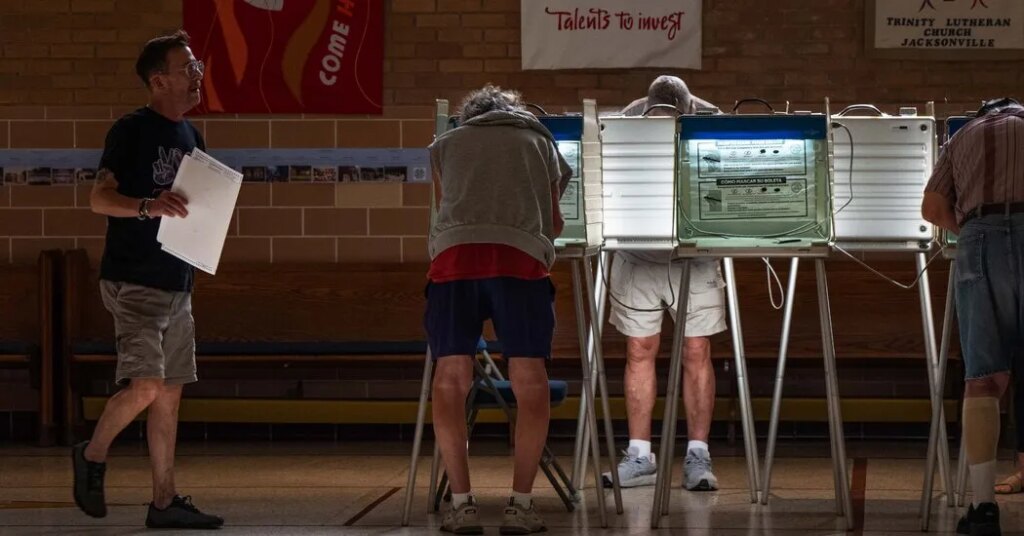
The midterm election has drawn a strong overall turnout, as millions of Americans have already cast their ballots on Tuesday as the midterm cycle approached its conclusion.
Whether turnout can approach the record-setting levels of the 2018 and 2022 midterms, however, won’t be known until polls across the country have closed. But things were off to a strong start when more than 50 million people cast ballots during early voting, which exceeded levels of four years ago in virtually every Senate battleground state.
The turnout thus far on Tuesday has been particularly high in states where Election Day vote tends to make up a larger share of the overall total. In Ohio, for instance, large counties like Franklin and Hamilton were trending significantly higher than what was seen in 2022, with totals not far removed from the presidential election two years ago. (Turnout in presidential elections is consistently far higher than it is in midterms.)
The record for votes in a midterm election came in 2018, when more than 120 million Americans cast a ballot, according to the Election Administration and Voting Survey. In 2022, that declined slightly to 112 million, even as the number of early votes increased — a sign of how the popularity of early voting has shifted voter behavior.
As in previous years, Republicans seem to be enjoying strong Election Day advantages in states that report live turnout by party registration. As of Tuesday afternoon, Republicans in Florida were enjoying a wider advantage than two years ago, voting on Election Day by a nearly two-to-one margin.
Republicans were also leading registered Democrats by 12 percentage points in Nevada, a wider margin than their Election Day advantage in 2024.
In both of those states, registered Republicans made up a smaller share of the advance votes this year than they did in 2024 — and a wide majority of votes are cast ahead of Election Day.
Trying to interpret what turnout on Election Day could mean in various races, however, has similar pitfalls to those seen when trying to analyze the early vote, particularly in states where Election Day totals are unrepresentative. In most states, the raw totals of ballots cast are a useful barometer of overall engagement, but they can’t indicate for whom those votes are being cast. In many cases, advantages for one party in the Election Day vote might result from disadvantages in the early vote.
Direct comparisons to the Election Day turnout in 2022 could be considered an unfair comparison in many states, particularly those that experienced large increases in early voting turnout in 2024, like Georgia, Florida and Texas. (In all three, the raw number of votes cast on Election Day decreased between 2022 and 2024.)
Brad Raffensperger, the Georgia secretary of state, said in a news conference on Tuesday afternoon that Election Day turnout in the state was tracking toward around 1.4 million votes, which would be a slight increase from two years ago and about on par with 2022.
The post Election Day Turnout Is High Across Battleground States appeared first on New York Times.