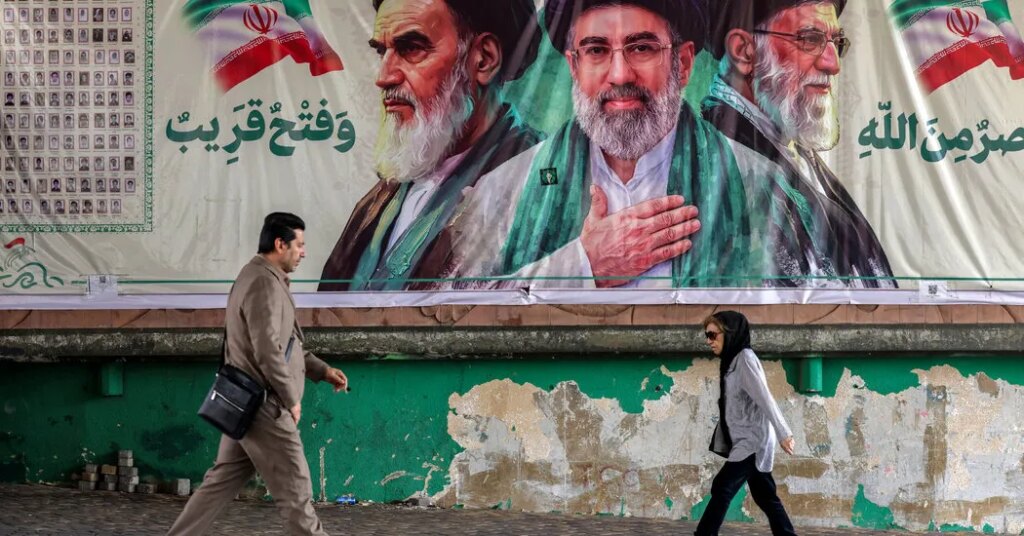
From pulpits at Friday prayers to street rallies, Iranian clerics and officials are increasingly urging the country’s leaders to reverse their longtime pledge not to pursue nuclear weapons.
This demand, once seen as a fringe position held by hard-liners, is moving into mainstream public debate, and the shift could have dramatic consequences for Iran, whose government has for decades argued that its nuclear program was solely for peaceful purposes.
“We must be equipped with nuclear weapons — so that we can fight the criminal America with strength, God willing,” Ali Sepahvand, the Friday prayer leader in Iran’s western city of Kuhdasht, said last week, according to a widely distributed video.
As his voice echoed through a prayer hall, covered in photographs of commanders killed in the war with the United States and Israel this past year, the congregants chanted: “Nuclear deterrence is our inalienable right!”
The growing calls for Iran to pursue nuclear weapons come as the country’s leaders engage in diplomatic efforts to stave off renewed war with the United States and Israel, an outcome widely considered likely after the American midterm elections on Tuesday.
For decades, Iran’s officials have publicly endorsed the fatwa, or religious edict, from its supreme leader, Ayatollah Ali Khamenei, which forbade the development and use of nuclear weapons. Issued in his capacity as the head of Iran’s theocratic state, his decree barred Iranian institutions, including the military and Islamic Revolutionary Guard Corps, from pursuing a nuclear bomb.
Yet at the same time, Western intelligence agencies in past years reported signs Iran was enriching uranium to levels close to those that could be used to develop a bomb. Some officials in Israel and the United States accused Iran of preparing to build one, regardless of the fatwa.
To curb this threat, the United States and other world powers reached an agreement with Iran in 2015 to restrict its nuclear activities. Three years later, President Trump pulled out of that agreement.
Ayatollah Khamenei’s strategy, regional analysts say, had been to keep Iran’s nuclear intentions ambiguous in hopes of deterring attacks on Iran without it actually becoming a nuclear power.
But that approach failed to prevent the two wars Israel and the United States have waged against Iran since June 2025 — including the one in which Mr. Khamenei was himself killed in February.
“He created this neither in nor out situation, where they paid for a bomb they didn’t have,” said Mohammad Ali Shabani, an Iran analyst who edits the independent regional news site Amwaj.media. “Now, there is this sense that unless you have this ultimate weapon, you could end up at the mercy of not just the U.S., but Israel, at any point.”
President Trump’s own comments may strengthen this assessment, analysts say.
“If they had a nuclear weapon, I’d be calling the Supreme Leader and I’d be saying, ‘Mr. Supreme Leader, how are you, sir? Is there anything we can do for you?’ As opposed to bombing the crap out of him,” Mr. Trump said at the Republican midterm convention in September.
Inside Iran, calls for withdrawing from the Treaty on the Non-Proliferation of Nuclear Weapons, or N.P.T., which prohibits development of a nuclear weapon, have been growing ever since Israel and the United States attacked in 2025.
In recent weeks, an increasing number of Iranian political and religious figures have added their voices to this chorus, suggesting to some Iran analysts that there is an effort orchestrated, or at least enabled, by the country’s leadership.
It is unclear whether serious debate over Iran’s nuclear doctrine has reached the new supreme leader, Mojtaba Khamenei. But on Saturday, Iran’s top national security figure, Mohsen Rezaei, said in an interview on state television that Iran’s leaders were discussing it.
“No new decision has been made yet,” he said. “Of course, the debate now is whether we want to keep the same doctrine we had before the war, if war breaks out again.”
Advocating for withdrawal from the N.P.T. was once a minority position within Iran’s leadership, said Mohammad Ghaderi, a foreign affairs expert in Tehran.
Now, he argued, it is becoming a majority view. “They argue that if the military threats from the United States and Israel persist, withdrawing from the N.P.T. represents a crucial step toward establishing deterrence,” he said.
Raising the nuclear prospect at a time when Iran could be at the cusp of another possible attack by the United States or Israel may itself be a strategy, said Omid Memarian, an Iran analyst at DAWN, a Washington-based Middle East research group.
Mr. Rezaei’s entry into the debate, while Qatar has been leading intensive mediation efforts between Washington and Tehran, may be an attempt to push the United States to reach a deal, Mr. Memarian said.
“They are playing with this card: If the negotiation fails, we will seek a different path, and it will be costly for you,” he said.
Especially notable has been the number of Friday prayer leaders adding their voices to the calls and effectively challenging the late ayatollah’s fatwa.
“The taboo is gone,” said Mr. Shabani. “A religious foundation for the shift is here. The question is whether a strategic or political shift will follow.”
Some of Iran’s leading reformist figures, like the president Masoud Pezeshkian and former president Hassan Rouhani, continue to back Iran’s peaceful nuclear doctrine.
In Iran’s leading reformist newspaper, Shargh, a former diplomat, Kourosh Ahmadi, warned this week that abandoning that doctrine poses grave risks. The plethora of pro-weapon statements from prominent figures, he said, “is dangerous because it makes the work of officials trying to prevent another war more difficult.”
And until Iran could manage to build a bomb, he argued, the chances of being attacked would actually increase.
After U.S. and Israeli strikes wiped out most of Iran’s top leadership and battered its infrastructure, it is harder for critics of the nuclear option to make their case, said Sina Toossi, an Iran expert at the Center for International Policy, a Washington-based think tank.
“The central problem for advocates of restraint is explaining what Iran gained from remaining below the nuclear threshold,” he said.
At the same time, he said, a new round of U.S. attacks “could strengthen the very arguments for the nuclear weapons that Washington says it wants to prevent.”
At public prayers in Tehran on Friday, the prayer leader, Mohammad Javad Haj Ali Akbari, declared that changing Iran’s nuclear doctrine was “a national demand,” according to a video posted on social media.
His congregants immediately responded with a refrain common at government-sponsored rallies from decades past: “Nuclear energy is our inalienable right!”
“This is an old slogan,” he told them, and smiled: “We have gone way beyond that.”
Leily Nikounazar and Sanam Mahoozi contributed reporting
The post On Cusp of Renewed War, More Iranians are Calling for Nuclear Weapons appeared first on New York Times.