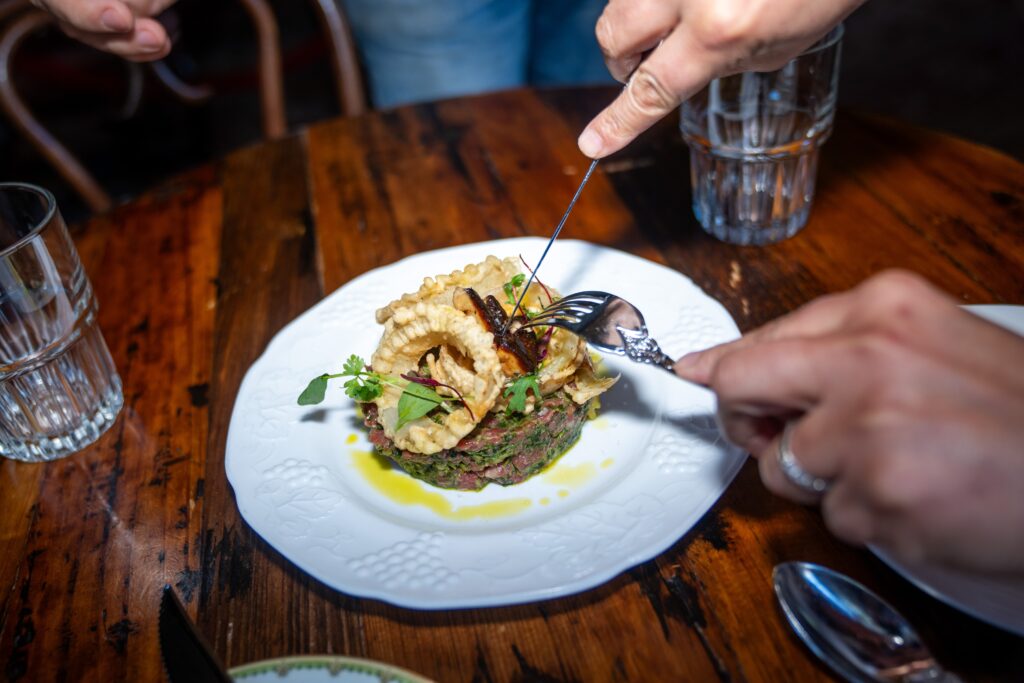
As voters across the United States decided the fate of Congress on Tuesday, voters in the District faced a decision on duck livers.
Instead of high-stakes votes that could determine the trajectory of the country, D.C. residents weighed a citywide ban on foie gras, the French delicacy with a fancy name and a recipe some argue amounts to bird torture.
The group Pro-Animal DC and other backers of the ban say it’s cruel to force-feed ducks and geese with a tube down the esophagus to enlarge their livers before slaughter. Foie gras fans say the dish is delicious and no more fraught than other meats people put on their plates.
On Tuesday morning in the Wesley Heights neighborhood, where houses sell for millions of dollars, several residents said they opposed the ban, known as Initiative 86. The number is restaurant slang for when an item is out of stock.
“I love to eat foie gras,” said attorney Nick Schandlbauer. “I don’t like initiatives that interfere with hundreds of years of history and artisanal food-making.”
Outside Horace Mann Elementary School, Todd Boulanger, a 55-year-old consultant, said he also voted against the initiative. “I don’t think you should restrict restaurants,” he said. “It’s a delicacy.”
Boulanger said he thought it was “weird” that foie gras was on the ballot at all.
In the same neighborhood, 67-year-old Rebecca Ellertson voted in favor of the ban.
“It’s inhumane, and foie gras isn’t good for your cholesterol. Who buys it anyway?” the retired teacher said. “Rich, wealthy people eat it. I vote for the working class.”
Pro-Animal DC has spent more than $470,000 throughout its effort to kill foie gras in the District, according to campaign finance filings. The crusade has a mascot: a duck named Olivia who waddles around the city with her presumably healthy liver and her owner, Meghan Abrego.
Abrego and Olivia spent Tuesday morning at Eastern Market. “Everyone recognized her,” Abrego said. She planned to bring Olivia to Tuesday evening’s watch party for Oye Owolewa, the Democratic nominee for an at-large D.C. Council seat, Abrego said.
Those who enjoy foie gras — or don’t think it should be singled out — have said a ban would be an intrusive and ridiculous use of government power. Celebrity chef José Andrés has come out in opposition to a ban. “So we are banning all meats? If Duck goes all goes next?” he wrote on social media.
Peter Cole doesn’t like foie gras, but he still voted against the ban. “I think it’s an overreach,” said Cole, who owns a company that runs private social clubs.
Besides determining a major shift in who controls Congress, voters across the U.S. are also deciding on a range of ballot initiatives. In California, a wealth tax is on the table. Idaho residents are voting on abortion access — and an official state gun. Transgender rights are on the line in several states.
Denver is also considering a foie gras ban. But in the nation’s capital — where the race for mayor was essentially decided in June’s Democratic primary and where residents are not represented by a voting member of Congress — the issue provided the only serving of political drama on the ballot.
The debate has spawned Halloween costumes and a tasting menu at the conservative haunt Butterworth’s; it has become a sort of litmus test for morality.
With the lack of drama in the mayor’s race, Allison Hanna said, the foie gras initiative “felt like a reason to go to the polls today.”
“I don’t care for foie gras. I also don’t care for the mistreatment of animals,” she said.
Her husband Matt Hanna also voted for the ban, but he said, “It does seem a little silly that it’s on the ballot.”
At the Palisades Recreation Center in Northwest Washington, some voters smiled politely but shuffled past Liesel Wolff, a volunteer for the Initiative 86 campaign, as she held a poster of a duck being force-fed. Others ignored Wolff as she chirped: “Good morning. Do you know how you’re going to vote on Initiative 86?”
Joe McHugh, 68, said he thought there were more important issues to deal with, such as gun violence, education and the region’s high cost of living.
“I’m not sure it rises to the level to be a ballot initiative,” he said. He left the question blank on his ballot.
Todd Stein, 59, a vegan who works on Capitol Hill, voted for the ban. “We should be a state, so we can vote on senators, but until we get that,” he said, “we vote on things like whether to be cruel to animals.”
But Frank Vogl, 80, who lives in Palisades and works as an adjunct government professor at Georgetown University, disagreed.
“It’s almost making a mockery of the system,” he said after voting against the ban. “We have an affordability issue in this country. How many people are going to go out and order foie gras?”
Some people flip-flopped.
Lauren Briggerman said she signed the petition to get the foie gras ban on the ballot. But the attorney actually likes foie gras, she said, and after reading an op-ed by Butterworth’s chef Bart Hutchins in The Washington Post, she decided she couldn’t support the ban anymore.
She left that question blank on her ballot, unable to square the ethical dilemma.
“Hopefully,” she said, “no one’s going to come egg my house.”
The post D.C.’s biggest Election Day fight is whether to give foie gras the bird appeared first on Washington Post.