The last straw for Representative Haley Stevens came Saturday afternoon.
She was on the cusp of appearing at a unity event with Dr. Abdul El-Sayed, who defeated her in a summer primary and became Michigan’s Democratic Senate nominee. Several powerful intermediaries had been trying to broker peace between the former rivals, who were sparring over Dr. El-Sayed’s strong criticisms of Israel.
But after Ms. Stevens issued a hostile statement Friday morning calling upon Dr. El-Sayed to condemn an ad made by a supportive PAC and make other concessions, he stepped before reporters and said what his campaign had been signaling privately: He no longer wanted Ms. Stevens to join him at a Detroit church on Sunday.
It was one thing not to be welcomed by Dr. El-Sayed’s Senate campaign. It was quite another for him to say so in public.
So Ms. Stevens on Sunday did what she had been telling everyone she would not do. She endorsed former Representative Mike Rogers, Dr. El-Sayed’s Republican opponent in a race critical to control of the Senate.
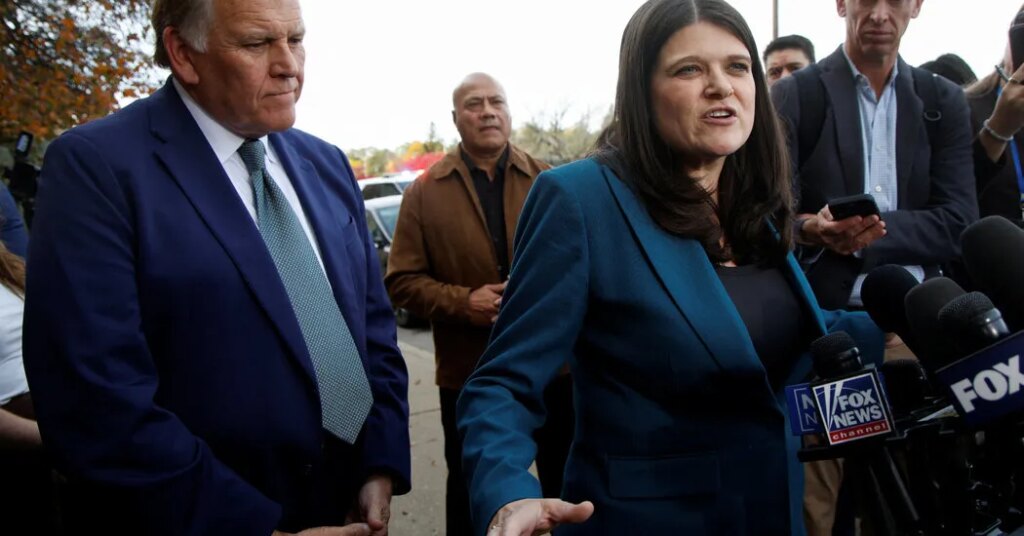
“Abdul made very clear that I was not welcome in his campaign, that he didn’t need me there, that he didn’t want me there,” Ms. Stevens said while standing next to Mr. Rogers outside a Black church in Detroit, where they had just attended the Sunday service. “I did endorse the Democratic nominee, and he chose to close this campaign by saying I wasn’t welcome. I’ve never been invited to a campaign event. That’s fine. You know, he’s busy. He’s running all around.”
Ms. Stevens’s extraordinary declaration and church appearance with Mr. Rogers were a stunning denouement of her weekslong feud with Dr. El-Sayed, who narrowly defeated her in the Michigan Senate primary in August. Throughout their evident tension this fall, she insisted she was a team player and a good Democrat who would grit her teeth and back Dr. El-Sayed while working hard for other party members on the ticket.
Their dispute is deeply personal, involving slights between two mercurial millennial politicians of sizable egos quick to take offense.
Dr. El-Sayed, supremely confident, did not wish to give an inch to a defeated rival. Ms. Stevens, still absorbing her primary loss, eventually felt scorned by his campaign’s failure to include her in events or reach out to her for her views and embarrassed to be told to stay away.
But the breach also represents a major fissure coursing through the Democratic Party about what its relationship with Israel and Jewish donors should be. Dr. El-Sayed, if he wins on Tuesday and enters the Senate in January, would be the most anti-Israel U.S. senator since the formation of the Jewish state 78 years ago.
For now, the collapse of the Stevens-El-Sayed alliance has created an embarrassing and potentially costly drama for Democrats in a race that holds Republicans’ best chance of flipping a Senate seat. Ms. Stevens faced a swift backlash on Sunday from her party, which was caught off-guard by her defection.
“It’s just really unfortunate given the stakes that this has turned into such a spectacle because of one person,” said Lonnie Scott, a veteran Michigan Democratic operative. “It is definitely not ideal that we’d be talking about Haley Stevens three days out from an election.”
This account of their split is based on interviews with more than a dozen people involved in or briefed on talks with Dr. El-Sayed’s camp and Ms. Stevens’s team, some of whom spoke on the condition of anonymity to describe private conversations, as well as public remarks from Dr. El-Sayed, Ms. Stevens and Mr. Rogers.
A Unity Breakfast, and Then Nothing More
Days after Dr. El-Sayed won a bitter primary race against Ms. Stevens in August that centered on disagreements over Israel, they appeared together at a unity breakfast. Ms. Stevens gave him a hug. And that was about it.
Since then, Dr. El-Sayed’s campaign hired a handful of Ms. Stevens’s campaign staff members, but he had next to no communication with her, according to Ms. Stevens and two others with knowledge of their relationship. She was never invited to campaign with him, nor were her thoughts solicited about how to proceed.
At times, other Democrats tried to include her in the campaign.
In mid-September, Ray Wert, whose wife, Mallory McMorrow, had ran in the Democratic Senate primary but finished a distant third, texted Ms. Stevens. He had a request.
Mr. Wert, who is active in Democratic circles, wanted to publish an opinion essay in Ms. Stevens’s name attacking Mr. Rogers in a Jewish news outlet.
Ms. Stevens was initially receptive, according to screenshots of texts Mr. Wert provided to The New York Times.
“I really like what you wrote,” she messaged to Mr. Wert on Sept. 20.
Mr. Wert replied, “I hope I captured your voice.”
“You did,” she replied. “So nice.”
In late September, Ms. Stevens was suggesting edits to the essay over text. But something seemed to change at the end of the month.
“Pls hold for now,” she wrote on Sept. 30, without elaborating. “I love you all but cannot move forward with this right now.”
At the root of the disagreement between Ms. Stevens and Dr. El-Sayed was U.S. policy on Israel. Dr. El-Sayed has emerged as one of the Democratic Party’s leading critics of Israel. Ms. Stevens, who is not Jewish, once said “I see Israel in my dreams” at a Hanukkah service. The American Israel Public Affairs Committee, which supported her in the primary, spent at least $30 million attacking Dr. El-Sayed during the primary and began spending more starting in October.
Ms. Stevens’s fiancé is Jewish and is an AIPAC donor. She said in an interview on Friday that she is considering converting to Judaism.
The El-Sayed campaign believed no amount of acquiescence to Ms. Stevens would be sufficient, according to one of his campaign officials. So when she began to issue demands late last month that he disavow an ally’s online ad that she viewed as antisemitic, Dr. El-Sayed at first did not budge. She became increasingly critical of him in her cable television appearances. He tried to ignore her.
By last Wednesday, Ms. Stevens said she would not be campaigning with Dr. El-Sayed. That day, her fiancé, Jason Turkish, endorsed Mr. Rogers. He said that Dr. El-Sayed would make the world less safe for Jews, and that he hoped Ms. Stevens would run for the Senate again in the future.
Representative James E. Clyburn of South Carolina, a Democratic power broker and mentor to Ms. Stevens in the House, was privately growing nervous that Ms. Stevens might pull her support from Dr. El-Sayed and back Mr. Rogers.
In the eyes of some Democrats, it was time for an intervention.
On Thursday, Representative Debbie Dingell, the dean of the Michigan Democratic House delegation, sought to make peace. She arranged for Mr. Clyburn to invite both Ms. Stevens and Dr. El-Sayed to church on Sunday. Neither Ms. Stevens nor Dr. El-Sayed could refuse. Ms. Stevens looked up to Mr. Clyburn as a leader. Dr. El-Sayed needed a big turnout from Black voters. On Thursday, Ms. Stevens said she had been asked to participate in a “souls to the polls” event and would be there.
From Signs of Peace to All-Out War
Ms. Stevens had one condition. She wanted Dr. El-Sayed to disavow an ad produced by a PAC that backed him, saying it was antisemitic because it blamed U.S. support for Israel for high grocery prices.
On Friday morning, she released a lengthy statement that abruptly reignited tensions. She said that she had learned that Dr. El-Sayed planned to condemn the ad and called on him to apologize for comments he had made about Israel, as well as to take down an ad from his campaign featuring Tucker Carlson.
She said in an interview at her home later on Friday that she had been given a promise that Dr. El-Sayed would denounce the ad. She would not say who made that promise.
Dr. El-Sayed did not directly address Ms. Stevens’s public demands on Friday. But he was clearly fed up. He released a statement saying Ms. Stevens “seems intent on relitigating a primary that ended three months ago.”
Then came Saturday.
By the afternoon, Dr. El-Sayed was getting peppered with reporters’ questions about Ms. Stevens. He condemned the ad she objected to. But he also issued a stern warning: He did not want Ms. Stevens to appear with him on Sunday.
“I don’t want any distractions,” Dr. El-Sayed told reporters after a rally outside Detroit. He added, “It seems as though other folks are more interested in making this race about things that it’s not about.”
An aide helped Ms. Stevens craft a statement of her appreciation for his stance against the ad. It did not mention his public disinvitation. As late as Saturday evening, Ms. Stevens told allies that she was still behind Dr. El-Sayed and planned to lie low through the weekend.
‘Blindsided’
Democrats were on edge Sunday morning, with uncertainty hanging over the unity event later in the day. Would Ms. Stevens even be there? Would there be some kind of confrontation? Or maybe another peace offering?
There were positive signs the night before. Around 6 p.m. Saturday, former Gov. James Blanchard of Michigan, a Democrat, received a message from Ms. Stevens asking him to join her at the service with Dr. El-Sayed and Mr. Clyburn.
And about 10 p.m., Representative Jamie Raskin, a Maryland Democrat, spoke with Ms. Stevens and pressed her on whether she was still behind Dr. El-Sayed.
“I just want to be very clear about that: You’re supporting the whole ticket, including Abdul?” he asked her. She said yes.
Mr. Raskin went on NBC’s “Meet the Press” Sunday morning and sought to assure viewers she was still on board.
His information was out of date by the time he said it.
On Sunday morning, Ms. Stevens woke up angry about being told not to come to church. She called Mr. Rogers and asked if they could attend church together, a gesture he immediately embraced, she later explained. She told none of her friends and allies in Democratic politics about her plans.
They were all shocked to see her walk into the church with Mr. Rogers.
The two sat together in the second pew through an hourlong church service. Ms. Stevens occasionally clapped and raised her arm in praise while Mr. Rogers smiled. During the service, she posted an online video announcing she was endorsing him. “I don’t belong in Abdul’s campaign,” she said.
When the service was over Ms. Stevens and Mr. Rogers walked outside to greet a throng of reporters.
“I woke up this morning, and I decided to go to church,” Ms. Stevens said. “I’m here with the person who I am voting for for United States Senate and that is Mike Rogers.”
Mr. Raskin said he was “totally blindsided.”
‘None of this matters’
The blowback to Ms. Stevens was swift. Her congressional staff resigned en masse. Her onetime Democratic allies coordinated on group chats with the El-Sayed campaign about how they could be helpful and asked advice about what to post on social media. The Michigan Democratic Party chairman announced Ms. Stevens was kicked out of the party now and forever. Senator Chuck Schumer of New York, the Democratic minority leader, who privately backed Ms. Stevens in the primary, called it “a despicable betrayal.”
“I’m disappointed, but I understand,” said Mr. Clyburn, referring to Ms. Stevens’s decision.
Dr. El-Sayed brushed it off. “None of this matters,” he told reporters after attending the church service where he and Ms. Stevens were once scheduled to appear together.
Later in the day, a poll from The New York Times and Siena University showed Dr. El-Sayed leading Mr. Rogers by 11 percentage points.
Still, Republicans were gleeful for much of the day about the defection and the messy Democratic infighting. “Wow, this is BIG!” President Trump wrote on his social media site.
Mr. Rogers, standing with Ms. Stevens after church in Detroit, declared himself “honored” to have her support and said it came as a surprise. He cited the Rev. Dr. Martin Luther King Jr. and suggested he was in a better position than he would have been had she won the primary.
“I’m glad I’m not running against Haley Stevens today,” Mr. Rogers said.
Then he and Ms. Stevens got into separate cars and drove away.
The post Inside the Abdul El-Sayed-Haley Stevens Meltdown in Michigan appeared first on New York Times.