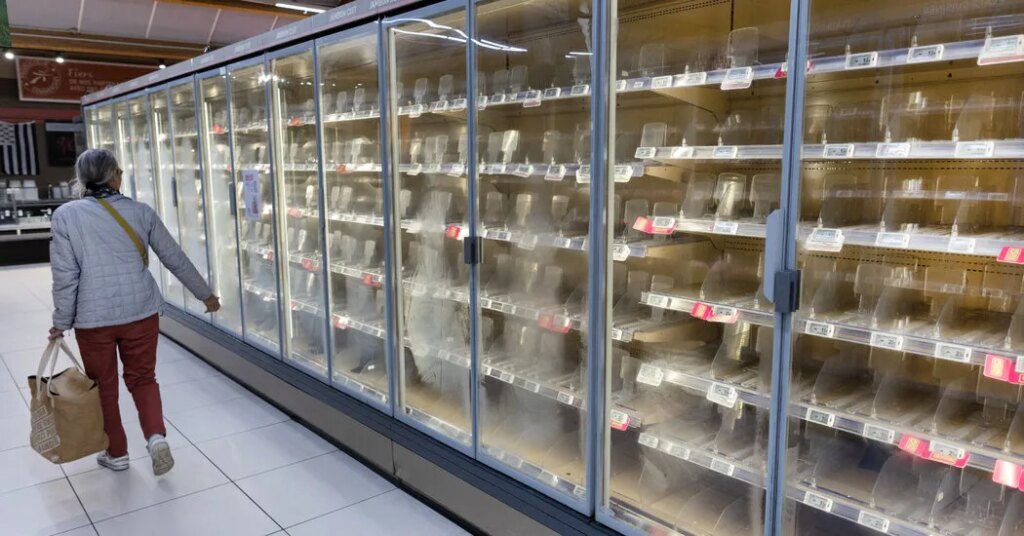
A spate of appliance malfunctions at U.S. military facilities over the summer seemed like just a nuisance: Refrigeration systems had failed at commissaries, spoiling food and temporarily limiting supplies.
Then, last month, freezers malfunctioned at hundreds of grocery stores in France in what officials called a cyberattack. On Monday, retailers in at least seven more European countries reported problems with refrigeration units.
Though it was not clear what caused the disruptions, experts said they had the hallmarks of cyberattacks. On Monday, the U.S. Army said that its cyber investigators were looking into the issue.
Here’s what to know:
What happened at the U.S. military sites?
On Aug. 26, freezers at a market in Fort Huachuca, an Army base in Arizona, suddenly went into defrost mode, according to a Facebook post from the base. All the food in those freezers was spoiled.
The same day, Naval Station Newport in Newport, R.I., reported “refrigeration system issues at the commissary.”
Army officials are now investigating whether those malfunctions and others at U.S. military facilities in August were part of a wider cyberattack, Reuters reported last week. Asked on Monday about the Reuters report, the Pentagon acknowledged “speculation regarding a potential cyber incident” and said that its inspector general’s office was investigating the matter.
The Army’s Criminal Investigative Division separately confirmed that its Cyber Field Office was looking into what happened at the commissaries — and working with French law enforcement agencies “in understanding the refrigeration outages in Europe.”
Have such problems occurred elsewhere?
Last month, hundreds of supermarket refrigeration systems were targeted in France, with more than 400 stores experiencing some form of equipment malfunction. The French authorities said they were investigating it as a cyberattack, but have not identified culprits.
On Monday, supermarkets in Belgium, Estonia, Finland, Ireland, Luxembourg, the Netherlands and Sweden reported issues with cooling systems. Many of the stores reported that the temperature in the units started rising uncontrollably, blowing hot air and spoiling the refrigerated products.
Brecht Stinkens, 38, manager of a Delhaize supermarket in Hoeilaart, Belgium, said in an interview that alarms were going off on several of his refrigerators at 4 a.m. Monday, and he immediately thought of what happened in France.
“Given what happened 14 days ago, I already knew what was going on,” he said. He estimated that his store lost about 100,000 euros ($112,000) because of spoiled food.
No one has claimed responsibility. The federal prosecutor’s office in Belgium said that it had opened an investigation into the malfunctions, though it did not say they were the result of a cyberattack.
The European Commission issued a statement that suggested it believed the systems had been hacked. It showed how “cyberattacks can disrupt services, affect businesses and directly affect citizens’ daily lives,” said Louise Bogey, a spokeswoman for the commission, the European Union’s executive arm.
Can a freezer be hacked?
Yes. Many supermarkets and large chains use centrally connected refrigeration systems with temperatures that are set remotely using internet connections. While many of these systems have cybersecurity protections, older ones are more vulnerable to hackers.
“We have a huge legacy problem in food and beverage as a whole,” said Sean Tufts, the chief technology officer of Claroty, a cybersecurity company in New York. “Historically, those kinds of things were always offline.”
The attack in France last month targeted systems made by three manufacturers whose units were remotely controlled, the national cybersecurity agency said at the time. Danfoss, one of the manufacturers, said that most of the affected units were older and did not have software updates that many manufacturers now use to secure their systems.
Mr. Stinkens said that the monitoring equipment for his store’s cooling system was also supplied by Danfoss. “That system was hacked,” he said.
Why would anyone hack a freezer?
The glitches highlight what experts say is the vulnerability of supply chains for day-to-day goods, especially as more parts of the consumer economy are connected to the internet.
Banks and technology companies have spent years building systems to protect against these sorts of weaknesses, but it is only more recently that workaday appliances such as freezers have become targets, experts said. For malicious actors, panic can be sowed by disrupting something as common as a grocery store, Mr. Tufts said.
“Food security is often taken for granted in Western countries,” said Richard Jones, a professor of criminology at the University of Edinburgh who studies cybersecurity and supply chains. “This is a wake-up call.”
Koba Ryckewaert contributed reporting.
The post Are Freezers Being Hacked? Europe and the U.S. Military Are Investigating. appeared first on New York Times.