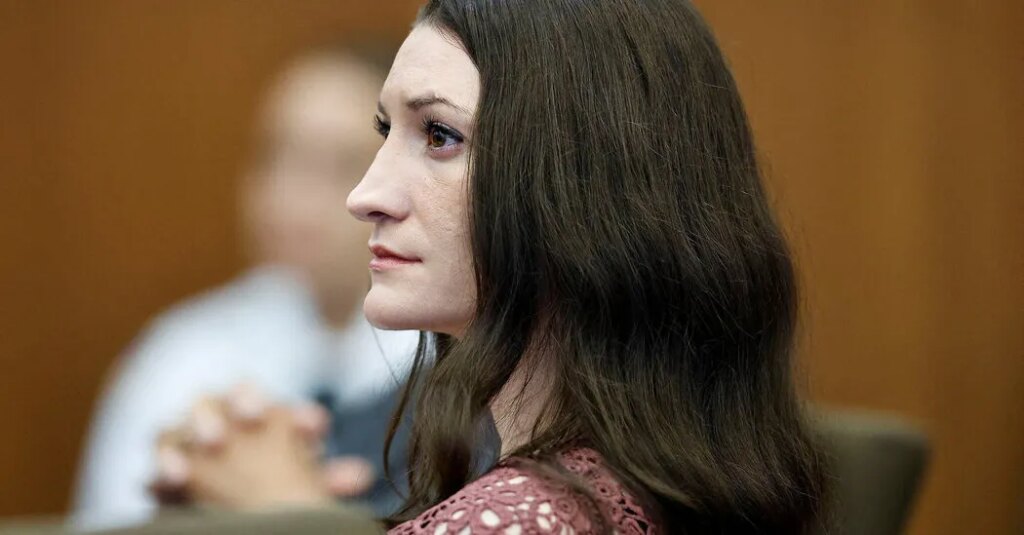
Lindsay Clancy, the Massachusetts woman charged with strangling her three young children in 2023, will return to court on Monday for a hearing that could reveal whether prosecutors will try her again for first-degree murder or reduce the charges, potentially avoiding a second jury trial.
Lesser charges could allow Ms. Clancy to have a bench trial the second time around, with a judge, not a jury, deciding her fate. Jurors at her trial this summer were unable to break an 11-1 deadlock after nearly 40 hours of deliberations, and Judge William Sullivan declared a mistrial on Sept. 2.
Judge Sullivan could set a new trial date during Monday’s hearing in Plymouth Superior Court, as well as rule on several motions. One, filed by Ms. Clancy’s lawyers, argues for the dismissal of the murder charges against her, on the grounds that the mistrial could have been avoided if Judge Sullivan had dug deeper into the conduct of the holdout juror who voted to convict her.
Others on the jury had complained during deliberations that the holdout was not following the rules regarding reasonable doubt. While the judge questioned all 12 jurors about it, he rejected a defense request to replace the holdout with an alternate. Soon after, he declared a mistrial. Ms. Clancy’s lawyer, Kevin Reddington, later asked for the charges to be dismissed.
Mr. Reddington has also argued for additional investigation of the holdout juror. The juror released a statement in late September saying he had no doubt that Ms. Clancy was guilty.
Prosecutors have asked the judge to bar lawyers from commenting publicly on the case from now on, a motion that Ms. Clancy’s lawyers have opposed.
Ms. Clancy’s case attracted an enormous national audience during her six-week trial. Public reaction to the outcome was fiercely divided, with the juror who voted to convict Ms. Clancy at the center of the debate.
Ms. Clancy, 36, has remained in custody at a state hospital since the mistrial.
Timothy Cruz, the Plymouth County district attorney, has built a reputation as hard-nosed and uncompromising. But his decision about whether to reduce the charges may be influenced by the jury’s near-consensus in the summer trial, when 11 of 12 jurors concluded that Ms. Clancy should be found not guilty by reason of insanity.
If found guilty of first-degree murder, Ms. Clancy would face a sentence of life in prison; the sentence for second-degree murder includes the possibility of parole after 15 years.
Ms. Clancy’s lawyer argued at trial that she was not criminally responsible for killing Cora, 5; Dawson, 3; and Callan, 8 months; because she was in the throes of severe postpartum mental illness at the time. After strangling the children, Ms. Clancy cut her wrists and throat and jumped from a window, sustaining spinal injuries that left her paralyzed.
The trial revived a national debate about postpartum mental illness, its treatment and how criminal cases involving postpartum women should be treated by the courts. The defense focused on Ms. Clancy’s persistent but unsuccessful efforts to find effective mental health care in the months and weeks before the killings, as she descended into anxiety and depression and struggled with intrusive thoughts about harming her children.
After the mistrial was declared, several jurors who voted to find her not guilty publicly criticized the holdout juror, arguing that he expressed doubt about Ms. Clancy’s guilt but refused to support her acquittal. The juror later said he had no doubt that she was guilty.
Some followers of the case have criticized the 11 jurors who favored acquittal, while others have focused on details that emerged about the holdout juror’s past, including the fact that he had been charged in 2021 with misdemeanor domestic violence. The charge was later dismissed.
The online furor around the case has raised concerns about the prospect of seating another jury for a second trial, given the trepidation many prospective jurors might feel about their possible exposure to criticism and threats.
The post Judge in Clancy Case to Weigh Motion to Dismiss Charges at Hearing appeared first on New York Times.