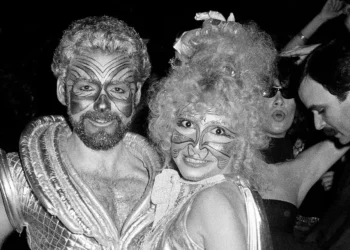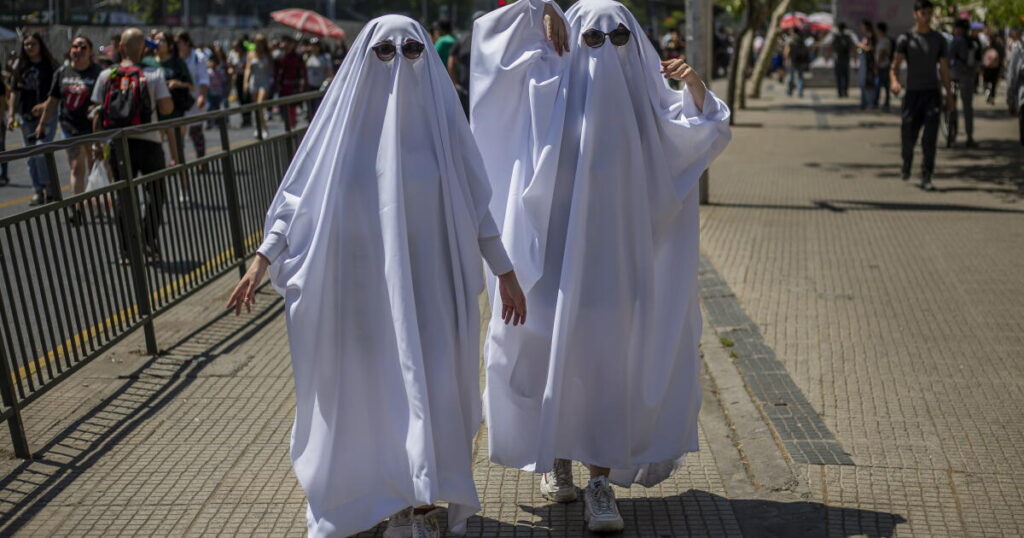
Every Halloween, my children watch their friends dress up as ghosts, witches and monsters, collect candy and revel in the excitement. And every year, I explain why our family doesn’t participate.
It’s not because I fear Halloween. In fact we gladly hand out candy to trick-or-treaters. It’s because I fear a culture increasingly willing to surrender reason to superstition.
I know for most families it’s just candy and costumes. I don’t believe a child wearing a witch’s hat will suddenly embrace witchcraft or that carving a jack-o’-lantern means believing in evil spirits.
But Halloween is an occasion to confront a year-round hazard: Americans remain remarkably susceptible to supernatural and superstitious claims, even in an age of extraordinary scientific achievement.
A Gallup survey last year found that 39% of Americans believe in ghosts, 27% believe people can communicate with the dead and 25% believe in astrology. A 2026 YouGov poll found that 44% believe ghosts probably or definitely exist.
And this isn’t merely a harmless fascination with the unexplained. Belief can carry consequences.
People spend money consulting psychics who claim to predict their futures. Grieving families turn to mediums promising messages from deceased loved ones. Vulnerable people make decisions about relationships, finances and health based on claims that lack credible scientific evidence.
What disturbs me isn’t that people enjoy a good ghost story. It’s that some people mistake the story for reality.
As an observant Jew, I raise my children in a home filled with religious traditions, rituals and a belief in God. I recognize the apparent irony of a religious father warning against supernatural beliefs.
But faith and superstition aren’t synonymous.
My faith gives me a framework for understanding life’s deepest questions. It doesn’t require me to believe that a stranger with tarot cards can predict my children’s futures or that a psychic can summon my deceased father.
In fact, the Torah explicitly prohibits divination, sorcery and consulting the dead. Deuteronomy 18 condemns these practices, while Leviticus 19:26 warns against divination and soothsaying.
Religious devotion does not grant permission to surrender intellect. Eight centuries ago, the philosopher Maimonides dismissed astrology, divination and sorcery as falsehoods that deceive the gullible. He insisted that faith must not come at the expense of reason.
Modern polling reveals an equally striking paradox.
Gallup’s 2025 survey found that 78% of Americans who attend religious services weekly or almost weekly were classified as paranormal skeptics, compared with 57% of those who never attend.
Those findings challenge the fashionable assumption that abandoning organized religion necessarily produces a more rational society.
Perhaps established religious traditions, with their theological boundaries and prohibitions, can actually discourage certain forms of superstition.
Of course, correlation doesn’t establish causation. And religious believers are hardly immune to irrational thinking.
But the findings should make us question the simplistic equation of religion with credulity and secularism with skepticism.
For me, this isn’t an abstract philosophical debate.
As a father of four, I want my children to experience wonder without abandoning reason. I want them to marvel at the natural world, ask difficult questions and recognize how much remains beyond our understanding.
I love watching birds of prey, like observing the astonishing adaptations that allow an osprey to spot a fish beneath the water and seize it with extraordinary precision. The more I learn about the science behind these abilities, the more extraordinary nature becomes.
I don’t need to invent mystical explanations to experience awe. Witnessing a total solar eclipse this summer filled me with a profound sense of transcendence, despite knowing its celestial mechanics. My Hasidic tradition teaches to recognize the divine in nature, not merely in what science cannot explain.
Indeed, science once weakened my faith. Now it restores it.
That journey taught me that mystery should inspire curiosity, not credulity. When we encounter something we cannot explain, our first instinct should be to investigate, not invoke supernatural forces.
Children naturally inhabit a world where imagination and reality sometimes overlap. That makes our responsibility as parents especially important.
A 2025 developmental psychology study found that approximately half of parents reported their children believed in ghosts, even though many parents actively discouraged such beliefs.
That doesn’t prove Halloween creates superstition. It doesn’t even establish that celebrating Halloween makes children more likely to believe in ghosts.
And I won’t pretend otherwise.
But culture shapes the stories children encounter, the questions they ask and the explanations they learn to accept.
When supernatural imagery saturates our entertainment, we should at least distinguish between enjoying fantasy and accepting extraordinary claims without evidence.
We can enjoy wonder without worshiping mystery. We can acknowledge the limits of science without filling every gap in our knowledge with ghosts, spirits and psychic powers. And we can believe in God without believing everyone who claims to speak for God — or for the dead.
This Halloween, millions of children will dress as ghosts and witches. Most will come home with candy, happy memories and no lasting belief in the paranormal.
That’s fine.
But millions of adults already believe in ghosts, mediums and other supernatural phenomena. Some will lose money, surrender judgment or place their trust in people exploiting those beliefs.
The danger isn’t children pretending that ghosts are real. It’s adults who never learn the difference.
Eli Federman often writes on the intersection of religion and society. X: @EliFederman
The post If 44% of Americans believe in ghosts, is Halloween still harmless fun? appeared first on Los Angeles Times.