For some time now, the Democratic Party has been desperately searching for its own version of masculinity — one that can meet our highly contentious social and political moment without breaking from the party’s cherished progressive principles.
Earlier this campaign season, this casting about led to Graham Platner. The Maine Senate candidate’s oyster cages and kettlebells seemed to offer a forceful rebuke to the internet right’s efforts to emasculate Democrats as “soy boys” and “snowflakes.” But the implosion of Mr. Platner’s campaign showed the danger of grasping for masculine credentials while overlooking the specific history and character of the man.
To better understand the role masculinity is playing in national politics in 2026, I spoke with more than 20 political scientists, strategists and pollsters. We discussed how the right has changed the way Americans think about male leaders and how the Democratic Party is adapting to these powerful new currents. What I heard spoke to an electorate whose political sensibility has shifted dramatically over just the past five years or so.
Rewind back to 2020, when the party was enamored with some of the most progressive ideas in a generation, including universal basic income, defunding the police and pursuing greater racial equity. The male presidential primary candidates on the left that year reflected those goals, while also exuding decency, decorum and “niceness” — a combination that had become something of a Democratic archetype.
Those restrained, dignified figures no longer feel calibrated to the current political moment. We’ve seen the resurgence of a more aggressive form of masculinity — one less interested in accommodating others than in performing its own manly bona fides and staying on the attack at all times. This has manifested in figures like Pete Hegseth, Robert F. Kennedy Jr. and Elon Musk — men who are shaping both our country’s politics and the provocative talking points that drive public conversation. And online, the far right espouses a “red pill” ideology that embraces misogyny, ethnonationalism and a return to traditional gender roles.
In an era when masculinity has reclaimed a level of cultural cachet it hasn’t enjoyed in some time, manly characteristics remain a political vulnerability for Democrats. The question for the party is how it can put forward leaders who counter these developments while still speaking to the new cultural frequencies being harnessed by the right. It’s a difficult needle to thread.
Mirya Holman, a professor of public policy at the University of Houston, describes how Donald Trump’s rise to the presidency has itself functioned as a new paradigm for manhood in modern politics. “The Republican Party is now seen as a place where you can be this strong, masculine person that comes out of nowhere and takes power,” she said. “We’ve moved toward this really aggressive, over-the-top view of what it means to be a political leader.”
For Democrats to respond successfully, they’ll have to go beyond trotting out grizzled men with hulking physiques and folksy charisma, a form of political cosplay that obscures the party’s true ideals and avatars. Instead, they need to look beyond masculinity and embrace an even older American political style — one that masculinity has been serving as a proxy for all along.
The midterm elections and the political landscape surrounding it showcase the ways that male Democrats have responded to this cultural shift. For a time, voicing moral outrage against Mr. Trump had started to ring hollow, and yelling about his venality and malfeasance only deepened right-wing caricatures of scandalized but rudderless liberals. As the Johns Hopkins scholar Lilliana Mason sees it, in this era it often feels as if “the left is stuck holding the bag” — forced to thanklessly react to an audacious statement or position staked out by its right-wing antagonists.
But during Mr. Trump’s second term, Senators Jon Ossoff and Chris Murphy have been reeling off scathing attacks on the president and the G.O.P. in ways that are actually driving the conversation rather than defensively responding to it. They represent what you might call the fiery resistors. The past two years have cried out for some kind of accountability, and strong lines of attack such as Mr. Ossoff’s popularization of the “Epstein class” epithet have gained traction with an embittered electorate.
Gov. Gavin Newsom of California could also be included in this category, as his combination of condemnation and acid mockery of Mr. Trump has come to feel like a metronomic counterpoint to the current administration. But he also represents a distinct response all his own to this political epoch.
Since last year, Mr. Newsom has made an explicit effort to appeal to the kinds of young male voters who were partly responsible for returning Mr. Trump to the White House in 2024 — starting a podcast with strong overtures to the manosphere, adopting a truculent social media strategy and assuming a rhetorical style that borrows from the snarky put-downs and hostile argot of the right’s trolling subcultures.
In some ways, Mr. Newsom is attempting a brash experiment: Can the style of the right be merged with the substance of the left, and how successful can such a political chimera be? While Mr. Newsom’s shrewd mirroring may have gained some purchase among millennial and Gen Z men and the larger internet ecosystem, it’s not a strategy that can scale for the Democratic Party — both because most Democrats don’t possess Mr. Newsom’s nasty streak and because it doesn’t counter the right’s viciousness and cruelty so much as it co-opts it.
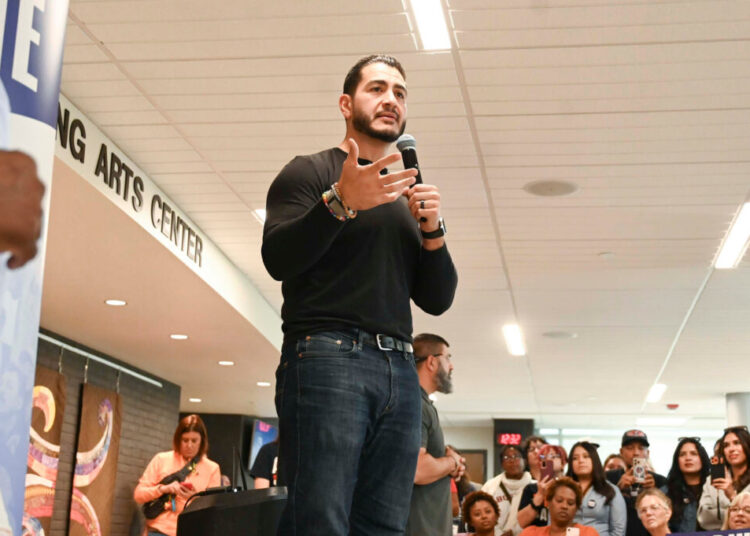
The U.S. Senate hopeful from Michigan, Dr. Abdul El-Sayed provides one of the most vivid case studies of masculinity in the Democratic Party right now. Dr. El-Sayed’s brawny physique, black T-shirt and jeans campaign uniform and scrappy populist rhetoric mark him as a down-to-earth fighter. For Dr. El-Sayed, convincingly embodying masculinity is a way to reframe the progressive policies he espouses, portraying himself as a vigorous champion of the people — and an avowed enemy of the “suits” running Washington.
And then there’s James Talarico, the Texas state representative working to flip a crucial Senate seat in a state Mr. Trump won by 14 points. Mr. Talarico has presented himself as a principled man of faith, someone who channels his Christian values into keen critiques of political corruption, corporate interests and income inequality.
His approach to masculinity is subtler than Mr. Newsom’s or Dr. El-Sayed’s. Instead of leaning into swashbuckling physicality or caustic wit, he’s projecting himself as a virtuous role model with integrity, tolerance and the righteous fury necessary to, as he declares in his campaign slogan, “start flipping tables.” (That is a reference to Jesus Christ in the Second Temple of Jerusalem.) The U.S. Senate candidate from Texas personifies a timeless archetype — the rousing street preacher — sharply tuned into our contemporary social ills.
According to Dan Cassino, a pollster and political scientist at Fairleigh Dickinson University, “the signifiers of masculinity have shifted.” As people’s views of institutions, wealth and privilege have curdled, those signifiers have moved to outsiders operating away from the system — intrepid crusaders determined to aggressively overhaul the insulated worlds where men like John Kerry or Joe Biden once thrived. It’s a populist masculinity that, at least superficially, transcends parties. “This is what Trump embodies, right? Drain the swamp, burn it all down,” Mr. Cassino said. “The underlying message is a deep cynicism about all power structures.”
The new masculine characteristics that Democratic candidates are striving to project go beyond resistance to entrenched institutions. This emerging male archetype also exemplifies agency and independence — a certain “rugged individualism” that’s always appealed to Americans.
Mr. Cassino compared it to the politics of Teddy Roosevelt in the 1890s and 1900s: “I as the frontier man can come in and throw out these crooked politicians.” The historical parallel is that Roosevelt himself had campaigned through the height of the Gilded Age. For many voters today, the most revered form of masculinity seems to be one that defines itself in direct opposition to its predecessors gliding through backrooms and ballrooms, fluently speaking the language of the genteel insider. The men embodying this current political moment are explicitly casting themselves as “bold” and “young,” often with a blue-collar agency that codes as a scourge to the gridlock and self-dealing of Washington, D.C.
Which is why someone like Sam Forstag is on the tip of so many Democratic strategists’ tongues right now. A former wildland smokejumper and labor union leader, Mr. Forstag is a 32-year-old Democrat running for a U.S. House seat in western Montana. “Age is a really important component,” Ms. Holman, the University of Houston professor, said. “Young men are just automatically perceived as more agentic.”
Mr. Forstag’s platform is focused on addressing affordability and health care costs and the responsible use of public lands, but his campaign also possesses a knife-sharp populist edge that bears a strong resemblance to Mr. Platner’s marooned one. While Mr. Forstag’s congressional race in crimson-red Montana may make him look like an underdog against his Republican opponent, his age, background and campaign vow to challenge the oligarchy suggest a potent blueprint for the Democratic Party.
Even Democratic women have found significant success in recent years running campaigns emphasizing what have traditionally been considered masculine traits. In what were arguably the two most consequential national races of 2025, female Democratic candidates won governorships in New Jersey and Virginia by large margins — and they did so by leaning heavily into backgrounds serving and protecting their country.
The New Jersey gubernatorial candidate Mikie Sherrill ran ads showcasing her career as a Navy helicopter pilot, wearing a green bomber jacket and promising to “run toward the fight.” In Virginia, Abigail Spanberger defeated her Republican opponent to replace the incumbent, Glenn Youngkin, by highlighting her eight years as a C.I.A. officer investigating international terrorism and drug cartels.
As Mr. Cassino explained to me, nearly every ad from Ms. Spanberger and Ms. Sherrill highlighted their backgrounds in the military and national security. For Democrats, he said, a “common winning formula is let’s get a female candidate who has a military background who can demonstrate masculinity.”
In the current political climate, those macho credentials can distinguish nominees from the polished politicos that so many voters now reflexively loathe. “How does someone prove that they’re not corrupt, that they’re not an insider?” Mr. Cassino asked. “If they’re showing these masculine traits, if they’re showing that they’re a fighter, that can be seen as a sign.”
Clearly the inchoate political sea change that’s taking shape in the midterms is about more than just masculinity. It’s also about a burning desire to elevate candidates who personify values that set them apart from the current gerontocracy. Manly vigor is just one avenue for aspiring Democratic politicians to establish daylight between themselves and an old guard — Chuck Schumer, Mitch McConnell, Chuck Grassley, Dick Durbin — that’s come to inspire exasperation and ire from the American masses.
As Meredith Conroy, a political scientist at California State University, San Bernardino, asked: “Is it that we’re demanding someone who’s masculine, or are we demanding a reaction to the status quo? And the status quo is these wealthier politicians who don’t get their hands dirty, spend all their time in D.C. and haven’t had to work a real job in a long time.”
We may be in a masculine moment, but scratching at the surface of that moment — as the Democratic Party has been forced to do over the past two years — reveals an even deeper and arguably more elemental yearning. The political zeitgeist is shifting from technocrats and canny operators to outsiders who stand apart from the system voters have come to despise. Americans want rough-hewn everymen and everywomen who are credibly animated by a shared righteous indignation.
In this climate, it’s easy to see why one of Mr. Talarico’s most famous lines — a declaration that essentially announced him to the public and awakened his fledgling base — is a galvanizing salvo against the superrich: “The only minority destroying America is the billionaires.”
That kind of disposition and character — authentic, unbowed and rooted in a visceral grasp of right and wrong — will always transcend a single gender, speaking to voters’ desperation for a long overdue era of both justice and renewal.
Mike Mariani is a journalist based in the Washington D.C. area and the author of “What Doesn’t Kill Us Makes Us.”
The Times is committed to publishing a diversity of letters to the editor. We’d like to hear what you think about this or any of our articles. Here are some tips. And here’s our email: [email protected].
Follow the New York Times Opinion section on Facebook, Instagram, TikTok, Bluesky, WhatsApp and Threads.
The post The Democratic Party’s Masculinity Crisis appeared first on New York Times.