To mark The Times’s 175th birthday, Times editors asked writers to reflect on — and imagine a little bit about — the newspaper’s front page on the day they were born. This is part of a series. Look up your own birthday page here.
In the 1980s, when I lived in San Francisco, I bought a desk from a used furniture store. It was my first serious writing desk, made of oak and as big as an aircraft carrier. Other than my futon, it was the only piece of furniture I owned. Once I got it home, I discovered that the two lower drawers were lined with newspapers. Old, yellowed newspapers, torn at the edges and some of them stained. The reason they were there was that they’d stopped being news. At some point, the information they contained, however assiduously reported and eagerly awaited, had become unimportant.
So why were those newspapers so fascinating to me? Why, whenever I opened a drawer, did I stop to read at least a paragraph? Partly, it was out of curiosity. I wanted to know what the world had been like when the previous owner of the desk had been alive. I wanted to know who the owner was. And I thought that, by reading Herb Caen’s column in The San Francisco Chronicle (where, in 1958, the term “beatnik” was used for the first time in print), I might find out.
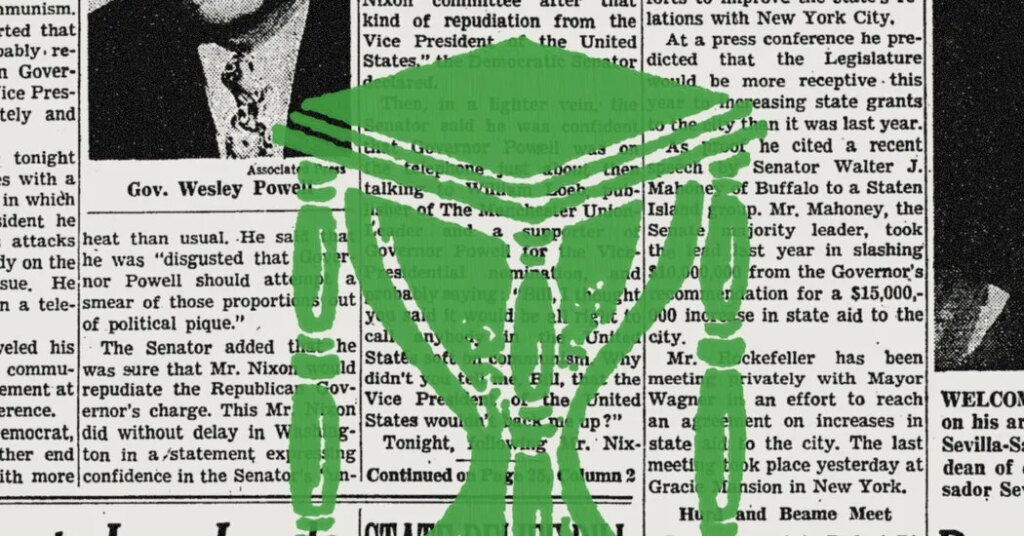
Which is how I feel now, more or less, confronted by The New York Times from the day of my birth. At first glance, the Late City Edition published on March 8, 1960, seems a lot older than I am. Everything was black and white then, in more ways than one. The layout of the page has a primitive, haphazard look as well. The articles appear not so much laid out as hectically fitted together. The term of art in those days was “paste up.” I had a magazine job in my 20s where we cut bits of typesetting with X-acto knives and glued them into place on a board. The jagged quality reminds me of that — and of those old linotype machines, with their clattering metal type, that John Updike had Rabbit Angstrom once operate for a living.
Clearly, it was a rougher, cruder time, before the sleek sway of Apple product design. To my eye, the page’s appearance gives it a heightened sense of newsworthiness. Each article looks as though it’s fighting for space. You can hear the sound of the newsroom in the background, the reporters on deadline calling in their stories, shouting over bad telephone lines to editors taking dictation, phones ringing, typewriters banging and copy boys running the copy down to production. The dull gray page brings back the ubiquity of newsprint itself, the smell of the ink, which came off on a reader’s hands, like proof of participation in a sacred rite. The familiar sight of a commuter on a crowded train courteously manipulating his kite-size newspaper into a more manageable size by deft flicks of the wrists. And the civic communion that resulted from everyone’s gazing at a shared reality rather than into the private portal of a smartphone.
But what was going on, exactly, as I first saw the light of day? To a greater degree than I would have guessed, the same things that are going on today. Apparently, in 1960, people were equally concerned about the president’s health. And so from Felix Belair Jr. we get the reassuring report that, despite the fatigue President Dwight Eisenhower showed during his recent trip to South America, he returned Stateside looking “deeply tanned from his four rounds of golf in the Puerto Rican sun.” There are articles about trouble with Cuba, a fight over the filibuster, a Hollywood actors’ strike and the Tuscaroras’ loss in the Supreme Court after a “long fight to prevent the use of their land in western New York for the Niagara Power Project.”
Of course, I can see what the reporters at the time couldn’t: I can see what’s coming. The Associated Press photographer who took the lead photo focused his camera on Eisenhower (our only elected bald president) as he doffed his hat to the Nicaraguan ambassador. But my eye is drawn to the face half-hidden in shadow that would loom so large throughout my childhood and the next decades: that of Richard Nixon.
A sense of futility can arise from reading old newspapers, as it can from reading old books. If your task in life is to record what happened on a certain day, you’re doomed, come midnight, to pitch your observations into oblivion.
But there’s a more optimistic view. (You were probably hoping for some optimism.) True, every single front page of any newspaper has a 24-hour expiration date. But a newspaper publishes a new front page every day. Taken together, what you see (to borrow from St. Augustine) is the soul of an age, distended through time. The business of writing comes down to the simplest virtues: Patience. Persistence. Fortitude. Each day, you write your allotment of words. You try to be as honest and as eloquent as possible. Then you do it the next day, and the next, in the mad hope that, adding up, they will complete the picture.
And sometimes you get lucky. What you write one day is true of all of them, and you touch upon eternity. This happened to the Times reporter Ralph Katz, who, in the lower left-hand column here, informed his readers that “commuters were delayed in getting home last night by a broken third rail in the tunnel under Park Avenue.”
Jeffrey Eugenides won a Pulitzer Prize, among other awards, for his 2002 novel “Middlesex.”
Source image by CSA Images/Getty Images
The Times is committed to publishing a diversity of letters to the editor. We’d like to hear what you think about this or any of our articles. Here are some tips. And here’s our email: [email protected].
Follow the New York Times Opinion section on Facebook, Instagram, TikTok, Bluesky, WhatsApp and Threads.
The post Jeffrey Eugenides: My First Day Seems So Much Older Than Me appeared first on New York Times.