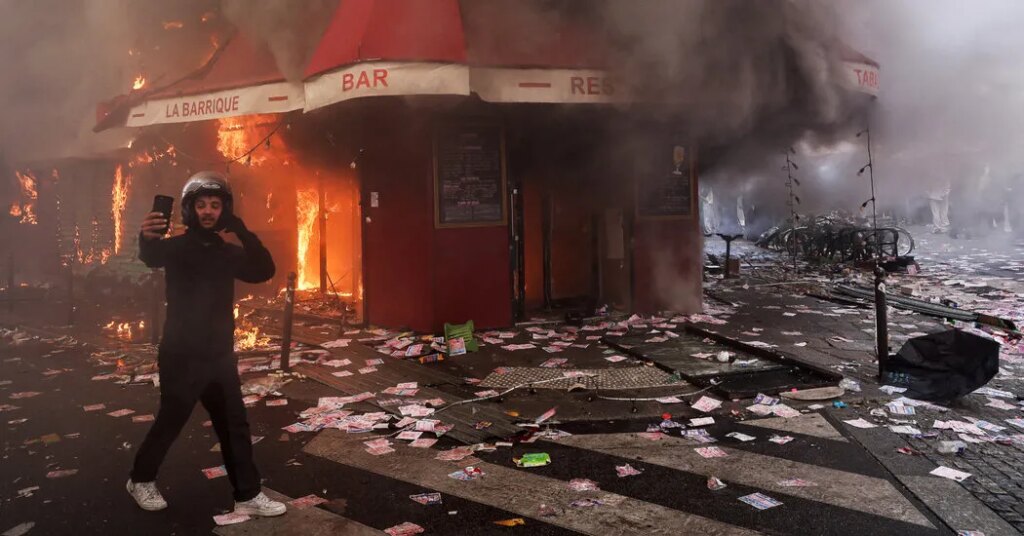
The shattered glass, bits of metal and discarded groceries strewed across Rue Beaurepaire have been swept up. The smoke from fires and tear gas is a memory. Wooden boards have replaced smashed windows.
It took Anita Lollchand, 68, five days to muster the courage to leave her apartment in search of groceries after the street, where she has lived for 40 years, devolved into a lawless zone of break-ins, looting, burglary and arson. In her building, young masked men burst into the foyer, ripped out the intercom and hammered at the glass on a second door. The glass cracked but didn’t give, and she trembles at the thought of what might have happened had they gotten through.
“We’ve seen so many protests here,” she said, breaking into tears. “This wasn’t a protest. It was a revolt.”
Oct. 17 marked a dark day in France. Large, peaceful demonstrations across the country were overtaken by riots, attacks on government buildings and looting. While admitting failures of security and intelligence, the government blamed both far-left insurgents and opportunistic delinquents.
The French Chamber of Commerce and Industry released its grim accounting this week. About 2,500 businesses across France were affected, and 47 percent of them were severely damaged. Some 480 were in the Paris region.
A small, curving street that unfurls from Place de la République — the city’s favored site for left-wing gatherings — Rue Beaurepaire sustained heavy damage. On its three short blocks, there were smashed windows, three building fires, and break-ins and looting in at least eight stores and two apartment buildings.
While some businesses have gone back to normal, serving cafés crèmes in the morning and Cambodian bowls to the lunch crowd, many locals say they are still trying to make sense of what happened on a street they had considered lively and friendly.
“This country is already falling apart,” Rudy Zylbersztejn, 32, said from behind his chrome counter inside Deni’s Bagels, which he opened with his brother six months ago. Thugs tried to break through their storefront window that day, but the reinforced glass only cracked.
“We’re destroying ourselves,” Mr. Zylbersztejn added.
Early warning signs
A 19th-century street, Rue Beaurepaire was the site of barricades defended by young teenagers during the final bloody days of the Paris Commune, the short-lived revolutionary government that ruled Paris in the spring of 1871.
Because of its proximity to the Place de la République, Rue Beaurepaire’s modern-day residents and store owners are used to protests. But nothing like this.
The day began with shop owners opening a few hours before the march planned by students and union groups, protesting poor conditions in high schools and the rising cost of living.
But the crowd differed from the usual protesters, said Didier Mondragon, the franchise owner of a small Franprix grocery store at the start of Beaurepaire. They were younger, dressed in black and wearing masks, he said. Acting on instinct, he closed the store around 1:30 p.m., pulling down metal shutters over the storefront while he and his workers had lunch and waited inside in hopes of reopening later.
Just over an hour later, the exterior security camera revealed a strange scene — people dressed mostly in black appeared like a flash mob, and, forming a group, they jumped up and down in unison. Inside, the store echoed with noise as the group kicked and hit the shutters. Mr. Mondragon and his staff had just enough time to take refuge in the basement before the mayhem erupted.
Over the next three hours, people poured into the store. They smashed fridge doors, threw over shelves, cracked into cash registers and left the floor covered with discarded jars and packages. They stole up to 200,000 euros of merchandise, he estimated, along with about 45,000 euros in cash they took from the safe.
One of his customers, Sophia Costa, was in her second-floor apartment across the street watching with horror as people attacked the pharmacy next door to the grocery. They didn’t seem to be looting for themselves. Instead, they grabbed items from the shelves and tossed them into the road, like carnival workers.
She saw people throwing bottles and breaking a second-story window across from her, the site of a physiotherapy clinic, where some walls were stained with iodine that appeared to have been looted from the pharmacy and tossed into the clinic.
Worried that they might attack her windows too, Ms. Costa closed her shutters. Soon, she smelled smoke. Beneath her, a legal assistance office had been broken into and set on fire. The pharmacy across the street was also burning, along with a bar down the block.
At one point, four fire trucks roared onto the street.
Around 5 p.m., Ms. Costa heard people running up her building’s stairwell, shouting “get out” and “fire.” They banged on her door.
She found herself face to face with some of the same people she believed had set the fires, now inside warning residents of the danger. It was just one confusing thing about that day.
“There were a lot of contradictions,” said Ms. Costa, 22, a decorative painter who moved to France from Italy.
Two blocks down, Habib Saïdi stationed himself in front of the clothing store Agnès B., a French chain where he has worked for more than two decades. Groups of young men dressed in black approached to push the windows and test the door locks, he said. One carried an iron bar, another pliers. “They were equipped,” he said.
Unarmed, Mr. Saïdi repeated the same plea: “This is my store.” It worked; the store was spared. He, like many other people on Rue Beaurepaire, said he had alerted the police. But no officers arrived.
“We were completely left to fend for ourselves and abandoned by the police,” said Mr. Saïdi, who runs security for the company. The Paris police did not respond to a request for comment. At least two people were convicted of stealing from the Franprix.
There was not just rioting and looting. There was also organized robbery. When Ms. Lollchand, the longtime resident, ventured out with her son around 11 p.m., she saw men sawing into the metal shutters of the Boxing Shop up the street, and then hurrying packages into their waiting van. Ms. Costa, who also went outside later, encountered two girls who tried to sell her boxing gloves from the store.
The scene was enough to keep Ms. Lollchand inside for days.
A violent encore
The chaos continued the next day.
Emmanuelle Leonardi, a brand manager for the clothing designer Petite Mendigote, learned from a live news broadcast that the company’s storefront on Rue Beaurepaire had been smashed open and was being looted.
Dozens of black-clad thieves made off with thousands of euros’ worth of clothes and bags, she said. The company would have fared worse had it not been for a local resident, Sofía Serna Ángel, who confronted the gang in front of the shop’s broken window.
“I started stopping the people who were leaving with stuff, telling them, “That’s really cowardly, it’s not right — you’re ruining people’s lives,” said Ms. Ángel, who is in her thirties. Most of the thieves, she said, appeared as young as 12. Many, she said, were polite. The riots had not only damaged stores, she noted, they unjustly polluted the protests’ cause.
Other neighbors joined her to stand vigil before the broken window for hours, ensuring the looters stayed away.
“It shows that there is a collective conscience after all,” Ms. Leonardi said. “That’s why I still have hope.”
The next morning, many neighbors arrived to help clean, Ms. Leonardi said. Others started fund-raisers to help the store owners rebuild. Ms. Costa said she met many of her neighbors for the first time as they fled their burning building together. They have since met for drinks.
“There is a little light after the storm,” said Mr. Mondragon, the Franprix owner, who hopes to rebuild and reopen his store within a few months, after insurance kicks in.
Many on the street are bracing for more protests on Saturday and beyond. “What are they going to look like?” Mr. Mondragon said. “In a month, in a year, we will always have this apprehension, wondering what is going to happen.”
He added, “It was hell.”
The post How Locals and Shopkeepers Tried to Save One Paris Street From Rioters appeared first on New York Times.