Hundreds of thousands of people poured into the streets of French cities again on Saturday for protests that began with the festivity of a Halloween parade but gave way to darker scenes of clashes between demonstrators and the police.
The violence fell well short of the arson and looting that engulfed Paris and other cities on Oct. 17, when a mass demonstration muted into widespread lawlessness. The crowds, estimated by the government at 320,000, were also smaller than on the previous two Saturdays of nationwide protest.
Still, the turnout — and the chaos — was significant enough to suggest that France remains in the grip of acute unrest, nearly two months into a protest movement that began with rebellious high school students.
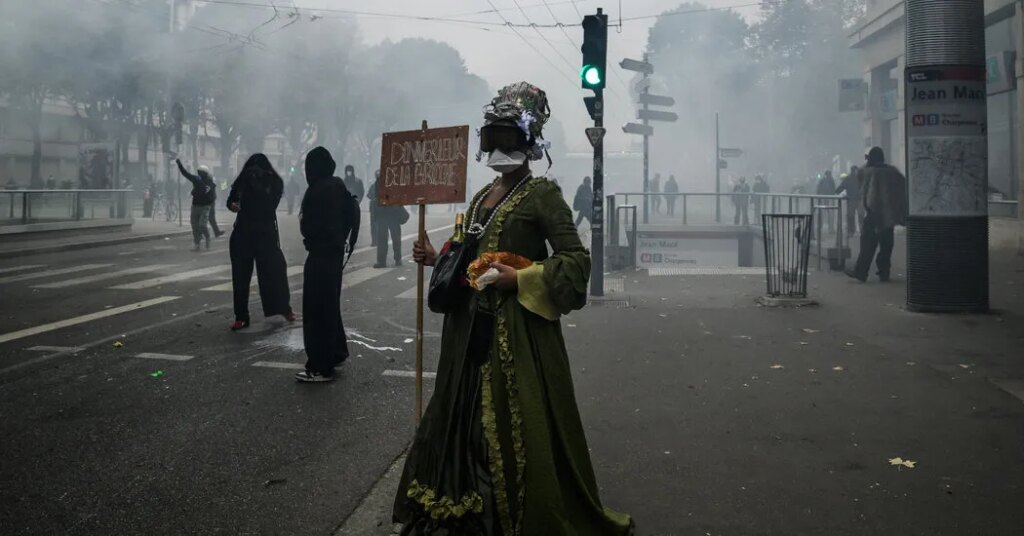
In several cities, the police fired tear gas and sprayed water cannons to disperse some protesters after what had been peaceful rallies. In Paris, 200 to 300 rioters, masked and clad in black, skirmished with police officers into the evening, lobbing Molotov cocktails, fireworks and other projectiles.
It was a discordant end to a day that had begun on an upbeat, even joyful, note. Many people made the most of the fact that the demonstration coincided with Halloween. They showed up in eye-catching costumes, as Spider-Man, Zorro or the Pink Panther, dancing as often as they marched. One, dressed as Marie Antoinette, held a sign that said, “Let them eat cake.”
French officials had said they worried that the holiday would introduce a dangerous element, since demonstrators might conceal their faces. They marshaled 70,000 police officers, the same number as last week, and shifted routes to keep the protesters away from city centers.
France’s interior minister, Laurent Nuñez, condemned what he said were violent rioters, with links to the far left, who mixed in with the protesters. Many of them broke into clashes with the police as the marches ended and the authorities tried to disperse the crowds.
On Saturday evening, Mr. Nuñez said, the police in Paris were still confronting “groups that intend to head to the Bastille,” the site of an uprising in 1789 that is a milestone in the French Revolution. The Paris authorities had prevented the march from starting there.
“The intent is to create an insurrectionary climate — a quasi-revolutionary atmosphere — and to attack domestic security forces in order to gain access to stores, to carry out looting, to attack public buildings, and they are attacking law enforcement in an extremely violent manner,” Mr. Nuñez said.
In Paris, television images showed the police coming under attack by fireworks and Molotov cocktails. At least one officer was briefly engulfed in flames, an attack that Mr. Nuñez said qualified as attempted murder. Trash bins were set alight, as was a car. Similar chaotic scenes played out in Marseille, Rennes, Nantes, Toulouse, Montpellier, Angers and Tours.
Marine Le Pen, the far-right leader and presidential candidate, condemned the targeting of police officers, writing on social media that the “perpetrators of this attack must be found and sentenced with the utmost severity.”
Jean-Luc Mélenchon, a far-left leader who is also running for president, accused the government of undercounting the crowds. He claimed they were as large as previous demonstrations, despite the change in the route.
The police arrested 565 people, which Mr. Nuñez said prevented a worse outbreak of violence. The authorities also carried out 40,000 spot checks across the country to prevent people from taking weapons to protest areas.
But Mr. Nuñez was careful not to declare victory. The Interior Ministry warned that the violence could intensify long after darkness fell. On Saturday night, bands of people still roamed Paris and other cities. “We will remain vigilant throughout the evening and the night,” he said.
It was a stark contrast to earlier in the day, when people began massing for the marches. Brass bands played music, and the protesters’ costumes provided a celebratory atmosphere. Several people said they wanted to help reverse the narrative set on Oct. 17, when the marches mutated into violence, with gangs smashing shop windows and looting the contents.
“I’m really worried about how the riots have been instrumentalized by the far right,” said Helen Olive, 50, who was among a group of parents who had dressed as “super parents.” “We want to turn that narrative around.”
Arthur Fleury, a 20-year-old literature student, came as a prisoner riding a dinosaur and wearing a mask of Ms. Le Pen, the far-right leader. “Protests are about making demands but also having fun,” he said. “I was going for an absurd costume to capture the spirit of the movement.”
As the crowd marched along its route in eastern Paris, a bystander dropped candy from his balcony, drawing cheers. But there were already signs of trouble. Half a dozen masked protesters in black pushed trash bins, one of which was burning, into the middle of the crowd. They set a second bin on fire near where a police unit was stationed.
Other demonstrators used water to put out the fire, precipitating a small clash with the masked group. “That’s no way to protest,” said one of those who helped put out the fire.
Among the protesters were Morgane Voisin, 22, and Corentin Schnell, 19, both of whom wore white outfits identifying them as “street medics” able to deliver first aid. Ms. Voisin, a sales consultant, said she participating because her younger siblings had faced harsh conditions in high school.
Mr. Schnell, an engineering student, said he joined after his younger brother told him he was tear-gassed and almost struck by a stun grenade at a protest this month.
“The mere fact that people are being injured by the police makes me furious,” Mr. Schnell said. “So, I’ve come to demonstrate and to try to provide medical care — to limit the damage, regardless of which side it’s on.”
On Saturday, the two said they saw one person who had been injured in the head. Help arrived quickly. “Long live youth!” Ms. Voisin said.
Giulia Imbert contributed reporting.
The post Clashes Erupt Again in France, After Festive Start to Day of Protest appeared first on New York Times.