Like many Americans, Michael Nave has a hunch that politicians of both parties enrich themselves while the working class struggles to make ends meet.
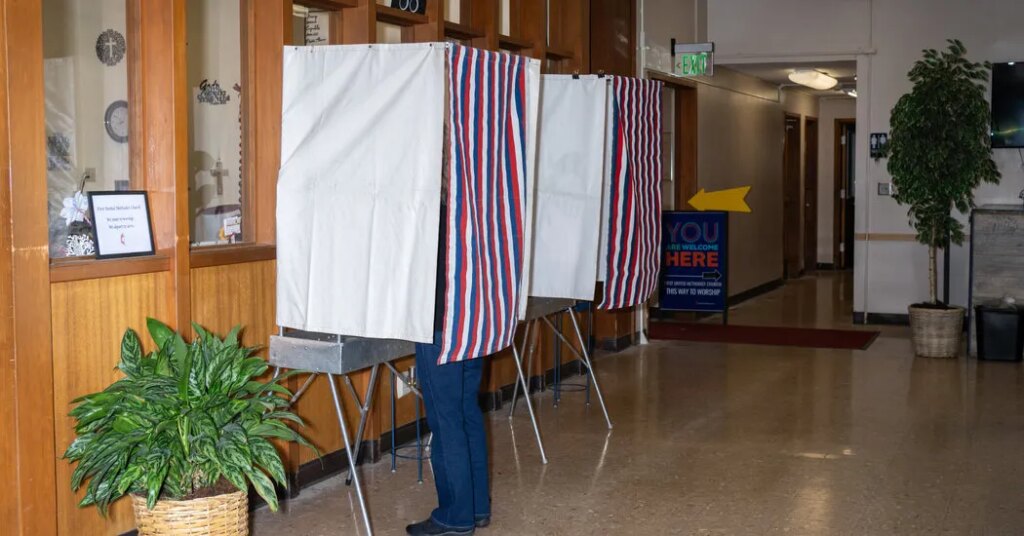
But on Wednesday, Mr. Nave, a Republican, decided the party in power has become too corrupt. He cast his vote early, in Clearwater, Fla., against every Republican on the ballot, including Representative Anna Paulina Luna, who has been depicted by her opponent as emblematic of a party rife with self-enrichment and cronyism under the leadership of President Trump.
“Trump said he would drain the swamp, and he’s become the swamp,” said Mr. Nave, 61, of Dunedin, Fla.
Allegations of corruption in Washington are nothing new in political campaigns. They are usually shrugged off by voters who figure all politicians are equally guilty, whether they be Democrats such as former Senator Bob Menendez of New Jersey or Republicans like former Representative George Santos of New York. But Democratic efforts to bolster the issue this year may be resonating amid a drumbeat of stories about Mr. Trump’s staggering increase in wealth and the billionaire and corporate elites who have supported him.
Some recent polls have shown corruption has risen to the top of issues that voters say they care about most, fueled by a withering distrust in government and a sense of opacity in Washington.
“How can you always trust what’s behind a closed door?” asked Karen Jarrett, 58, who lives in Tennessee, a quick drive from the state line with Mississippi. She added, “People’s eyes are wide open now.”
But such sentiments may go only so far amid greater worries about inflation, war and personal security.
“It didn’t click with me,” Juan Pino, 51, a cook in Florida, said of corruption. He voted straight Democratic because, he said, he always votes that way.
Democrats are certainly trying to drive home the issue by tying politicians’ self-enrichment and insider trading to the soaring cost of living. Republicans, too, including Ms. Luna, are seeking to capitalize on corruption as a campaign theme.
And for some voters, it seems to be sinking in more than ever.
“It’s more out in the open now,” said Steve Wiegard, 46, who works with a fire safety company in Olive Branch, Miss. “I think about it every day.”
The word has become a constant refrain in campaign ads from both parties, even if the definition of corruption has at times been stretched. A political action committee supporting Democrats this week launched the latest corruption-themed attack ads, including one highlighting stock trades by Representative Victoria Spartz of Indiana and her family, which the ad says accompanied “policies that make life more expensive” for voters.
A committee supporting Republicans this month launched an ad labeling Troy Jackson, the Democrat challenging Senator Susan Collins of Maine, “too corrupt” for the state because his son is a lobbyist.
Corruption now seems to include secretive nondisclosure agreements struck with data centers, the war in Iran, even the gerrymandering of Black-majority districts after the Supreme Court weakened the Voting Rights Act.
“We have politicians trying to pick the voters instead of voters picking the politicians,” said Chaz Molder, the Democratic mayor of Columbia, Tenn., and a House candidate who saw his home drawn out of the Middle Tennessee district where he was running. “That is corrupt.”
The most recent entrant: Democratic efforts to clog Alaska’s four-person ranked-choice ballot with candidates who could siphon votes from the incumbent Republican senator, Dan Sullivan, including one challenger named Dan Sullivan.
In the Tampa Bay region of Florida, corruption has emerged as central to the race between Ms. Luna and Leela Gray, a Democrat and retired Army brigadier general. Voters in the newly redrawn district overwhelmingly supported Mr. Trump in 2024, but Democrats hope to flip the seat by tying Ms. Luna to the president and portraying her as a glamorous partygoer, currying favor with wealthy donors.
One ad for Ms. Gray called Ms. Luna “part of the problem in D.C., including the culture of corruption,” highlighting allegations in the media that she gave insider information to a Republican influencer who then placed a bet on a political prediction market.
Ms. Luna has denied the report, sent a cease-and-desist letter to her opponent’s campaign over the ad and noted a Justice Department letter that confirmed she is not under investigation. In turn, Ms. Luna has sought to portray Ms. Gray as compromised because she owns stock in Big Pharma, companies building data centers and big banks buying up single-family homes.
In an interview, Ms. Luna said she has led the fight on corruption by seeking to restrict stock trading by members of Congress. “The only reason this is a national discussion is because I forced it,” Ms. Luna said.
In interviews at early voting sites with more than two dozen voters in Ms. Luna’s district west of Tampa, most agreed corruption is a problem in both parties, but many shrugged off relentless attacks as par for the course.
James Shively, the owner of a landscaping company, said both parties were untrustworthy. He voted Republican because, he said, “Democrats are socialists.” Jonathan Castro, a human resources specialist with no party affiliation, voted for Democrats because he believes Trump’s immigration enforcement policies are too draconian.
Neither said his vote hinged on corruption.
For Jeff Davis, a Republican retiree, corruption was a bank shot in his congressional choice; he said he had voted against Ms. Luna because she supports Mr. Trump, who he believes is corrupt.
Marc Bachyrycz, a personal trainer with no party affiliation, cast his ballot for Ms. Luna because like him, she is an Air Force veteran. He also appreciated that while in office, she tried to crack down on congressional stock trading.
“No party is without fault, but at least she’s trying to do something,” Mr. Bachyrycz said.
For some voters, the issue is breaking through, even if it’s not decisive.
“I know insider trading has always gone on, but I think now it’s way worse,” said April Robinson, 52, an independent who voted along with her husband for Ms. Gray. “They are purposefully manipulating the markets.”
To others, the tried-and-true of their preferred party still holds sway. Joelle Eden, 57, a former Democrat who switched parties a decade ago, voted Republican because she believes the party prioritizes public safety and border control.
“I just want to make sure the country is safe,” Ms. Eden said.
Curt Anderson and Anastasia Economides contributed reporting.
The post Voters Usually Ignore Corruption as an Issue. It Now Has Their Attention. appeared first on New York Times.