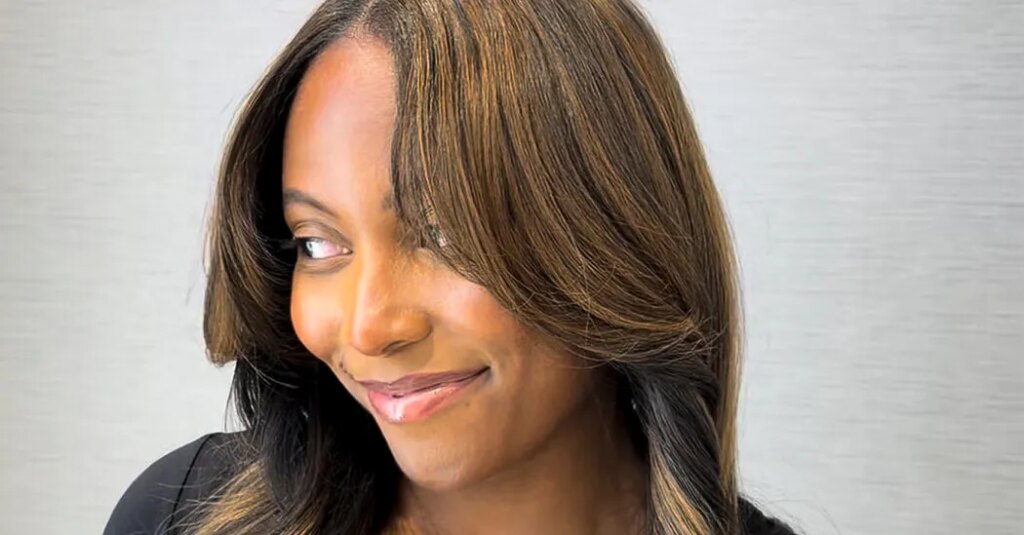
Some of Sophia Ederaine’s fondest childhood memories are of the time she spent at the hair salon with her mother, twin sister and aunt: the gossip, the smooth pages of fashion magazines she’d flip through, the smell of the hot comb.
The salon was a place where she “grew up as a woman,” she said.
As a 33-year-old, she has never been able to recreate the experience. Over the years, she said she has encountered stylists who lacked foundational skills, like deep conditioning and hair trims. That is, if she could even get into a salon chair: Independent hairdressers she has worked with often had stringent booking policies with “a hundred rules,” like requiring clients to wash and blow dry their own curls before an appointment.
“There’s so few people who specialize in Black hair and can do it well,” said Ederaine, a dermatologist based in Houston.
So Ederaine was surprised when she came across a stranger’s social media post suggesting that she might be able to avoid some of these problems at Ulta Beauty — a chain beauty retailer that houses salons, some of which are populated by stylists trusted by other Black women.
Soon she was joining a chorus of voices on TikTok and Threads who in recent weeks have announced their plans to break up with their hair stylists in favor of the corporate chain. (A spokeswoman for Ulta Beauty declined to comment for this article.)
Not everyone is sold. But it’s cracking open a conversation about the inconveniences many Black women have come to expect when getting their hair done, and highlighted the changing landscape of Black salons.
“We were just like taking these poor treatments,” Ederaine said. Like everyone else, she wants to “just go somewhere that respects us, respects our money.”
Money is a big factor. Styles like blowouts and silk presses can cost upward of $200 before tip. (Add to that the fact that Black consumers in the United States spent $6.6 billion on beauty products in 2021, according to data from McKinsey. Black women generally use twice as many products as white women.)
As loyal as some women may have been to their neighborhood mom-and-pop salon or freelance stylist, cheaper options have their undeniable appeal.
“I was a bit nervous and apprehensive, I won’t lie to you, just because I had never gotten styling at Ulta,” said Keira Bruce, a 27-year-old actress and entrepreneur in Atlanta who visited the store for the first time earlier this year for a silk press and a trim for about $134.
She returned months later for the same service, but this time, she added a color treatment. It all came to $182, she said. “I had always seen the salon back there and just assumed that they really didn’t do Black hair,” she said.
Ulta has had salons in its stores since the company started about 36 years ago. Those salons were already home to some stylists with expertise in highly textured and coily hair, but in the past few years, Ulta has pushed to train more of them.
Three years ago, the company collaborated with the Black Beauty Roster, a consulting platform that helps brands access beauty professionals with diverse expertise, wanting to revamp its textured hair education program, according to Maude Okrah Hunter, the platform’s founder.
In July, Black Beauty Roster announced it was partnering again with Ulta to introduce an “All Textures Certification” pilot program.
Corporate hair salons that served clients with textured hair, like JC Penny, have long existed alongside the traditional salons where generational pearls of wisdom were passed down over shampoo bowls. But that nostalgic vision of Black salons has become more rare as rising costs for brick-and-mortar have made it difficult to do business and many stylists work independently.
“I didn’t want to have the operational responsibilities,” said Kimbra Thompson, who last year joined Ulta’s salon team in Plano, Texas, after three decades of working as an independent stylist.
Other shifts in the field have introduced more competition into the Black hair space, giving clients more options.
Since 2021, nearly 10 states, including Louisiana, New York and California, have passed legislation requiring cosmetology and hair schools to train students in the care of curly, coily and textured hair. This change has helped usher in more non-Black stylists with the skills to care for Black hair, some of whom have built large followings online in recent years.
Steven Serrato has been a professional hairstylist for 12 years and specializes in textured hair. Though, at his salon suite in New York, he often encounters Black clients who are nervous about “trying someone new for the first time, someone that doesn’t look like you.”
Over the years, he has heard “some crazy stories” from his clients who have described experiences of being turned away for their hair being tightly coiled. “I don’t want to add to anybody’s hair trauma,” he said.
Ulta has faced its share of criticism for its salon services. In April, a mother in New York sued the company, claiming an employee had told her and her daughter that their assigned stylist was “not comfortable” doing their type of hair.
Amid the recent buzz around Ulta, some remain skeptical that the retail store is offering better services.
Pearl Foreman, a 35-year-old health care I.T. worker living in Houston, was happy with her independent stylist when it came to getting a professional wash, condition, trim and silk press for around $150.
Still, the online debate this month piqued her curiosity, so she went to her local Ulta Beauty salon this week to see if she could get a similar service for a lower price. With tip, she said she paid $227. “It’s not cheap,” she said.
She was also put off when, according to her telling, the stylist warned her she would have to pay extra for the flat iron, a tool that’s necessary for this style and whose cost is typically included in the final price.
After two days, she said her newly straightened hair already started reverting to its curls.
“I’ve had a more silkier silk press before,” she said. “It’s not going to last.”
Weena Jerome, who owns Renaissance Curl, an independent Black hair salon in Harlem, said she understood why some of her policies — like booking a separate consultation before a service and putting down a deposit — could be a “turnoff” to her clients.
But she explained that it gives the salon a chance to examine new clients’ hair and determine if the service that they booked is what their hair needs and whether the stylist will have enough time to do it.
Although she saw chains like Ulta as drawing some clients away from traditional salons, Jerome wasn’t worried.
“I think there’s space for everyone,” she said.
The post Can a Corporate Chain Be a Great Black Hair Salon? appeared first on New York Times.