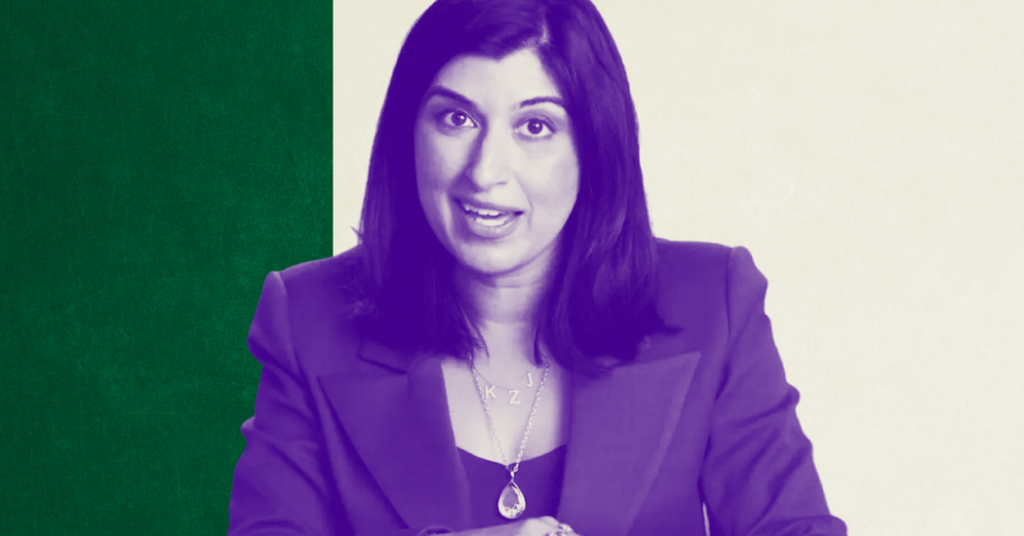
Rising inequality is a big problem in America. But a ballot measure like California’s proposed billionaire tax is not the solution, argues the economist Natasha Sarin. By driving billionaires out of the state, it could cost California more revenue than it raises. Luckily, she offers other ways to make the wealthiest Americans pay their fair share.
Below is a transcript of an episode of “The Opinions.” We recommend listening to it in its original form for the full effect. You can do so using the player above or on the NYTimes app, Apple, Spotify, Amazon Music, YouTube, iHeartRadio or wherever you get your podcasts.
The transcript has been lightly edited for length and clarity.
Natasha: Tax the rich.
Archival clip of crowds chanting: “Tax the rich!”
Natasha: It’s probably the most powerful rallying cry in American politics today.
Archival clip of Zohran Mamdani: “When I ran for mayor, I said I was going to tax the rich.”
Natasha: Our government has no problem taxing you. But billionaires? Not so much. And that’s why California has proposed a new wealth tax for billionaires. I’m originally from California, and I care a lot about the state. I also care a lot about the fairness of our tax system, and billionaires should absolutely be paying a lot more in taxes.
Archival clip: “There’s no reason why a handful of people have the majority of the world’s wealth.”
Archival clip: “FTaxing the wealthy will not hurt you, it will help you.”
I understand why people are enthusiastic about this idea, but I have to say: I think if California passes it, it’ll backfire. So let’s start by digging into what this wealth tax is and how it came about. When Donald Trump’s One Big Beautiful Bill Act passed last summer, it created an astronomical hole in California’s finances.
Archival clip: “The cuts to Medicaid are scheduled to take effect just after midterm elections.”
Archival clip: “An estimated 10 million people are expected to lose their health insurance under the law.”
So in order to fill this gap, California’s largest health care union has proposed a tax on the state’s billionaires. There are about 250 of them. And this tax would be——
Archival clip: “A one-time, 5 percent tax — just on billionaires — to fund health care for us.”
An emergency tax — meant to help cover the millions of Californians who stand at risk of losing health coverage. But I think that there are at least three big problems with this ballot measure. My first problem with this tax is that it’s just too easy to dodge. Billionaires are flighty. It’s pretty easy for them to just pick up and move to another state. We saw some of California’s most famous billionaires — including Sergey Brin and Larry Page, who co-founded Google and were the richest people in the state — up and leave just because of the threat that this wealth tax might become law.
If you count the seven billionaires that have left so far, that’s already a third of the entire revenue that California’s wealth tax could have even hoped to raise. And some researchers at Stanford actually think that, in aggregate, this wealth tax is going to lose more money for California than it’s going to raise. That’s because when billionaires move, they take their wealth tax revenue with them, but also the state income taxes that they pay in annually to the state, to help fund important education and infrastructure projects. The bill’s designers tried to deal with this by imposing a retroactivity provision, saying that anyone who was in the state by January of 2026 would have to pay this wealth tax.
But there are a lot of legal questions about whether that provision’s going to stand. And in fact, billionaires are continuing to threaten to leave California, because they’re worried that this isn’t just a one-time tax.
Archival clip of David Sacks: “It’s like the Democrats are doing everything they can to get me to leave the state. Even if they say this is a one-time thing, we all know that it won’t be one time.”
The second problem is that it’s just hard to figure out how much wealth these billionaires have, and how much they should be paying in these wealth taxes. For many of them, their wealth is tied up in private business stakes, where valuations can fluctuate wildly, day to day. California’s proposed tax has tried to solve this problem by using a formula based on companies’ financial statements. But the problem is that many companies don’t actually prepare those financial statements. And even when they do, there is a ton of discretion that billionaires could easily exploit to value their stakes at the lowest possible amount, so their tax liability would be low.
But let’s just say that the state actually comes up with these numbers. That brings us to problem three: low liquidity. Billionaires’ wealth often isn’t sitting in a bank account somewhere ready to be taxed. Instead, it’s tied up in their ownership stakes in their companies.
Archival clip of “The Ezra Klein Show” with Ray Madoff: “Salaries are for suckers. When people take a salary, they are subject to high income taxes and payroll taxes. And Jeff Bezos and a lot of our other multi-centibillionaires have no interest in paying those taxes.”
In order to pay the 5 percent tax, they would often have to sell off a share of their ownership stake in their companies. In some cases, that’s legally prohibited; so even doing so, or trying to, opens up a whole can of worms.
All these structural issues could discourage growth and investment in California’s economy.
Meaning that the next Google or Meta won’t be started in California, if its founders are looking for more favorable tax treatment elsewhere.
Archival clip: “Florida has become the magnet for money, offering no state income tax.”
That comes at a real cost for California, for its economy and for its tax base. You might think that the solution to these state-by-state tax problems is a federal wealth tax.
Archival clip of Elizabeth Warren: “It’s time for a wealth tax in America.”
Archival clip of Bernie Sanders: “The billionaire class cannot have it all.”
But a federal wealth tax would still have the same set of problems: trying to figure out how much wealth people have, and designing a tax system that is actually going to allow us to tax it.
It would also face a host of new constitutional challenges. And given the Supreme Court’s current 6-to-3 majority for conservatives, it seems unlikely that the tax would ultimately survive. The good news is that, I think, there are real solutions for taxing the wealthy much more than they’re taxed today; and these are unlikely to run into the same set of challenges as a wealth tax. For one, I would make it so that the estate tax has real bite, so that the ultrarich aren’t just able to pass their fortunes down to their kids without having to pay estate taxes.
We also need to do a better job taxing the companies that these billionaires own, in the form of a higher corporate tax. That tax increase is ultimately paid for, in part, by billionaires, because they’re the ones that own these companies. And we definitely shouldn’t let the wealthy fund their lifestyles by borrowing against their stakes in the companies that they own. It’s crazy that the very wealthy can borrow to buy yachts or mega-mansions, and ultimately never see any tax bill at all because that activity — the borrowing — isn’t taxed.
These are tried and true ways of actually taxing wealth. They’re not without their own complications, and I know they don’t fit neatly on a bumper sticker.
As we watch inequality continue to grow, this issue around how do we tax the wealthy is going to animate our political discourse. It’s going to be at the center of what 2028 presidential candidates are talking about. I worry that if we spend a lot of time and political capital talking about an approach that doesn’t work in wealth taxation, we lose the opportunity to talk about the approaches that actually will.
Thoughts? Email us at [email protected].
This episode of “The Opinions” was produced by Emily Holzknecht. It was edited by Kaari Pitkin and Alison Bruzek. Mixing by Pat McCusker and Isaac Jones. Video editing by Jan Kobal, Dani Dillon and Steph Khoury. The postproduction manager is Mike Puretz. Original music by Pat McCusker, Carole Sabouraud, Isaac Jones and Aman Sahota. Fact-checking by Mary Marge Locker and Kate Sinclair. Audience strategy by Shannon Busta, Kristina Samulewski and Ali Baluch. The director of Opinion Video is Jonah M. Kessel. The director of audio engineering is Isaac Jones. The deputy director of Opinion Shows is Alison Bruzek. The director of Opinion Shows is Annie-Rose Strasser.
The Times is committed to publishing a diversity of letters to the editor. We’d like to hear what you think about this or any of our articles. Here are some tips. And here’s our email: [email protected].
Follow the New York Times Opinion section on Facebook, Instagram, TikTok, Bluesky, WhatsApp and Threads.
The post Tax the Rich? Easier Said Than Done. appeared first on New York Times.