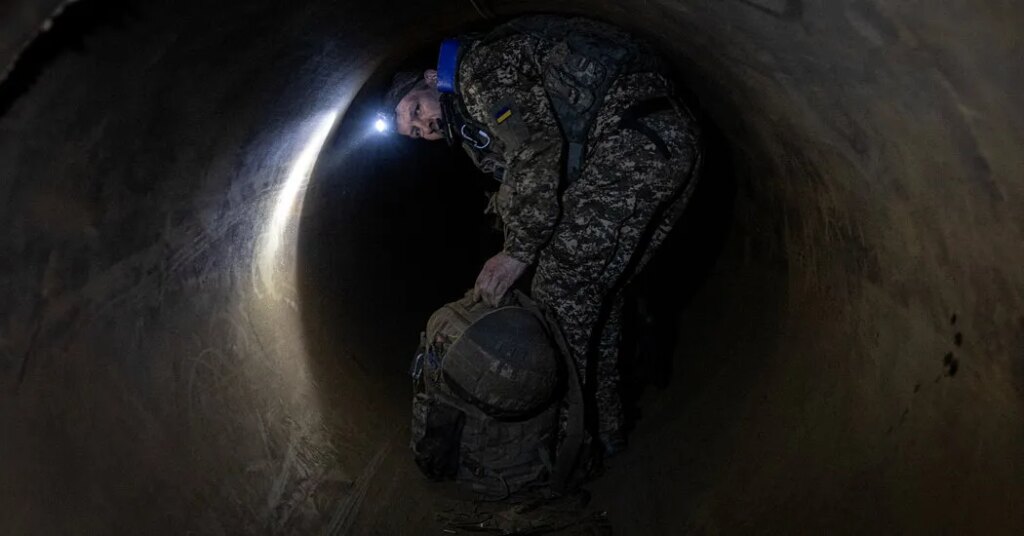
Deep inside a forest in drone-infested eastern Ukraine, I stepped onto a small metal platform and descended into a postapocalyptic world of modern warfare, where the only safe place is underground.
When the elevator stopped, a vast subterranean space came into view — a logistics hub, hundreds of yards long and at least three yards high. Connected to it was a buried web of pipes that once carried natural gas between Ukraine and Russia.
Ukrainian troops cannot stand up in the pipes, which are less than four feet in diameter. Yet they spend weeks at a time inside them, fighting Russians with guns and grenades, ferrying out fellow soldiers injured or killed at the front, and carrying in critical supplies. With drones stalking the battlefield above, this is the future of war, Ukrainian strategists say.
As I approached one of the pipes, the smell of residual gas made my head spin. Soldiers caked in brown dust constantly popped out from or disappeared into the tunnel on the rusty electric buggies that roll through the underground network.
I put on protective goggles and a gas mask and sat behind troops who had been ordered to their positions. Inside the pipe, the smell would be even stronger, they said.
Then we set off.
Riding In
It hadn’t taken long on this October day to see why the Ukrainian military wants to take more of the battle against Russia below ground.
To get to the hole in the earth that led to the pipe, our photographer, Finbarr O’Reilly, and I first had to cross open fields in a pickup truck with a group that included three soldiers. We were within range of drones that target anything that moves.
The soldiers were quiet, the mood tense. One of them held a drone detector in one hand and a phone in the other, asking reconnaissance pilots monitoring the stretch of road about “dots in the sky.” The detector kept beeping.
Suddenly, the soldier shouted for everyone to run for it.
The driver stopped and we all jumped out, sprinting as fast as we could away from the pickup, a preferred target for drones. We put distance between ourselves to reduce the potential for injuries, or worse, if the drone attacked.
The drone’s buzz overhead grew fainter, then louder again. Through some bushes, the only cover I could find, I saw a soldier aiming his gun at the sky, ready to shoot. The drone flew away.
After another half-hour of driving through the fields and one more hurried exit from the pickup under drone threat, we sped into the forest.
One of the soldiers in the truck, Oleksandr, had been doing regular rotations in the pipes for three months. Even after a 10-day break, his lips were dry and cracked. The dust seemed to have altered the color of his skin.
His task for the next few weeks would be to evacuate wounded soldiers. Going long periods without fresh air or an open sky is difficult, said Oleksandr, who like others I spoke with asked that his last name be withheld for security reasons. So is using plastic bags and bottles as a toilet.
He prefers the pipes, he said, to the constant tension of being exposed to drones.
Trading Fire
Russian forces were the first to use abandoned industrial pipes in this war, reviving a tactic reminiscent of World War I, when English and German troops dug tunnels under enemy lines.
In the area we visited, near Kupiansk in northeastern Ukraine, there are about 80 miles of long-disused gas pipes.
Russian troops used the pipes late last year to infiltrate Kupiansk. The Ukrainian military then planned its own underground operation. Ukraine’s Khartia Corps sought maps of the pipes and tracked down retired gas specialists who had built the network. The corps then installed ventilation, the most difficult task.
During Ukraine’s first such operation, its soldiers ran into Russians inside a pipe, said Col. Volodymyr Lysiuk, deputy commander of the Khartia Corps. They engaged in a fierce firefight but could not push the Russians back.
So the Ukrainian troops cut an exit from the pipe, dug a tunnel toward a parallel one and then broke back into the first pipe behind Russian positions, trapping the enemy, he said.
Ukrainian forces killed dozens of Russians and took several prisoner, Colonel Lysiuk said.
President Volodymyr Zelensky and independent military analysts say the operation helped Ukraine defend the town of Kupiansk, though the battle continues. Based on field research in Ukraine, a team led by a Vienna-based military analyst, Franz-Stefan Gady, described the underground operation as a “tactical success,” saying it slowed rather than fully halting the Russian advance.
The success has prompted Ukraine to look at other ways to move the war underground. It has already gone subterranean with some defense production and logistics. The armed forces are calculating the costs of building a network of tunnels to better connect observation posts with supplies and other support in the rear of the battlefield, according to two Ukrainian military officials with knowledge of the matter.
While offering protection from drones, the shift below ground has brought other terrors. Soldiers told me about a friend who died from smoke inhalation after a Russian bomb struck the entrance to a pipe. One soldier, Rostyslav, 46, said that toward the end of his rotations, he began to feel that he had no strength left and desperately needed to get out.
During his breaks, it takes time to readjust. “After being in the pipe, sometimes you wake up at home and, before getting up, you first try to measure the height of the ceiling,” he said. “Then you realize you’re in your apartment.”
But overall, he added, “it turns out you can live in the pipe.”
Riding Out
Dust stung our faces as we crept through the tunnel.
On uphill stretches, the buggy slowed to a crawl, and on the descents, it picked up speed, reaching about 10 miles an hour. It took us about 40 minutes to travel six miles through the narrow pipe.
We arrived at another logistics hub. This one, albeit deep underground, is close to what is known as the zero line, the last point on the front with a Ukrainian position. Several Russian guided aerial bombs struck nearby above us, sending a slight tremor through the underground space.
“The Russians just finished their lunch,” said Vladyslav, 32, a senior sergeant who commands the position, jokingly explaining that such bombing usually comes in the early afternoon.
The hub was a beehive of activity. To get out of the buggies’ way, I climbed over bags of soil dug out from the tunnels. Soldiers then pushed the sacks farther along inside the underground space.
The pipe had been cut through the middle to create two entrances facing in opposite directions. During the day, the buggies mostly carried parcels of ammunition and food. At night, in the opposite direction, they mostly carried soil.
When Vladyslav shouted that a Russian quadcopter drone was approaching a tunnel entrance, soldiers scrambled over the bags of soil and food, rushing deeper inside. Russian drones, he said, regularly try to find ways into his position, sometimes with thermal imaging to detect body heat.
One by one, soldiers scheduled to rotate out gathered in the hub, waiting for a ride. A buggy driver sat inside the pipe, listening to a popular Ukrainian song about a man asking for a hug.
On the way back, we saw an opening in the side of the pipe lit by a yellow glow. We stopped near it to pick up more soldiers as they climbed out of a side tunnel. Closer to the exit, the buggy could no longer carry everyone, and we had to walk the last 50 yards, crouching.
Above ground, we got into a car that would take us back through the open fields. “Oh, God, help us here,” the driver, who went by the call sign Radik, said as he started the engine.
He drove at breakneck speed, racing up hills and plunging back down. We had moved from the unpleasant war of the future to the terrifying war of today.
When we reached a road covered with nets to shield vehicles from drones, marking the exit from the most dangerous part of the journey, the driver called his wife.
“Honey, I’m back,” he said. “All good. Kisses.”
The post Ukrainians Are Fighting Russians Inside Underground Gas Pipes. I Went in One. appeared first on New York Times.