The first great Shakespearean actor I ever saw was Patrick Stewart. He was playing Capt. Jean-Luc Picard on “Star Trek: The Next Generation” at the time, not exactly a figure from the Elizabethan canon. But as Picard — the emotionally super-contained Starfleet commander — he often found himself reaching for Shakespeare’s words, to express some cosmic hope or grief.
When we learned on Thursday of Stewart’s death, at 86, we lost the most broadly influential Shakespearean of his day. “What a piece of work is man,” Stewart’s Picard says in a 1991 episode to Q, an intergalactic villain with a low opinion of humanity. It was the first time I (and millions of teenagers like me) ever heard those words said so beautifully.
To Q, Picard was arguing for mankind, but to us, he was arguing for a life infused with that extraordinary language. Imagine being able to treat “Hamlet” with such authority? To make it part of the tissue of your own thinking? It turned out, this was something you could do forever. Three decades later, during the pandemic quarantine, Stewart went online and read us all of Shakespeare’s Sonnets, one per day. “Pity the world,” he read, offering comfort.
Long before Stewart strode onto the starship Enterprise bridge, he had trained at the Bristol Old Vic Theater School and performed with the Royal Shakespeare Company. He had a respectable if not staggering theatrical career in the 1970s and ’80s, and when he signed on for an initial six-year “Star Trek” voyage in 1987, some worried that it would mean abandoning that “legitimate” work.
But even when he was ascending to sci-fi stardom, he somehow kept his classical mantle. The “Star Trek” writers knew what they had, and so they kept steering his character toward poetic language, richly spoken. Picard discusses “Henry V” with the android Data on the Holodeck; in a two-part episode, “Chain of Command,” Stewart and an old Royal Shakespeare Company colleague, the great David Warner, share torture sequences that could have been in “Henry VI.”
And as much as Stewart taught American television audiences about Shakespeare and declamation, the television camera taught him — of all things! — a kind of close-up delicacy.
In 2008, 17 years after his tart conversation with Q, Stewart came to the Brooklyn Academy of Music as Macbeth. In this Chichester Festival Theater version, directed by Rupert Goold, the homicidal Scot was a tinpot Soviet tyrant who ate pickles and wore magnificently furry hats. I remember Stewart’s Macbeth, though, for his nearly invisible actorly touches, ones he seemed content for us not to catch: his half-smile at his vision of the “air-drawn” dagger, for instance, or the way he let his mouth go slack as his stifled conscience whispered in his ear. (You can watch the filmed version here.)
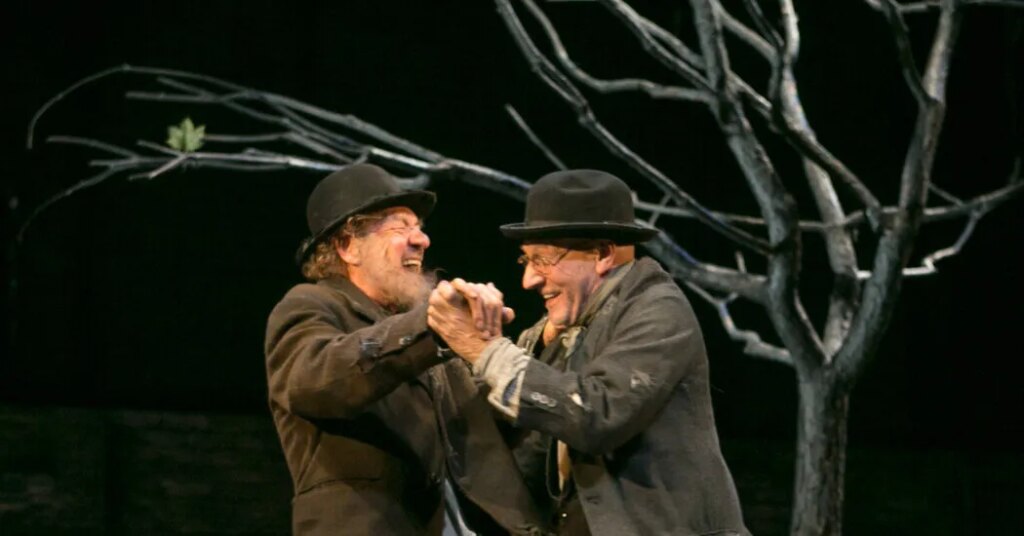
And in 2013, he and Ian McKellen came to Broadway with a virtuosic two-play repertory: Samuel Beckett’s “Waiting for Godot” (McKellen was the dreamer Estragon, Stewart the tutting Vladimir) and Harold Pinter’s “No Man’s Land.” The two of them, a loving double-act in actual friendship as well as onstage, were the finest Gogo and Didi I will ever see, a laughing-themselves-silly reminder of the play’s English music hall roots. (The existential thriller “No Man’s Land” oozed so much menace that even the 13-year-old memory of it makes my body react as if it’s under threat.)
There is more to Stewart’s work — his other comic turns, as well as his role as Professor X among the X-Men — and more to him as a man, and an activist too. But for the most part, Stewart’s talent lay in portraying the subtlest virtues: kindness, patience, attention. Those, of course, are the qualities of a teacher. It is perhaps no surprise that he was discovered by a “Star Trek” producer, long ago, while he was giving a class on Shakespeare. (Watch his little lecture-demonstration on the vaudevillian “quadruple take,” which he blissfully gave on camera to his wife, Sunny Ozell.)
As Picard, Stewart embodied the authority of the teacher rather than the general, and like any teacher, he was most thrilling when you could see him learning. He was certainly one of my first instructors in how art offers consolation.
In one of the finest episodes of “Star Trek: The Next Generation,” Picard tells the most ancient tale of all. He is trying to communicate with an alien who can only understand metaphor, so, as the alien lies dying, he relates the 4,000-year-old Sumerian legend of Gilgamesh and Enkidu. The two great warriors meet at Uruk and become friends, Picard says. But Enkidu dies there, and Gilgamesh mourns him.
“He who was my companion, through adventure and hardship,” Picard-as-Gilgamesh says, “is gone forever.” By then the alien is dead, but the captain hears himself. We hear him too.
The post Patrick Stewart Took Shakespeare Where It Had Never Boldly Gone appeared first on New York Times.