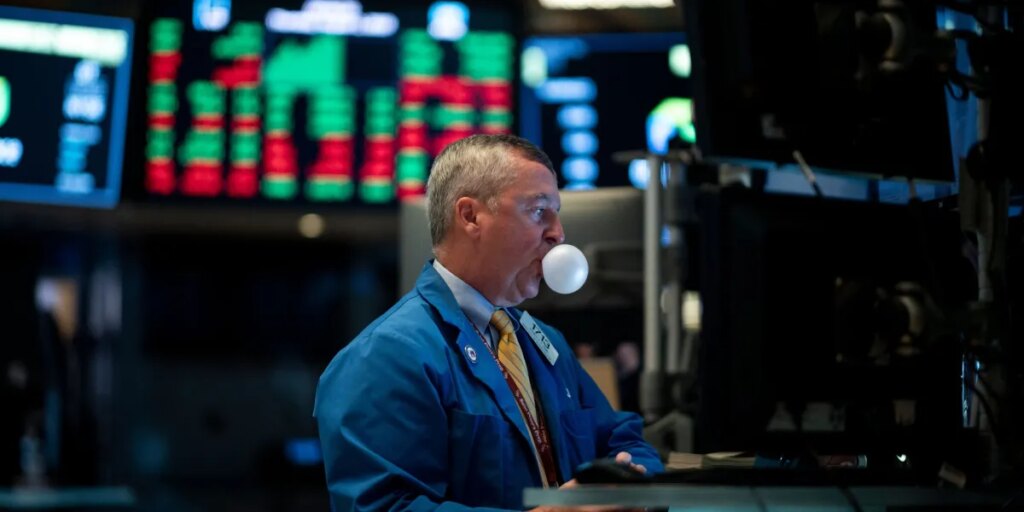
Stocks suffered more carnage this week as investors remain nervous about the durability of the AI boom in the wake of mixed quarterly earnings reports.
Alphabet saw its cash flow sink deeper into negative territory in the third quarter, with the Google parent also joining Meta and Amazon in charging ahead with massive spending plans. On Thursday, Alphabet fell about 12%, its worst day on record.
Meanwhile, Microsoft reported strong cloud growth and stayed free cash flow positive, though it said its capital spending will accelerate, while AI chip giant SK Hynix blew away earnings forecasts. And ahead of its IPO, Anthropic’s S-1 filing showed its cash flow turned positive in the first half of this year.
Some on Wall Street see investors sorting out AI winners from the losers rather than giving up on the sector altogether. That’s after numerous head-fakes in recent years that falsely signaled the AI boom was about to go bust.
According to market veteran Ed Yardeni, the AI investment boom faces financial, physical, and political constraints.
Financial constraints are evident in investors’ growing concerns that AI returns will be able to justify enormous capital expenditures as well as doubts about whether the supply of capital is sufficient to meet all the demand from hyperscalers, he explained in a note on Monday.
Indeed, just this past week alone, Elon Musk said SpaceX closed $40 billion in debt financing, Meta announced plans to raise $95 billion in equity, and Microsoft raised $25 billion in a bond sale.
Meanwhile, data centers have run into physical constraints like electricity shortages and limited grid capacity. At the same time, the growing political backlash against data centers could slow the buildout.
If any of these constraints worsen, stocks could dive further, especially considering that AI is now a major driver of corporate earnings and GDP growth, Yardeni warned.
“However, we view these constraints as healthy for the durability of the AI boom!” he added.
For example, if the supply of capital doesn’t flow as easily, it could lead to more efficient allocation, lowering the risk of over-investment. For his part, Yardeni expects hyperscalers to retain access to financing—thanks to their strong balance sheets—and keep spending.
That’s as Amazon, Alphabet, Meta, Microsoft, and Oracle are projected to invest nearly $800 billion this year and $1 trillion annually from 2027 through 2030. But AI companies with weaker balance sheets, like the so-called neoclouds, have seen their borrowing costs soar and may have to pull back.
But in Yardeni’s view, it all comes down to the U.S. economy, which he said has performed remarkably well over the past few decades. Even the midterm elections are unlikely to derail it, regardless of which party controls Congress.
“Further AI jitters therefore could set up buying opportunities rather than signal the end of the boom,” he said.
To be sure, a Democratic Congress could step up scrutiny of the AI sector and shape the debate around regulation, according to economists at Oxford Economics.
But any federal legislation on AI would unfold gradually and a nationwide pause on new data center projects is unlikely, meaning state and local governments will exert greater influence over the buildout, they added.
Given the geographic concentration of data centers, elections in Texas, the Southeast, and Midwest will matter most. But like Yardeni, Oxford sees some upside to any AI slowdown.
A less frantic buildout could ease stubbornly high inflation as reduced demand for chips and other tech inputs gives consumers some relief on prices for tech gadgets.
“If the AI capex cycle runs hotter for longer, this component of inflation would prove stickier, keeping pressure on the Federal Reserve to keep monetary policy restrictive for longer,” Oxford said Thursday. “However, a slower buildout would ease inflationary pressures through the end of the decade and relieve some of the upward pressure on long-term rates.”
The post An AI slowdown that takes some air out of the exuberance could actually extend the boom, Wall Street veteran says appeared first on Fortune.