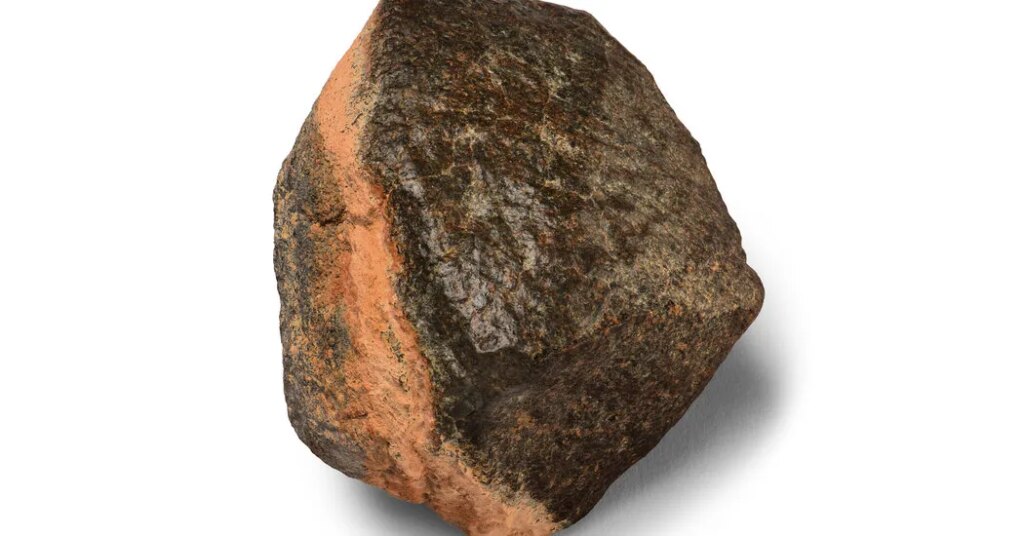
Reddish rocks found in the Sahara four years ago turned out to be older than almost anything on Earth. In fact, they are not of this world: They are pieces of Mars dating back 4.1 billion years.
Scientists described the meteorite fragments in a paper published on Thursday in the journal Science. Together they make up a space rock named Teghaza 001, after an ancient, abandoned salt-mining settlement in Mali close to where the fragments were found.
“It’s very rare to find something this old,” said Yang Liu, a planetary scientist at NASA’s Jet Propulsion Laboratory in California and the lead author of the Science paper.
Of the more than 400 Martian meteorites that have been found, only two, Allan Hills 84001 and Northwest Africa 7034, which is often called “Black Beauty,” rival Teghaza 001 in age.
For scientists, Teghaza 001 serves as a time machine. Its mix of igneous minerals preserves a snapshot of what Mars was like a few hundred million years after it formed. The minerals provide hints about both the mantle and the crust of early Mars.
“We really don’t have this kind of mineralogy in our Martian collection,” said Arya Udry, a professor of geoscience at the University of Nevada, Las Vegas, who was not involved in the research. “Any new rock that is unique from Mars is really exciting.”
An earlier paper by some of the same scientists reported that the meteorite contained evidence that abundant water flowed on Mars when the rock formed, based on water molecules bound within a mineral known as apatite. (The Martian apatite is similar to the mineral that is the main ingredient of your teeth.)
But the analysis also showed that the planet had already lost much of its water. Ultraviolet light broke apart the water molecules into hydrogen and oxygen, and the hydrogen floated away into space.
The meteorite’s journey began when a meteor hit Mars, knocking the rock into space. Eventually, it crossed paths with Earth. A chunk of the rock weighing nearly two pounds survived the fiery entry through the atmosphere. It landed as a meteorite and broke into eight pieces.
When Dr. Liu first received the meteorite sample to study, she did not expect it to be very interesting. It had been initially classified as a shergottite — the most abundant type of Martian meteorite and one that is usually not that old.
But when she looked, she saw zircons, a type of crystal that is usually not found in shergottites. “It’s very unusual, and I see a lot of them in the sample,” she said. “That was a quick alarm bell going off.”
Using a dating method based on the ratio of uranium isotopes, the scientists learned that the zircons were about 4.1 billion years old. Two other dating methods confirmed the age.
“Once we recognized that this Teghaza sample was an ancient one, we immediately became interested in trying to characterize its water,” said Lee Saper, a planetary scientist working at the NASA Ames Research Center in Mountain View, Calif., and another author of the two Teghaza papers.
The water in the apatite appears to have come from two different sources. Some of the water was in the magma that rose from the Martian mantle.
Dr. Liu said the mix of elements of the mantle portion of Teghaza 001 looked significantly different from what had been measured in other Martian meteorites. “Which is suggesting it’s more primordial, not affected by later processes,” she said.
Other water molecules came from the surface and the atmosphere, percolating through the crust. The scientists could tell that much of the water on Mars had already escaped to space, because those molecules possessed a higher concentration of deuterium, the heavier version of hydrogen, which is less likely to float away.
The deuterium-to-ordinary-hydrogen ratio in Teghaza 001 is similar to what was found in Allan Hills 84001. “It’s not completely changing our view of Mars at that time, but now we have two data points instead of one, which gives us a lot more confidence,” Dr. Saper said.
It is not certain when the rock was knocked into space or when it landed in the Sahara. But by comparing the mineralogy of the meteorite with what robotic spacecraft have measured from orbit around Mars, the researchers have identified 13 locations where Teghaza 001 could have originated.
The researchers said they looked forward to additional analysis by other scientists. “We looked at a small part of it,” Dr. Saper said. “There’s a much more complex story that’s yet to be uncovered.”
The post A Meteorite Found in the Sahara Is a 4.1-Billion-Year-Old Piece of Mars appeared first on New York Times.