The Federal Reserve made a bet when it decided to hold interest rates steady on Wednesday instead of following September’s increase with another.
The wager centered around a belief that the Fed had the flexibility to gather more information about the state of the economy and the inflation problem it is trying to vanquish before raising rates again, as it is widely expected to do at its final gathering of the year in December.
The stakes for the Fed are high. If price pressures do not moderate as many officials believe in the coming months, or new ones emerge, the central bank could find itself playing catch-up. The more aggressive the Fed has to be later on, the bigger the economic fallout could be.
“Waiting is not costless,” said Claudia Sahm, a former economist at the Fed who is now the chief economist at New Century Advisors. “If they wait and find out that those upside risks to inflation they were worried about are not risks but reality, then the Fed will have to do more.”
Two members of the policy-setting committee on Wednesday signaled they believed the Fed could not afford to wait. Lisa D. Cook, a governor who President Trump has sought to fire, and Beth M. Hammack, president of the Federal Reserve Bank of Cleveland, voted for a quarter-point increase.
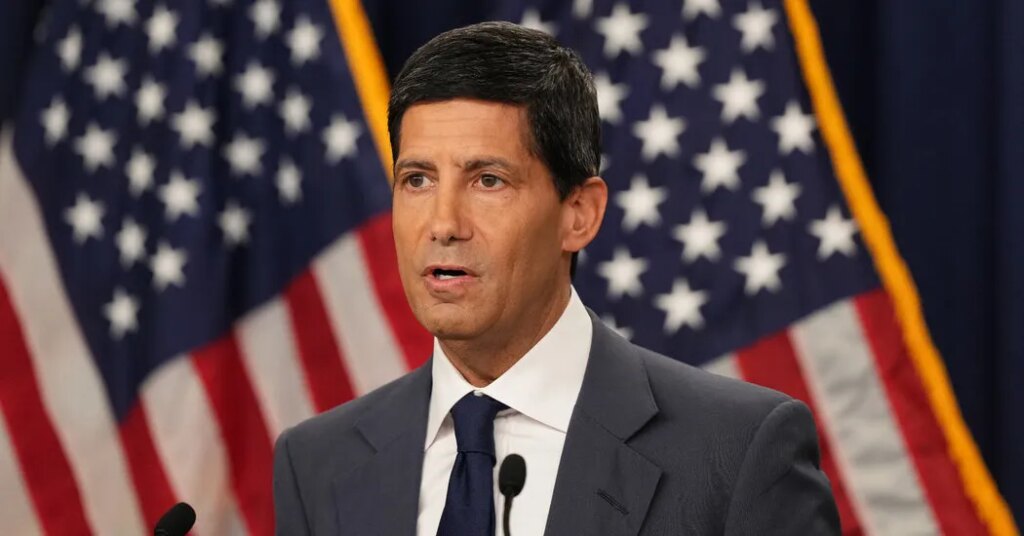
They were outnumbered by the 10 other officials who voted to hold rates steady. Kevin M. Warsh, the Fed’s chairman, cited a number of reasons not to raise rates despite far-from-reassuring inflation data since the last meeting.
What did not play a role were the midterm elections, he said. Instead, Mr. Warsh homed in on expectations about future inflation, which still suggest continued confidence that the Fed will eventually make good on its promise to bring inflation back to its 2 percent target after more than six years of overshooting it. Metrics tracking inflation expectations in the year ahead have moved sharply higher, but those are much more volatile and tend to fluctuate with energy prices, which are up significantly because of the war with Iran.
Mr. Warsh also said that the economy, while growing strongly, was not yet overheating and in turn exacerbating the Fed’s inflation problem. Lastly, he emphasized that credit conditions for households and businesses had become more onerous in recent weeks.
That shift has materialized as a spurt of volatility across equity markets as well as costlier financing for artificial intelligence companies, whose continued growth is a crucial propellant for the economy. “That isn’t something that we’re uncomfortable with. It tells me the policy is working,” Mr. Warsh said.
In one signal Mr. Warsh sent to convey the Fed was not done raising rates, he said of financial conditions: “I’m unwilling and unable to call them tight.”
Mr. Warsh gave other hints that further increases are coming. Taming inflation required “new monetary medicine” and the Fed was in the process of figuring out the “appropriate protocol,” he said.
The right dosage will depend on the incoming economic data, said Richard Clarida, a former vice chair at the Fed who is now at Pimco. One or two more rate increases after a move in December are plausible, he said, but that is contingent on inflation decelerating as it has yet to do.
“If we’re sitting here a year from now and core inflation is running at 3 percent, then they’ve got more to do,” Mr. Clarida added.
A primary driver of inflation has been the war with Iran, which has unleashed an energy shock that has made oil, diesel and other products more expensive. A.I. companies have also played a part, pushing up prices for computer chips and related equipment.
On Thursday, the Fed will get the latest update on its preferred gauge, the Personal Consumption Expenditures price index. It is expected to show that “core” prices, which strip out volatile food and energy, rose 0.3 percent in September, or 3.1 percent compared with the same time last year. New gross domestic product data for the third quarter, also to be released on Thursday, is expected to show faster growth.
If inflation does not moderate in the coming months, Matthew Luzzetti, chief U.S. economist at Deutsche Bank, expects the Fed not to speed up the pace of increases, but instead to tack on more increases as the year progresses. To quicken the pace, the Fed would likely need to conclude that the “quantum of tightening that is required has increased,” he said.
At a minimum, he expects the Fed to raise rates in December and March. “If we were to continue to get persistently sticky inflation, it would not at all be surprising to get a rate hike in the second quarter,” Mr. Luzzetti said.
Ms. Sahm warned that inflation data early next year could be the next major pressure point for the Fed. Price pressures tend to run hot then because companies are more likely to push through price increases in January than any other month, according to research from the Boston Fed.
Another pressure point could arise if people begin to question the Fed’s commitment to raising rates to quell inflation, Mr. Luzzetti said. There was a whiff of that on Wednesday based on the initial reaction in markets to Mr. Warsh’s comments. Short-dated Treasury yields, which are highly sensitive to expectations about rates, fell while longer-dated yields edged up.
“If ultimately the Fed does not follow through on the tightening that they’ve signaled, that could lead to a more significant inflation problem,” he said.
The post In Moving Gradually, Fed Risks Having to Play Catch-Up to Quell Inflation appeared first on New York Times.