At first, it’s a day at the beach.
There are paintings of sunburned sunbathers, harbor scenes and even a group in swimwear watching a solar eclipse. These familiar subjects recall summers American artists Milton Avery, Adolph Gottlieb and Mark Rothko spent together along the Massachusetts coast.
But keep walking and the beach begins to disappear.
You stop before an abstract painting, unsure of what you’re seeing, much less what you’re supposed to feel. Is there a meaning you’re supposed to understand? Is simply looking enough?
“Avery, Gottlieb & Rothko: By the Sea,” on view at the Phillips Collection in D.C. through Jan. 24, traces the painters’ friendship and evolution toward abstraction through about 90 works, some of which haven’t previously been publicly exhibited. Curatorial and conservation research reveals how that transformation unfolded not only over decades but through revisions to individual paintings. In Avery’s “Girl Writing” (1941), infrared imaging uncovered desk legs he initially sketched but later eliminated, leaving the desk seemingly suspended in space. Rothko, too, reconsidered his compositions, painting over earlier arrangements of color.
Across town, the National Gallery of Art offers a complementary approach to understanding abstract art: Slow down, look closely and discuss what you see. Since June 2020, its virtual Art of Looking program has recorded about 37,000 total attendances across 158 sessions. Each hour-long session begins with a centering exercise before participants focus on one artwork.
“We really lean into the power of slowing down, looking carefully and having conversations about the works of art,” says Deirdre Palmer, the gallery’s manager of tours and docent programs.
Cassandra Anderson, the gallery’s interpretive programs manager, said participants can value the conversation, even if their opinions of an artwork remain unchanged.
“Ask yourself, what is it that I want to get out of this experience?” Palmer says. At the Phillips, visitors can follow the exhibition’s loose chronology. Or, as Palmer suggests, they can “wander through, see what grabs your eye, and try setting a timer — like, sit with it for 10 minutes.”
They’re both valid paths to understanding Avery, Rothko and Gottlieb’s connection. Avery, nearly two decades older than the others, mentored Rothko and Gottlieb, introducing them to working on colored construction paper and using its hues as a foundation for their compositions. The artists also sketched each other when they couldn’t afford models. Avery would later gift Rothko his “Study for Harbor at Night” (1932), which the exhibition displays for the first time next to the finished painting.
As World War II approached, however, Rothko and Gottlieb turned toward mythology, surrealism and the unconscious. Avery continued painting nature, though his compositions grew increasingly abstract.
What remained familiar? And what disappeared? Look at Gottlieb’s “The Seer” (1950) — a grid of eyes, fingerlike forms and a human figure. In “Black Sea” (1959), Avery reduced the shoreline to fields of color but left a diagonal line of surf as a clue to the landscape.
“[Avery] is so abstract in this time period, but he still has one foot in the natural world,” says Renée Maurer, associate curator at the Phillips. “He doesn’t want that to go away, because he is so affected by nature, and that is his visual language.”
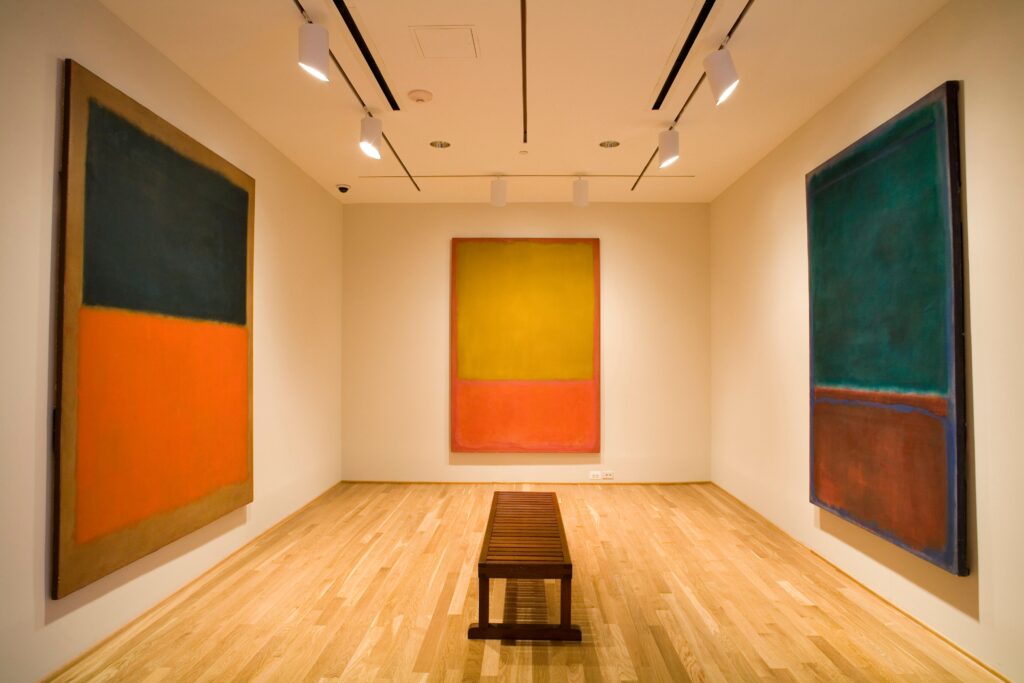
Rothko, too, embraced abstraction, though he resisted being labeled an abstract artist. By the 1950s, the beach figures were gone, replaced by fields of color, soft edges and deceptively simple compositions.
Conservator Patricia Favero used infrared imaging to examine paintings from the Phillips Collection’s Rothko Room. In “Green and Maroon” (1953), imaging revealed that Rothko’s lower color field was once divided, possibly an orange band above bright red, before he painted over them to create maroon. Drips on two other canvases suggest he sometimes turned them upside down while working.
So what was he after?
“I’m interested only in expressing basic human emotions — tragedy, ecstasy, doom and so on,” Rothko told art critic Selden Rodman in a conversation published in 1957.
Scale mattered, too. “Green and Maroon” stands more than seven feet tall. Rothko said he painted large canvases not to appear grandiose, but to be “very intimate and human.” He wanted viewers to encounter them at close range, writing in 1954 that “the first experience is to be within the picture.”
His words explain what he hoped to evoke, not what any viewer must feel.
“It’s about the viewer really finishing the work,” Maurer says.
Avery, Gottlieb & Rothko: By the Sea Through Jan. 24, Phillips Collection. phillipscollection.org.
The post A new Phillips Collection exhibition is a lesson in unpacking abstract art appeared first on Washington Post.