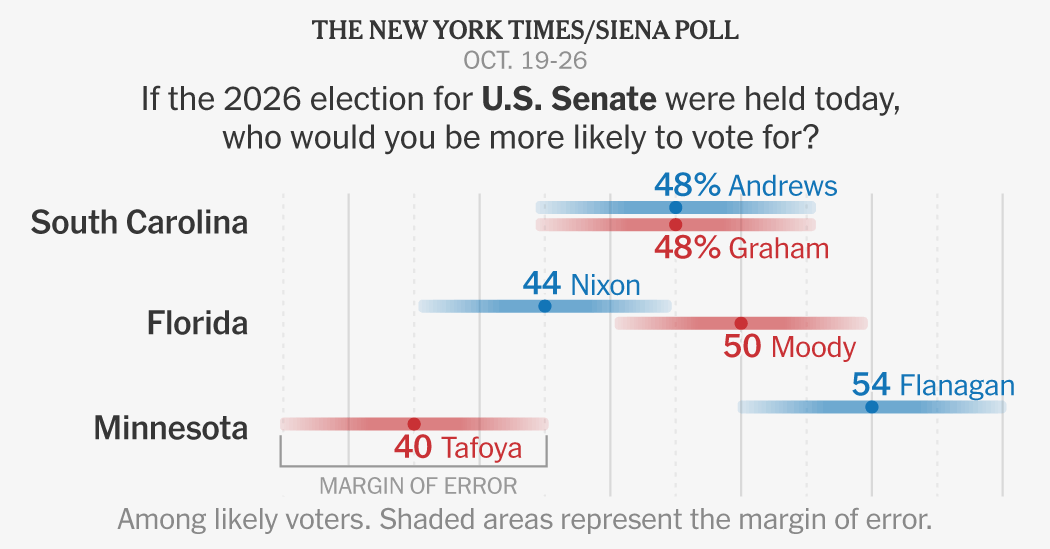
The Senate race in the usually reliably Republican state of South Carolina is effectively tied, according to new New York Times/Siena polls, as Senator Darline Graham’s bid to succeed her brother, Lindsey Graham, for a full term has become a tossup.
Ms. Graham, the Republican incumbent, was appointed to serve the remainder of her brother’s term after his death in July and decided to run for a full term with the encouragement of President Trump. She leads Dr. Annie Andrews, the Democratic nominee, by less than a single percentage point, making South Carolina a surprising battleground this year and widening Democrats’ possible paths to win control of the Senate.
South Carolina has not elected a Democrat to the Senate in this century.
Republicans are ahead in the Florida Senate race, but by a relatively small margin. Senator Ashley Moody, the Republican incumbent, leads the Democratic Senate nominee, State Representative Angie Nixon, by six points. It is a moderate lead in a state that Republicans won by double-digit margins in 2024 and 2022.
And Democrats lead comfortably in Minnesota, a blue state where the party worried its progressive Senate nominee could falter, suggesting that Republican efforts to make the contest about fraud in state government may not be having an impact on the race. Lt. Gov. Peggy Flanagan, the Democratic nominee, is ahead of Michele Tafoya, the Republican nominee, by 14 points.
The three states had been on the fringes of a contested Senate map that remains unusually wide and unsettled in the final days of the midterm campaign. The polls showed that South Carolina has moved squarely to the map’s center, as Republicans — dragged down by Mr. Trump’s unpopularity — have been forced to defend more seats in redder states than they expected just a few months ago.
Mr. Trump won South Carolina by nearly 18 points in 2024, and the state has not elected a Democrat to the Senate since 1998.
Dr. Andrews, a pediatrician, appears to be making the race competitive in part because of her strength with independent voters. She has the support of 57 percent of independent voters, the polls found, while Ms. Graham has the support of 37 percent. Dr. Andrews is also peeling away 7 percent of Republican voters.
Ms. Graham, a first-time candidate, had no experience in elected office before she was appointed to her brother’s seat, leaving her vulnerable in a tough year for Republicans. “I’m not that informed on national security,” she conceded in a primary debate in August, a stumble that underscored her inexperience.
South Carolinians seem concerned over her fitness for the job, with 51 percent of the voters in the polls, including 18 percent of Republicans, saying that she did not have “right experience to be an effective senator.” In contrast, 54 percent of voters, including 22 percent of Republicans, said that Dr. Andrews did.
“Even if I don’t agree with everything she says, at least I feel like she actually cares or means what she says or has her own take on things,” Douglas Stewart, a 35-year-old Republican in Columbia, S.C., said of Dr. Andrews. He said he planned to cross party lines and vote for her.
The poll found that support for Dr. Andrews came from voters who were excited about her candidacy, an important factor in drawing voters to the polls. The top reasons her supporters gave for backing her were related to positive views of her policies or character. For Ms. Graham, the primary reason voters have for backing her was to support the Republican Party.
Mr. Trump has been banking on loyal supporters to vote in the midterms. He rallied in the state last week and is scheduled to return on Thursday.
A majority of voters said that Dr. Andrews would do a better job handling the economy, and she held a narrow edge on who would better handle the cost of living. Voters were also split on which candidate has the best approach to foreign wars, with Dr. Andrews favored over Ms. Graham by 46-44 percent. Dr. Andrews edged out Ms. Graham 49 percent to 46 percent on a question about which candidate would do what is best for ordinary South Carolinians.
Ms. Graham has one advantage: She is much better known than Dr. Andrews. About a quarter of voters said they had not heard of Dr. Andrews or could not offer an opinion about her this late in the campaign, far greater than the share who said the same about Ms. Graham.
Her brother was a well-known, four-term incumbent. Though he had a sometimes difficult relationship with some of the state’s MAGA voters, who were skeptical of his foreign policy and immigration views, he was close to Mr. Trump.
“I think she’s going to pick up on her brother Lindsey’s positions,” said Donnie Phillips, 76, a Republican in Little River, S.C., who supports Ms. Graham.
“I had reservations during the primary, because of her being so new,” he added, “but I think — I hope — she will be a quick learner.”
In Florida, the Republican holds a moderate lead.
The six-point Senate race in Florida, Mr. Trump’s adopted home state, is closer than either party expected. The state has drifted to the right for nearly a decade, and national Democratic donors have all but abandoned spending on expensive statewide races there.
Ms. Moody is seeking election after she was appointed to replace Marco Rubio last year. She leads Ms. Nixon, a progressive firebrand, in every measure in the poll, including who voters trust to handle the cost of living and to do what’s best for ordinary Floridians.
Gabriel Ruiz, 21, a college student in Gainesville, Fla., said he planned to support Ms. Moody because of her economic policies and how she has prioritized border enforcement.
Mr. Ruiz said he voted for Mr. Trump in 2024 but considered himself an independent who “leans a little more toward the Democratic Party.” His support for Ms. Moody comes amid frustration with both parties: “I feel like there’s not much of a difference,” he said.
On voters’ top issue, however — who they trust to handle the economy — Ms. Moody has only a two-point lead over Ms. Nixon. And Ms. Nixon holds a wide advantage on that measure among independents.
Ms. Nixon, who joined the Democratic Socialists of America this year but has said that she is not a socialist, was viewed as too far to the left by 37 percent of Florida voters, but not too far in either direction by 41 percent. Overall, independents support Ms. Nixon over Ms. Moody by a wide margin, 52 percent to 38 percent.
“Angie Nixon is a local Floridian,” said Richard Wainwright, 52, an independent from Orlando who described himself as a progressive. “She has a business. She definitely talks about policies that would help Floridians prosper, and that’s something that I’m looking forward to.”
In Minnesota, the Democrat has a wide lead.
In Minnesota, Ms. Flanagan’s wide lead comes from support across many demographics. She is ahead of Ms. Tafoya, a Republican former sports broadcaster, among younger voters and older voters, white voters and nonwhite voters, college-educated voters and voters without a college degree.
Ms. Tafoya’s supporters appear to be motivated by concerns about Ms. Flanagan. More than 40 percent of voters in the poll mentioned something negative about Ms. Flanagan when asked about their main reason for backing Ms. Tafoya. Many specifically named fraud concerns; a fraud scandal over social services programs has dominated state politics in Minnesota for more than a year. Concerns about corruption and fraud were second only to the economy in terms of issues driving voters’ decisions.
Some voters have concerns about Ms. Flanagan’s progressive politics, according to the poll. Forty-three percent of Minnesota voters worried she is too far to the left, the highest level in either ideological direction among the six Senate candidates polled in the three Times/Siena surveys.
Still, it does not seem to be much affecting the race. Ms. Flanagan is even winning over 6 percent of voters who said they supported Mr. Trump in 2024.
“I can’t vote for Republicans again this year,” said David Bichanga, 54, an independent living in Minneapolis, who was a 2024 Trump voter. “They are going to be a rubber stamp for Donald Trump and make the economy even worse.”
“I don’t love her,” he added, referring to Ms. Flanagan, “but she’s not a Republican — and that’s what I want right now.”
Sophia June contributed reporting.
The post The Senate Race in Heavily Republican South Carolina is a Tossup, Poll Finds appeared first on New York Times.