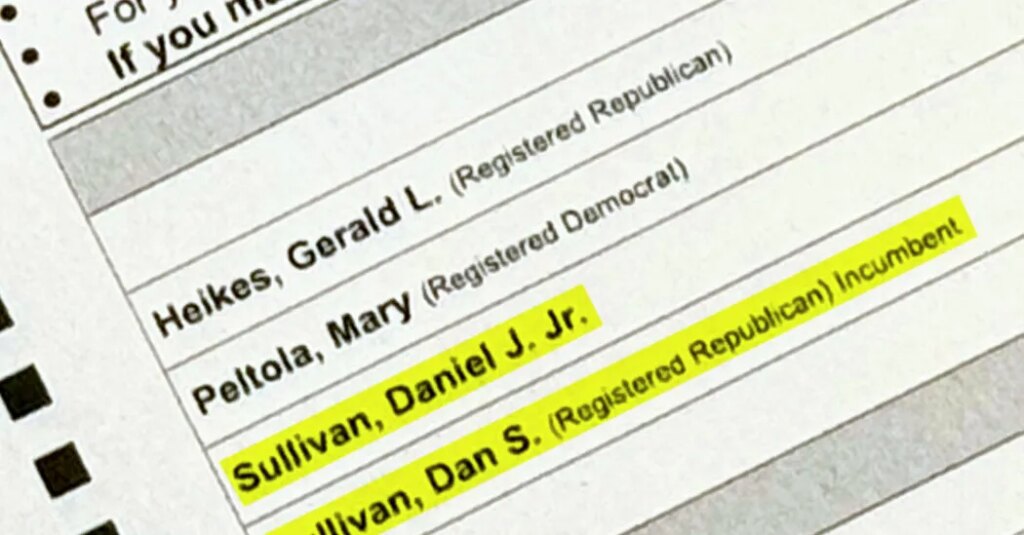
In the summer of 2025, a staffer for Mary Peltola, the Alaska Democrat who was eyeing a run for Senate, received unusual instructions from top campaign aides: Find as many people named Dan Sullivan in Alaska as you can.
The staffer complied, combing through voter records to produce a list of Dan Sullivans from across the state.
This was no random request. Dan S. Sullivan is the name of the state’s Republican senator. And if the Peltola campaign or its allies could track down and persuade another Dan Sullivan to run for Senate, the confusion could cost the senator crucial votes on the state’s unusual, four-person ballot.
The plan worked. This spring, a retired teacher from a tiny fishing village along the Alaska Panhandle, reachable only by air and sea, announced his candidacy for Senate. His name was Dan J. Sullivan.
The Peltola campaign has repeatedly denied any involvement in his candidacy. But The Times has found, based on interviews and text messages, along with documents prepared for a potential lawsuit against the campaign, that not only did Ms. Peltola’s team work with people trying to recruit Mr. Sullivan to run for Senate, but the effort was much broader. The group worked to coax other would-be spoilers into the race, to dilute the incumbent’s support and help catapult the Democrat to victory.
The endeavor, which was internally called the ballot composition project, involved secret trips to far-flung Alaskan communities and the appearance of a mysterious Midwestern operative, who traversed the state using a fake name and made his pitch to would-be candidates over beers at brew pubs.
It also involved the Peltola campaign’s lawyers, as well as senior aides at the Democratic Senatorial Campaign Committee, which directs the party’s campaign strategy in Senate races across the country. From Washington to Anchorage, those advisers participated in regular conversations about the effort and even considered forming a new political party to draw conservatives onto the ballot.
Ballot-stacking tactics are common in politics and generally considered legal — and have been employed by both parties in Alaska. But this operation, which has not been reported before, reveals the lengths to which Democrats went to seek advantage in a Senate race that could determine control of the chamber.
“Alaskan voters need to know,” said Elisa Rios, Ms. Peltola’s former campaign manager and longtime aide, who was fired amid a staff shake-up in August, and agreed to a series of interviews with The Times since then. “There was a lot of speculation, and voters should get the full picture when making their decisions.”
Ms. Peltola was not directly involved in the project, Ms. Rios said, but she was “definitely aware.”
The operation had impact. On Tuesday, Ms. Peltola will be the only Democrat on the ballot, facing off against the two Mr. Sullivans and a long-shot candidate named Gerald Heikes who was also recruited into the race, according to The Times’s reporting. Polls give Ms. Peltola a strong chance of winning.
The Justice Department, meanwhile, filed a lawsuit in federal court at President Trump’s behest last week seeking to block certification of the election results if votes for the other Mr. Sullivan cost Senator Sullivan the win.
Both the Peltola campaign and the D.S.C.C. denied participating in efforts to recruit spoilers to the ballot in Alaska. Neither group addressed a detailed list of questions provided by The Times.
“The Alaskans for Mary campaign has no involvement with either Sullivan campaign and did not recruit any candidates into the race,” the campaign wrote in a statement.
The D.S.C.C. sent a similar response, saying it had “no involvement” in recruiting Mr. Sullivan “or any other Republican candidate.”
This article is based on interviews over the past two months with 12 people who participated in or were told of the plan, or were would-be candidates that the team tried to recruit. The Times also obtained dozens of text messages that provided updates on the progress of the effort. The reporting included the extensive interviews with Ms. Rios, during which she shared details of the operation.
Last week, as The Times prepared to publish this article, Ms. Rios, who had been planning to file a wrongful termination lawsuit against the Peltola campaign, contacted The Times and said she wanted to take back her previous statements.
“As discussed on our call earlier today, I am confirming that I have retracted all statements made regarding the 2026 Alaska Senate Race in connection with any article you may or may not be writing,” Ms. Rios wrote. “I am not willing to be a source for any story in any capacity.”
It is rare for a source to seek to retract comments made in previous interviews, and The Times’s standards do not obligate reporters to comply with such requests. The Times had never agreed that those previous interviews could not be published, and informed Ms. Rios last week that they would be a part of this story.
In addition, Ms. Rios’s interviews were consistent with The Times’s other reporting. She has not filed a lawsuit against the campaign.
“Our friend” Jerid
The operation began in the summer of 2025 to lure potential spoiler candidates onto the state’s unusual four-person ballot, Ms. Rios said. In one early meeting, she said, aides with the D.S.C.C. introduced a veteran Democratic operative named Jerid Kurtz to Ms. Rios and Anton McParland, who at the time was Ms. Peltola’s chief of staff. Mr. Kurtz, a native of Ohio, was introduced as a specialist in secret ballot maneuvers, Ms. Rios said.
Months later, in early 2026, Mr. Kurtz participated in a video call with members of the ballot composition team, Ms. Rios said. He told the group he had made contact with one of the Dan Sullivans. This Mr. Sullivan lived in the tiny village of Petersburg, and Mr. Kurtz described him as amenable to running if it would help Ms. Peltola, Ms. Rios said.
Mr. Kurtz “told us when he found him,” she said. He said Mr. Sullivan “said he hated Trump, and if it was going to help Mary, he liked Mary. He didn’t have any interest in being a politician, but if this could help.”
Mr. Sullivan, who has maintained that he entered the race of his own volition, did not respond to repeated requests for comment over the past week.
According to Federal Election Commission records, a pro-Peltola super PAC called 49th State PAC paid Wingspan Strategies, a firm co-owned by Mr. Kurtz, about $87,000 this fall. The PAC said in a statement this week it had “never hired or paid Jerid Kurtz for performing any services.”
Mr. Kurtz did not respond to repeated requests for comment. In recent days, he removed his LinkedIn profile from public view and made his X account private.
Text messages viewed by The Times show officials with the D.S.C.C. and the Peltola campaign communicating for months about the project. Mr. McParland asked for updates from “Jarid,” “Jared” or “our friend,” and D.S.C.C. officials quickly scheduled calls, the messages showed. (Mr. McParland, who was demoted to a consulting role in August, did not respond to multiple requests for comment.)
Ms. Rios regularly participated in the calls. She said the members sometimes chatted casually, and Mr. Kurtz occasionally grew animated when describing his tactics, saying he used pseudonyms and cover stories to keep his activities under wraps.
In late May, just before Mr. Sullivan filed his papers to run, Mr. Kurtz spoke by phone to a Peltola campaign aide, saying he had just gotten off a plane in Petersburg, according to Ms. Rios and another person familiar with the conversation.
The Peltola aides worried at times that Mr. Kurtz’s efforts would be discovered, such as when he posted an image of the Anchorage airport on his Instagram account.
“I am hearing that our friend in the state is being noticed,” Mr. McParland wrote in a text message in January reviewed by The Times. Andrew Piatt, the D.S.C.C.’s director of campaigns, replied: “We will check in.”
Alaska’s voting system makes it especially easy to add spoilers to the ballot. The state holds nonpartisan primaries, so candidates can claim any party affiliation on the ballot without being vetted by parties themselves. That allowed Mr. Sullivan of Petersburg, a longtime supporter of Ms. Peltola and other Democrats, to land a spot on next week’s ballot.
Republicans have also taken advantage of this system. When Ms. Peltola ran for re-election to the House two years ago, the state Republican Party backed an effort to help a Democrat — an inmate who ran his campaign from a New York prison — stay on the ballot.
This year, as soon as Mr. Sullivan entered the race, Republicans denounced him as a Democratic plant, but they haven’t been able to prove it. They attempted to remove him from the ballot, arguing that he was not a “good faith” candidate and citing his registration switch from unaffiliated to Republican just before the deadline to run.
In June, the Alaska Supreme Court brushed aside that argument, ruling there was no basis for removing Mr. Sullivan in either state law or the U.S. Constitution.
The lawsuit from the Justice Department, meanwhile, is still making its way through the court. Election law experts say the case is dubious, given that states control the administration of elections under the Constitution, and the suit seeks to challenge an election that hasn’t happened yet.
While the Justice Department is focused on the two Dan Sullivans, The Times found other Alaskans the team sought to recruit as spoilers. Not all of them, of course, shared a name with the Republican senator. Some would simply add more options to the ballot and potentially siphon support from the incumbent.
Matthew Salisbury of Anchorage said he got a call out of the blue last December from an unfamiliar Google Voice number with an Ohio area code.
A one-time candidate for the U.S. House, Mr. Salisbury said in an interview that the caller identified himself as Zane — no last name — and asked him if he would consider running in the upcoming Senate race. Zane also wanted to meet him in person.
Over beers at an Irish pub in Anchorage, and over more meetings and calls in subsequent months, Zane continued to press Mr. Salisbury to run for Senate. He said he was looking for independent-minded candidates, and that his backers would support Mr. Salisbury with outside spending. He seemed friendly and intelligent, Mr. Salisbury recalled, but never provided more details about his background or political party, and he wouldn’t say who was paying for the effort.
“I’m not naïve,” said Mr. Salisbury, who didn’t end up running for Senate. “I had to have that general idea that they’re not in it for me.”
When The Times sent Mr. Salisbury a photograph of Mr. Kurtz, Mr. Salisbury identified him as the man who called himself Zane. Efforts to reach the Google Voice number were unsuccessful, as were attempts to reach Mr. Kurtz at the email address he used with Mr. Salisbury, which includes the word “buckeye.” Public records show that Mr. Kurtz is from Ohio, known as the Buckeye State.
In late May, Mr. Kurtz, still posing as Zane, texted Mr. Salisbury that he had also tried to recruit several “upper level candidates, including a few of the folks currently in the gov race,” to no avail.
And he wanted Mr. Salisbury’s opinion on a recent news story, writing: “You see this craziness with another Dan Sullivan? What’s your read on that?”
A multipronged strategy
Throughout the spring, the campaign swapped leads with the D.S.C.C. on potential candidates and continued to participate in efforts to shape the ballot.
In one exchange of text messages obtained by The Times, Peltola advisers seemed to make fun of voters while watching a focus group, surmising the participants would be susceptible to being tricked into voting for a ballot spoiler.
“Do we have a scheme for you,” wrote a consultant for the Peltola campaign. A pollster on the chat wrote that one voter seemed like the perfect audience “for our ballot strategy plan :)”
The team’s spirits rose with the results of the Aug. 18 primary, as both Dan Sullivans advanced to the four-way general election. But there was one problem: The fourth spot on the ballot had gone to a Democrat who could siphon some votes away from Ms. Peltola that fall.
That Democrat, a progressive named David Leslie, quickly faced calls from his party to withdraw. One of those callers, Mr. Leslie said in an interview, was Jerid Kurtz. Mr. Kurtz met with Mr. Leslie in person, at a cafe in Fairbanks, according to a person familiar with the exchange.
Mr. Leslie soon agreed to drop out.
“I’m really proud of the action you took today,” Mr. Kurtz wrote to Mr. Leslie on Aug. 31, the day he dropped out, in a text message viewed by The Times.
Mr. Leslie’s exit cleared the way for another Republican to take his spot on the ballot, potentially dividing the G.O.P. vote even further: Gerald Heikes.
Mr. Heikes, a drywall contractor, said in an interview that he was recruited to run for Senate this spring “by a guy from the Midwest.” The man, whose name Mr. Heikes did not remember, first reached him on the phone, then met with him at a deli in his hometown of Palmer, Alaska. Mr. Heikes did not think he resembled the photo of Mr. Kurtz.
“He said, ‘Hey, if you go and file to run for Senate, we’ll back you — we can’t give you money or anything, but we’ll make things happen for you,’” Mr. Heikes said.
Mr. Heikes, who has said before that he believed God was telling him to run for office, decided after the meeting to run for the Senate.
Funding the new recruits
There were also efforts to support the new candidates financially. Back in March, Peltola campaign employees had dinner with a local political consultant named Jim Lottsfeldt. Mr. Lottsfeldt, who works with super PACs aligned with Ms. Peltola, agreed to lead an effort to boost the long-shot Senate candidates with outside spending, said Ms. Rios, who was among the attendees.
“We were talking about how we would balance the different distinct universes and create basically a Republican war in the primary,” Ms. Rios said.
Federal filings from Alaska Values, a new super PAC supporting Mr. Heikes, show that Mr. Lottsfeldt had requested advertising time from Alaska radio stations this month.
In an interview, Mr. Lottsfeldt denied any knowledge of or involvement in the effort, and said no such topic was discussed at the dinner. He argued that Ms. Rios was a source of “disgruntled, anti-Mary Peltola stuff that I think is often not true.”
He also denied an association with the Alaska Values PAC, but could not explain how his name ended up on the filings, suggesting it must have been an error.
“These forms have auto-whatever, it’s quite possible that my name was on it from a blank form and then it got moved over,” Mr. Lottsfeldt said. “Even if I had requested some time, OK, so what? There’s nothing illegal about that, there’s nothing suspicious about that.”
A new MAGA party
Even as the Peltola campaign and D.S.C.C. officials denied participation in the operation, the texts and documents reviewed by The Times show it involved the party’s Senate committee and its top law firm. At one point, when Peltola campaign aides toyed with an audacious idea to establish a right-wing state party that could challenge the incumbent senator, they contacted D.S.C.C. officials.
“Imagine if there was a MAGA party!” Mr. McParland, of the Peltola campaign, wrote in January.
“Smart,” replied Mr. Piatt, the D.S.C.C.’s director of campaigns. “Let’s see.”
Jacquelyn Lopez, an attorney with the Elias Law Group, the firm that represents both the committee and the Peltola campaign, was part of this effort, according to Ms. Rios. In a text message from April viewed by The Times, a campaign consultant asked Ms. Rios: “Do we need to follow up with Jackie about maga party stuff?”
In another message from that month that misspelled Mr. Kurtz’s first name, Mr. McParland wrote: “Jackie is calling Jarid.” Ms. Lopez did not respond to a request for comment.
The MAGA party plan fizzled out in May.
But in June, the D.S.C.C. celebrated alongside the campaign when an Alaska court cleared the way for the other Dan Sullivan to stay on the ballot.
“Other Dan won, will be on ballot,” Shelbi Dantic, a D.S.C.C. employee, wrote in an internal group chat.
Three people — two Peltola aides and a member of the D.S.C.C. staff — reacted with heart emojis.
Nathaniel Herz contributed reporting from Alaska, and Matt Zdun, Theodore Schleifer, Emily Davies and Beth Reinhard contributed reporting from New York and Washington. Georgia Gee and Julie Tate contributed research.
The post Inside Democrats’ Secret Effort to Stack Alaska’s Ballot appeared first on New York Times.